
Volume 5, Number 1, March 2002
AMOS (Advanced Mortar System)
- 1 AMOS Product Manager, Patria Hagglunds Oy, Naulakatu 3, FIN-33100 Tampere, Finland.
Abstract
The 120 mm mortar concept is going through major changes. What used to be a simple indirect fire weapon for the support of infantry units is nowadays something much more. Already when simply mounted on a chassis the mortar opens up new possibilities, which the armies around the world are just starting to realise. When the concept is further developed the possibilities are even greater. This paper describes the AMOS (Advanced MOrtar System) developed by the joint-venture company Patria Hagglunds Oy. AMOS is a twin-barrelled, breech-loaded, mortar turret suitable for integration to medium-sized (10–25 ton) wheeled or tracked armoured vehicles. The two-man turret has armament comprising two independent 120-mm smoothbore mortars mounted into a common cradle with an equilibrator and a loading device. The mortars fire conventional 120-mm, smoothbore, fin-stabilised ammunition. Special ammunition, such as cargo and guided ammunition, can directly be used as these were originally developed for smoothbore barrels. The mobility and protection of the APC chassis supports vehicle survivability in the modern battlefield. AMOS is characterised by its extremely high rate of fire that gives high impact on target—the maximum rate of fire is up to 26 rounds/min and the number of rounds in MRSI (multiple rounds simultaneous impact) is as high as 14. The lethality is therefore higher than with any other mortar systems. The Journal of Battlefield Technology is issued three times per year, in March, July and November. Subjects are presented under the broad headings of Firepower, Mobility, Command Systems, Surveillance and Target Acquisition, Training and Analysis, and Management. However, any topical battlefield issue of a technical nature is suitable for inclusion.
Introduction
There is a demand on the future complex battlefield for a protected, rapidly deployable, mobile, high-firepower weapon system, which gives short-to-medium-range fire support to the infantry and mechanised units and is capable of fighting against soft and hard targets.
In spring 1995 Patria Vammas Oy from Finland and Hagglunds Vehicle Ab from Sweden began to investigate a joint program to develop a protected mortar system. The formal cooperation agreement was signed in 1996 and a joint-venture company, Patria Hagglunds Oy, was established for the development of AMOS (Advanced MOrtar System).
AMOS is a twin-barrelled, breech-loaded, mortar turret suitable for integration to medium-sized (10–25 ton) wheeled or tracked armoured vehicles. The two-man turret has armament comprising two independent 120-mm smoothbore mortars mounted into a common cradle with an equilibrator and a loading device. The turret is designed to meet the highest requirements of combat capability and to give the crew a high survivability level in all battlefield conditions.
AMOS is characterised by its extremely high rate of fire that gives high impact on target—the maximum rate of fire is up to 26 rounds/min and the number of rounds in MRSI (multiple rounds simultaneous impact) is as high as 14. The lethality is therefore higher than with any other mortar system. The twin barrel concept reduces the overall number of systems, has lower barrel temperature and thus lower barrel wear.
The mobility of the APC chassis supports vehicle survivability on the modern battlefield and the system can rapidly deploy whenever fire support is needed. It also moves quickly to another firing position to avoid enemy counter-fire, justifying the expression “gun and run”.
The mortars fire conventional 120-mm, smoothbore, fin-stabilised ammunition. Special ammunition, such as cargo and guided ammunition, can be used directly as these were originally developed for smoothbore barrels.
AMOS has following main benefits:
- high rate of fire;
- direct-fire capability;
- rapid deployment (gun and run);
- ballistic and NBC protection;
- low chassis loads due to recoil system;
- large amount of ammunition on board;
- suitability for all standard 120-mm smoothbore mortar ammunition; and
- full 360º traverse.
Main principle
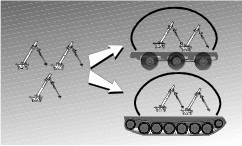
Traditionally, a Finnish 120-mm mortar platoon consists of three ground-based mortars. To respond to the future demands of the battlefield this platoon is to be replaced by one self-propelled under-armour mortar with high firepower. Figure 1 illustrates this main principle on which the AMOS system is built. A wheeled or tracked chassis gives the mobility, a twin-barrel concept with a sophisticated loading system gives the firepower, and an armoured turret gives the protection.
Platforms
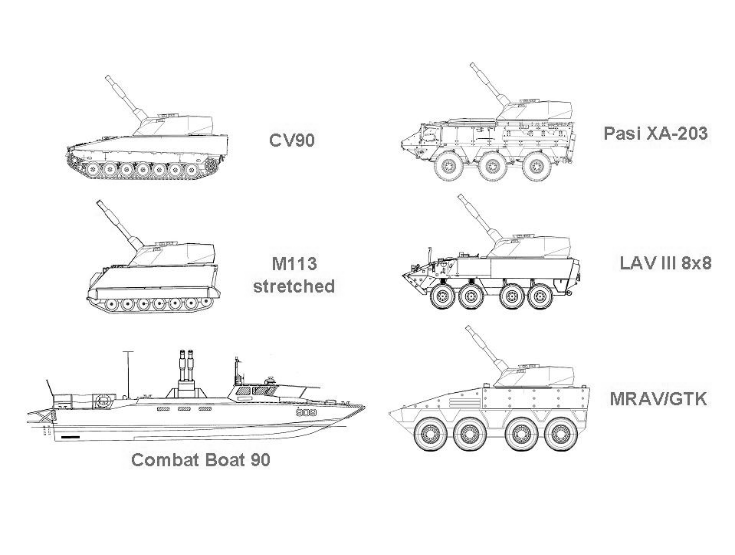
AMOS turret can be mounted to various wheeled or tracked platforms. The turret has been tested in a tracked CV90, wheeled XA-185, XA-203 as well as on a Combat Boat (Navy version of the turret).
The minimum required weight of the empty platform is approximately 10,000 kg to absorb the recoil force, which is 190 kN, when using the operating pressure 160 MPa. Figure 2 shows examples of platforms to be used.
Modular structure
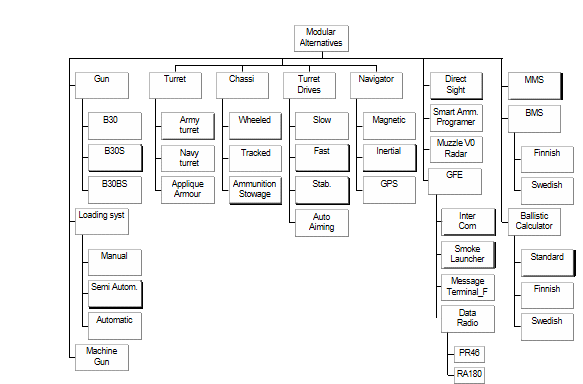
The AMOS system is designed to a truly modular concept, which means that extensive work has been invested on interface analysis during the concept development. The development process is based on following activities:
- definition of subsystems,
- physical interface analysis of these systems,
- definition of operational concepts, and
- functional interface analysis of these concepts.
From this material, a minimum commonality extraction was used to define the overall concept. The concept options are described in Figure 3.
Characteristics
Turret layout
AMOS turret is designed so that only low level of interaction is needed between the turret and the chassis regarding function and operation.
The turret is self-supporting regarding:
- weapon system,
- laying system,
- ammunition stowage and loading device, and
- fire control, communication, and navigation.
This feature provides a simple integration to the platform.
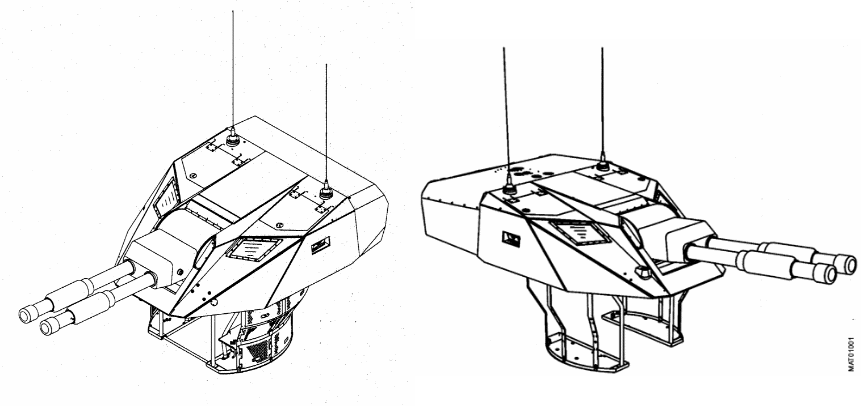
The AMOS turret family consists of two army versions, which are two-man turrets (Figure 4) and a navy version, which is a smaller and lighter remotely controlled turret. The difference between the army versions is that the heavier one has an ammunition bustle that can accommodate 44 mortar rounds.
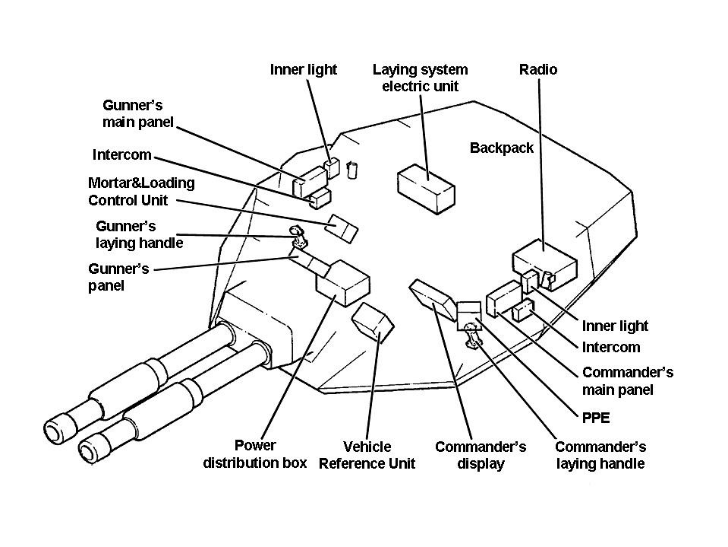
The internal layout of the turret consists of the electrical and communication systems. The main subsystems are:
- power distribution system,
- turret drive system,
- safety system,
- built-in test,
- sight and observation system,
- mortar and loading control unit (MLCU),
- battlefield management system (BMS),
- weapon-control computer,
- digital maps,
- navigation system,
- fire-control system,
- man-machine interface,
- monitors,
- panels,
- car area network (CAN) bus,
- radio system, and
- intercom.
Firepower
AMOS is characterised by its high firepower. There are several areas of firepower in which AMOS system is superior compared to any other systems.
Gun and run. Because AMOS has a real-time calculation of its own position and the target values using INS (Inertial Navigation System) or GPS (Global Position System) and Fire Control Computer, it can open fire within 30 seconds after reaching the firing position. Fire is adjusted onto the target by a forward observer via data radio. On the other hand, after completing the mission, AMOS can leave its firing position in less than 10 seconds, thus running before the rounds hit the target. This feature dramatically increases AMOS’s survivability against counter-fire.
MRSI. One of the key properties of AMOS is MRSI (multiple rounds simultaneous impact). This firing method utilises AMOS capabilities of using different increment charges (different muzzle velocities) at elevation ranges from –3 to +85 degrees, together with the rapid loading system. AMOS can fire up to 14 simultaneous rounds onto the target in main part of the firing range (from 1 km to 8 km).
Range. AMOS has a longer firing range than the traditional ground based mortar range due to an increase in the barrel length from 2m to 3m. This gives an increase in range from 7 km to 10 km (unassisted projectile), which leads to a 100% increase in coverage area from 154 km2 to 314 km2.
Rate of fire. The maximum rate of fire is 26 rounds/min while using the bustle autoloader, and 16 rounds/min while using the chassis storage, when there is the man-in-the-loop. These figures clearly show that AMOS firepower is equivalent to that of a complete traditional mortar platoon. The first four rounds can be fired in less than eight seconds, which enables AMOS to fully utilise the shoot-and-scoot tactics.
Direct fire. AMOS mortars also have a unique capability to fire in the direct-fire mode. With the laser rangefinder and a sight unit with day and night channels, the effective range is approximately 800 m. This is a very useful feature for self-protection and for operations in urban environments.
Ammunition types. Because AMOS has smoothbore barrels, all 120-mm smoothbore mortar ammunition can be used. AMOS has been tested with several HE, practice, illumination and smoke ammunition. Cargo and guided ammunition natures have also been qualified in AMOS.
Fire-control system
General. The AMOS Weapon Control System (WCS) consists of the drive system, weapon control computer, the weapon panel, and the direct sight. The WCS is in contact with the Fire Control System (FCS), which consists of the Dynamic User Interface (DUI), driver’s panel and the loader’s panel. The FCS has interfaces to the radio and the navigator. While the WCS is similar for each country, the FCS is tailor-made to each customer’s requirements.
Navigator. The navigator provides the position of the vehicle as well as the bearing and elevation of the mortar barrels. To compensate for any inclination of the vehicle, the navigator sensor is mounted on the weapon cradle.
Radio. The data radio is normally government-furnished equipment (GFE) and is integrated according to the customer’s requirements.
Digital maps. The Dynamic User Interface (DUI), which is connected to the navigation system, contains stored maps in digital format that allow the commander to see the vehicle position on the map as it moves around. The DUI is also connected to the radio so that positional information can be shared among a group of vehicles using the same system, which allows the commander in any one vehicle can see the position of the whole group.
Digital message handling. The commander can receive, edit, store and send messages in digital format by using the DUI and its keyboard together with the radio.
Loading system
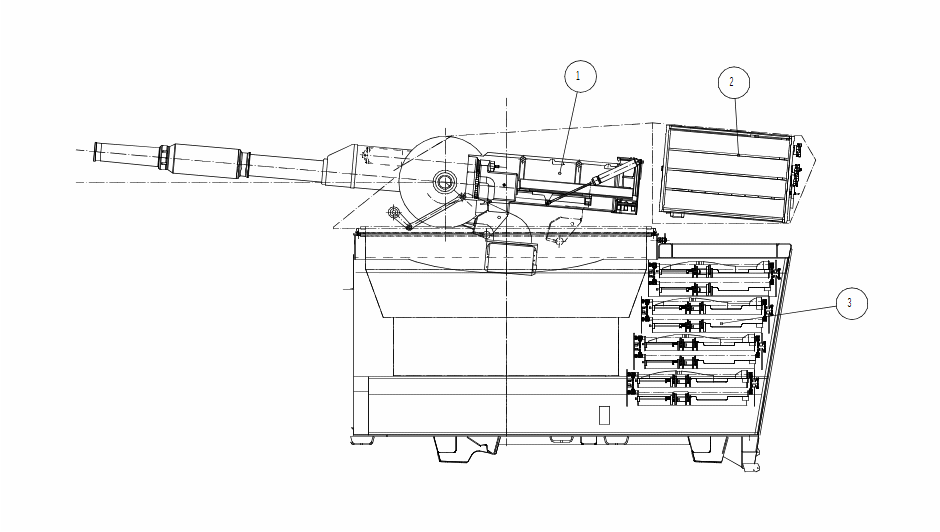
The AMOS loading system consists of three elements: a loading device attached to the gun cradle, the turret bustle magazine mounted in the turret bustle, and the chassis magazine mounted in the rear part of the vehicle.
Loading device functions
The semi-automatic loading device provided within AMOS is essential for the high rate of fire required. The loading device can be fed in two ways: automatically from the turret bustle magazine, or semi-automatically from the chassis magazine by the ammunition loader.
The ammunition can be fed to the loading trays automatically from the turret bustle magazine. The turret bustle magazine is an electrically driven, revolver-type ammunition storage. The gunner controls the ammunition loading sequence with the turret bustle control panel.
The chassis magazine is an electrically driven ammunition storage from which ammunition is transferred semi-automatically by the ammunition loader.
After the ammunition is fed to the loading trays of the loading device, the loading trays are swung down and the shells are rammed through the open breeches into the barrels. The breeches are closed automatically. The loading trays are then swung up to give room for barrel recoil movement and to enable them to be re-filled. The loading sequence is controlled by the gunner with the loading panel.
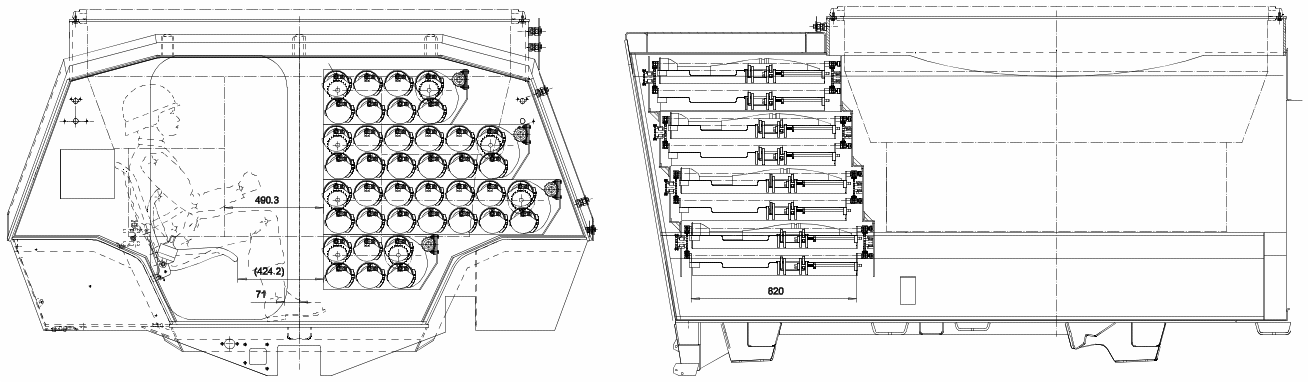
The ammunition chassis magazine is a modular unit designed for transportation, storage and delivery of ammunition. Module length can be varied to achieve a capacity of 6, 8, 10 shells, depending on available vehicle width. Independent modules can be stacked on top of each other as permitted by vehicle height (Figure 7). Ammunition magazine operation is controlled using a control panel (that is a motor control unit with current restriction), which can drive a maximum of four modules at a time. Power for ammunition storage operation is provided from the vehicle battery.
Amos versus conventional mortar
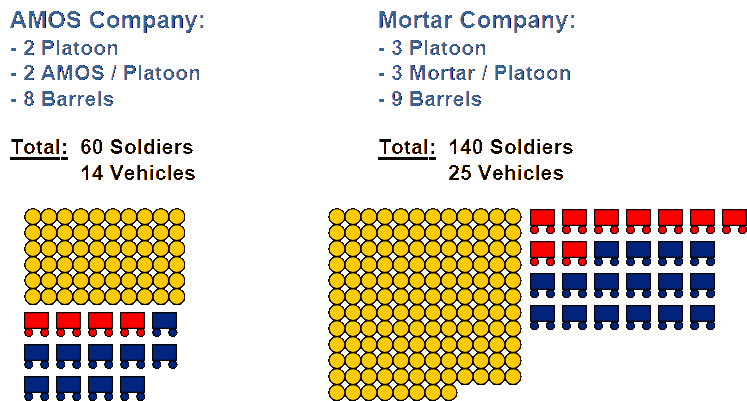
When comparing an AMOS company and a traditional mortar company as units (as opposed to our earlier comparison of their firing properties), the following conclusions can be reached.
AMOS company in Finland consists of four AMOS units, giving a total of eight barrels. A traditional mortar company consists of three mortar platoons, which all have three ground-based mortars, giving a total of nine barrels. When comparing the need for vehicles and soldiers there are clearly significant savings while fielding the AMOS system: the number of vehicles involved can be reduced from 25 to 14 and the number of soldiers from 140 to 60. These figures include all mortar company vehicles and soldiers: command platoon, fire platoons and supply platoon. These reductions in numbers are highly desirable on the modern battlefield and most armies are aiming for these levels of reduction (Figure 8).
Project status
The AMOS project was started in 1995 as a private venture and the first industry-owned system, Technology Demonstrator (TD), was completed in June 1997. The TD was first tested in a CV90-tracked chassis for about one year and approximately 1,000 shots. In 1998 the turret was moved to a XA-185 wheeled (6×6) APC chassis and tested for approximately 1,500 shots. The TD turret was also installed on a Combat Boat 90 and some preliminary firings were conducted.
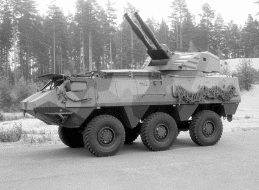
Patria Hagglunds signed a contract with the Finnish Defence Forces (FDF) in June 1999 of one prototype on a XA-203 wheeled (6×6) APC chassis (Figure 9). This unit was delivered in October 2000 and the FDF conducted a wide-ranging test program (both winter and summer) in Finland by firing over 1,000 shots and driving over 3,000 km in road and cross-country conditions.
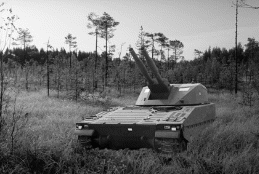
In September 2001 a contract with the Swedish Armed Forces (SAF) was signed including a turret mounted on a CV90-tracked chassis (Figure 10)
In March 2002 Patria Hagglunds is expecting a contract for four pre-series turrets for the FDF, which is then expected to lead to a series of deliveries starting in 2006. The SAF is predicted to follow in serial contract, deliveries starting at 2008.
There has also been considerable interest in the AMOS system from countries around the world, including Denmark, UK, The Netherlands, USA, and Australia.
Conclusions
Modern battlefield demands for the indirect fire support of 120-mm mortars has moved towards self-propelled, under-armour systems with high firepower. Modern mortars have to follow supported troops at the same pace. Today 120-mm mortar can replace light field guns, because the firing range is almost the same and the ammunition is even more lethal. AMOS, the Advanced MOrtar System, can also fire in the direct-fire mode; a useful feature especially for self-defence. Because of the twin barrel concept, AMOS fires 400 kg/min splinters in target, which is equivalent to a modern 155-mm artillery system. AMOS can also be mounted to a wide range of armoured chassis and thus fulfil the user requirement for mobility. AMOS can be seen as the answer for today’s requirements for indirect (and direct) fire support in modern armies.
Mr. Kari M Reunamaki is the AMOS Product Manager at the Finnish company Patria Hagglunds. He is a graduate of Tampere University of Technology (1987). He started at Patria Vammas as a project engineer in 1991 and was nominated as a research and development manager of the weapon systems in 1992. In 1995 the AMOS-project was launched and Mr. Reunamaki was selected as a project manager. The project coordination and marketing company Patria Hagglunds was founded in 1999 and Mr. Reunamaki was nominated to his current position. He can be contacted at Kari.Reunamaki@patria.fi.
This paper was originally presented at the Land Warfare Conference 2001, 12-14 November 2001, Sydney, Australia, and appeared in the Land Warfare Conference Proceedings 2001, and is reproduced here with permission of the Australian Defence Science and Technology Organisation (DSTO).
This paper remains copyright of Patria Hagglunds Oy, Finland 2002.
Prospective authors are requested to submit papers to the appropriate editor, or directly to the Editor-in-Chief. Guidance to authors is contained in the inside back cover of each Journal and is available on the Journal web page at http://www.argospress.au/jbt.