
Volume 4, Number 2, July 2001
An Evaluation Of The Effectiveness Of Three Methods Of Spear Grip Used In Antiquity
Abstract
This paper describes some of the different types of grip used in antiquity to hold spears when used for stabbing attack. There has been some debate about the effectiveness of a particular method of gripping a spear when it is used in attack and this is discussed. The ancient pictorial evidence concerning spear grips is reviewed and summarised. Field trials to compare the effectiveness of three distinct methods of single-handed grip using a spear were undertaken and the observations of the field experimentalist are considered and described. The effectiveness of different grip methods were quantified in laboratory trials using an instrumented spear, in which the impact force and energy were measured. These laboratory trials indicated that, of three grip types, the over-arm grip delivered most energy, the under-arm about half that of the over-arm, and a shoulder-level grip the least.
Historical Introduction
Two recent publications by Stephenson [1] and by Underwood [2] suggest that in Roman and medieval times the spear was not used in the conventional over-arm position so familiar from Greek vases but was held under-arm with the thumb forward, at shoulder level (Figure 1).
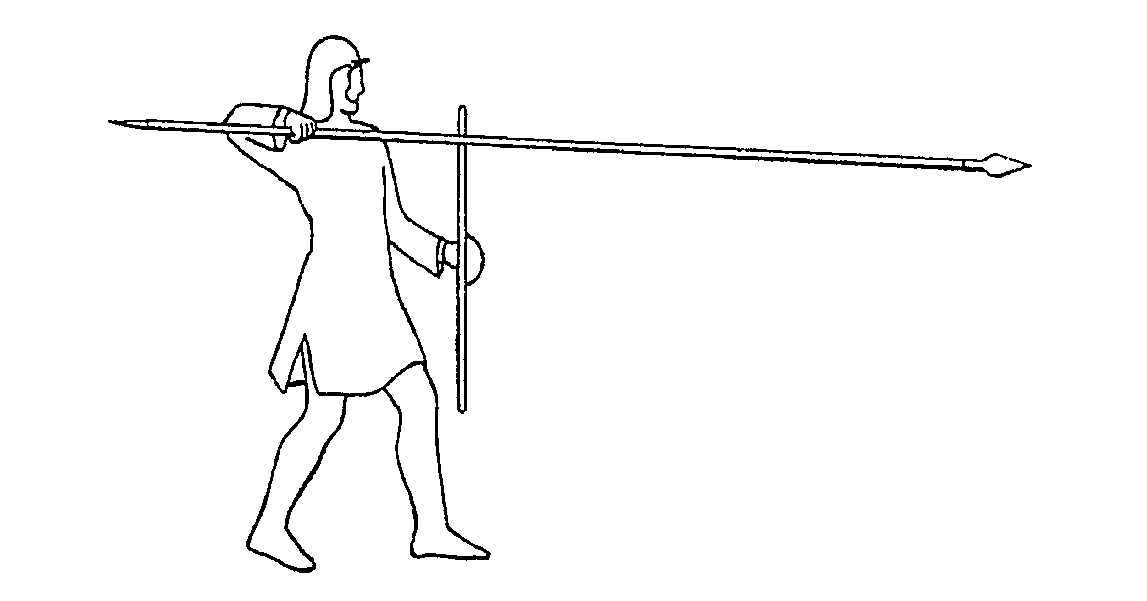
Underwood only suggests it as a possibility but Stephenson maintains that this was the normal Roman grip. He argues that all Roman monuments which appear to show the spear being used over-arm, are in fact showing soldiers throwing javelins. He bolsters his argument by pointing to the scene on the Arch of Constantine that shows three Roman soldiers with their spears held in the conventional over-arm position as illustrated in Figure 2.
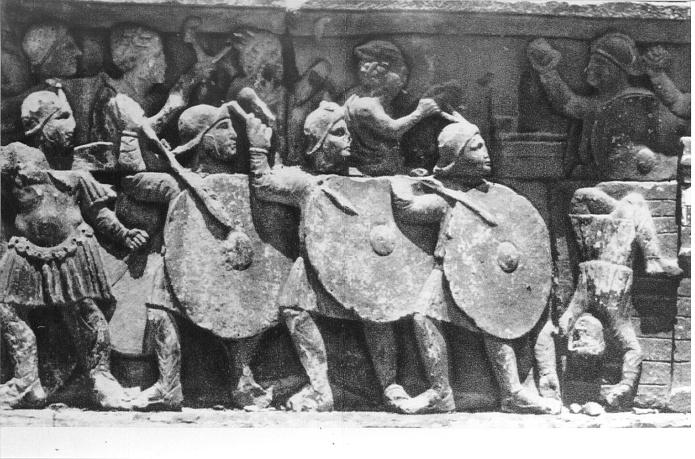
He claims that, as the scene shows the siege of Verona, the soldiers must be holding javelins. This is a very difficult argument to challenge, except where the soldiers are clearly shown in close combat. In view of this one of the authors decided to examine the pictorial evidence.
The Greeks during the age of the city-states held their spears in two ways:
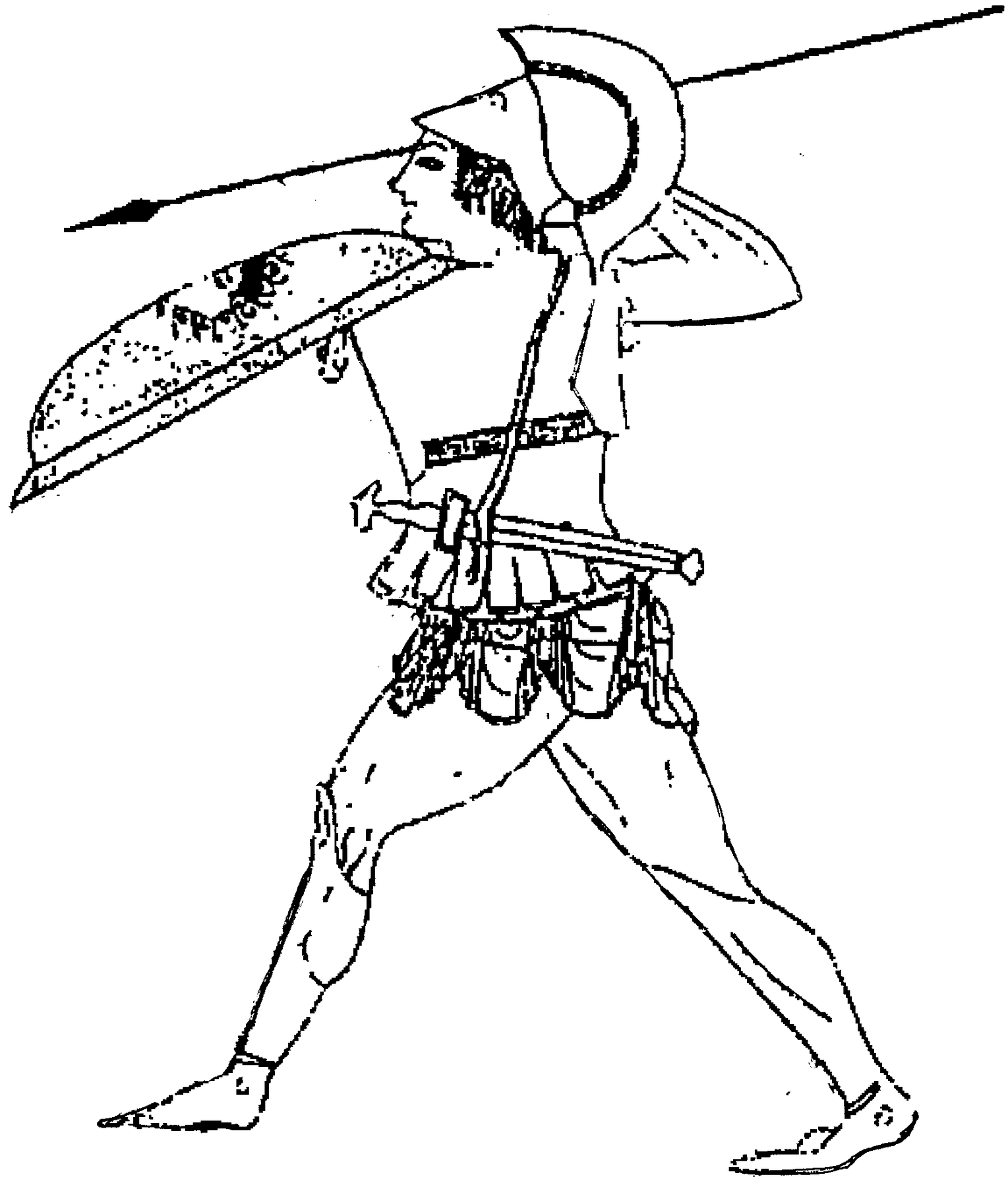
In the over-arm position, gripped at the point of balance, with the thumb pointing backwards (Figure 3). This was by far the most common method. Nearly 70% of vase painting representations [3] show this grip. It is always shown when the phalanx is depicted.
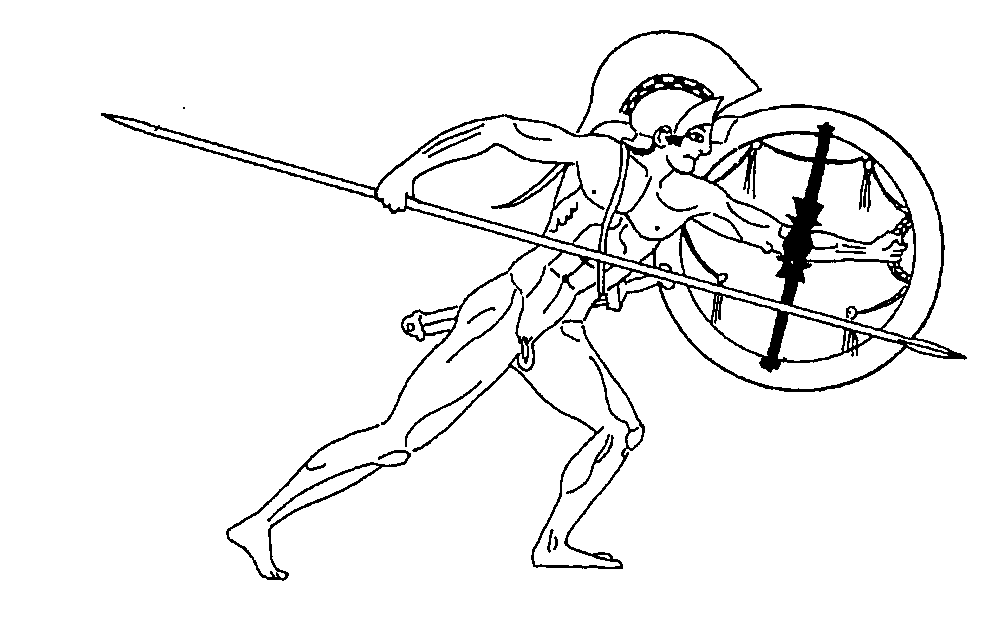
In the under-arm position, gripped at the point of balance at waist level, with the thumb pointing forwards (Figure 4). This seems to have only been used in loose formation or in single combat.
A third method, the two-handed grip is very rarely shown on vase paintings. When depicted it is shown both under-arm and over-arm. In the latter case the thumbs point backwards. The Macedonians used the two-handed grip and were copied by several Greek states during the Hellenistic period. Unfortunately no clear representation of this grip is shown in any Greek sculpture or painting. However, numerous Roman mosaics show this grip being used by huntsmen fighting large animals such as bulls, wild boars and large cats (Figure 5). The grip is invariably shown with both thumbs facing forward. There seems to be no reason for supposing the Macedonians held their pikes in a different way.
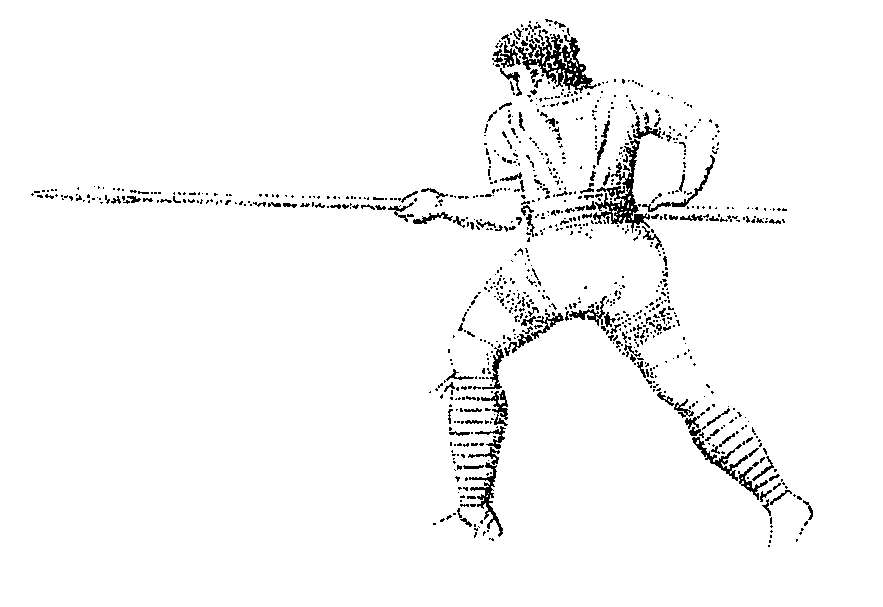
A unique method of holding the spear is shown in fourth century BC tomb paintings from southern Italy [4] (Figure 6). Some paintings show warriors fully armed with typical Samnite panoply, feathered helmet, triple-disc cuirass (breastplate), shield and greaves (shin guards). Others show the warriors armed only with shield and greaves, in what appear to be gladiatorial scenes. They are using spears/javelins up to about 1.65 m long; both over-arm and under-arm held at the butt end, like a sword.
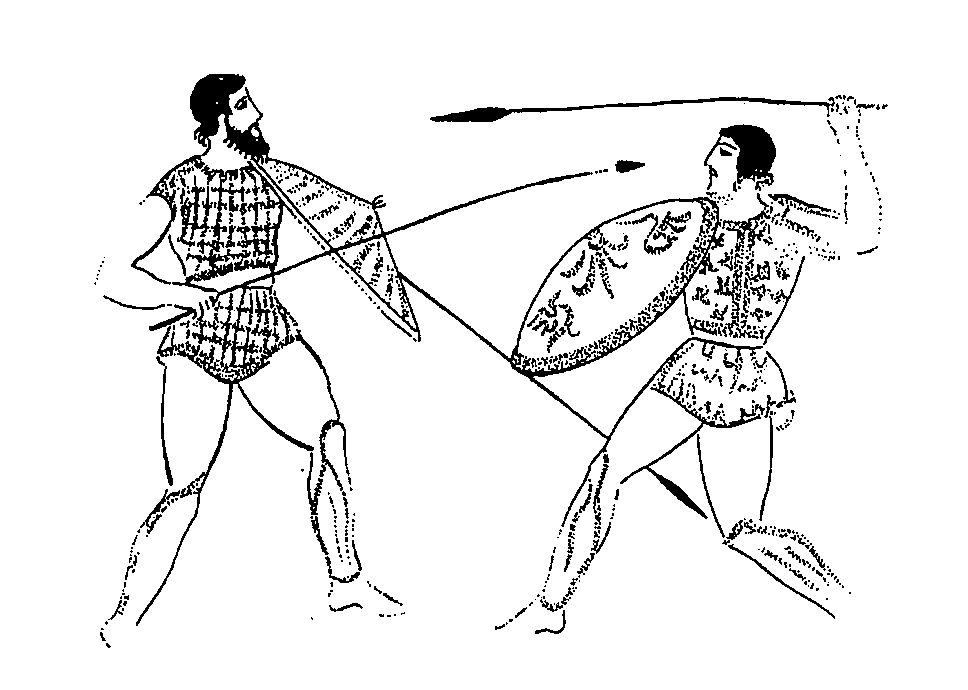
When used under-arm the hand is at waist level. The Samnites were renowned for their ability to move quickly, suggesting a less rigid formation than their Roman enemies. It is impossible to determine whether they ever fought in battle as depicted in these tomb paintings; other paintings show more conventional spear grips. Warrior burials in central and southern Italy contain spears up to 2.6 m long including point and butt. This is probably the greatest practical length for a one-handed infantry spear.
The Romans of the republican period had a long tradition of spear fighting inherited from the Greeks and Etruscans in Italy. The retention of the name hastati (spearmen) for the second line in Roman battle array who were equipped with pila (heavy javelins), testifies to an earlier era when they had used the spear. At the time of Polybius (circa 150 BC) the triarii, the third line of the battle array, were armed with spears [5]. Polybius, a Greek general, was brought to Rome for questioning after the defeat of Macedonia in 168 BC. Whilst in Rome he became a friend of Scipio Aemilianus, the greatest Roman general of his day. Polybius wrote a universal history of his own time including a detailed account of the Roman army. We can be confident that the Romans of his day used their spears in the same way as the Greeks, as Polybius always explained those items that would not have been clear to his Greek audience. Had the Romans used their spears in an unusual way Polybius would surely have recorded this in his writings.
From about 100 BC, when the spearmen of the legion, the triarii, were abolished, until the second half of the second century AD when the spear was reintroduced, it is generally accepted that all legionaries were armed with sword (gladius) and heavy javelins (pila). However the Julii Monument, at St Remi in southern France [6], shows armoured infantry, surely Roman, fighting with swords, pila and in several cases spears held in the conventional over-arm position. The interpretation of this monument is controversial but it shows that the spear was still used in this way.
Whether the legionary occasionally still used the spear or not, most of the Roman auxiliary infantry certainly did. However there are few indisputable representations of them doing so. Most of the auxiliaries in the west were of Celtic origin. Although the Celts were renowned as swordsmen, grave finds show that the spear was also regularly used. At least two Gallic infantrymen, fighting with the spear in the conventional over-arm fashion, appear on the Arch of Orange in Provence, southern France [7]. The date of this monument is also controversial; most would date it to the reign of Tiberius, first quarter of the first century AD. Certainly the military equipment shown in the battle scene at the top fits this early date but it has recently been argued that it is much later, (circa AD 200).
Auxiliaries shown on Trajan’s Column (circa AD 110) [8] are easily identified by their oval shields. Unfortunately the weapons on this monument were made of bronze and have all disappeared. Only occasionally when the figures are in the background are the weapons sculpted. There are several scenes showing auxiliaries with their right arms raised in the over-arm position and one scene (LXX) where they are clearly fighting in a spear phalanx. The Trajanic monument at Adamklisi [9] in Romania shows the spear being used underarm held at waist level (Metope XXXIV). Another very damaged metope shows two auxiliaries fighting with spears held over-arm.
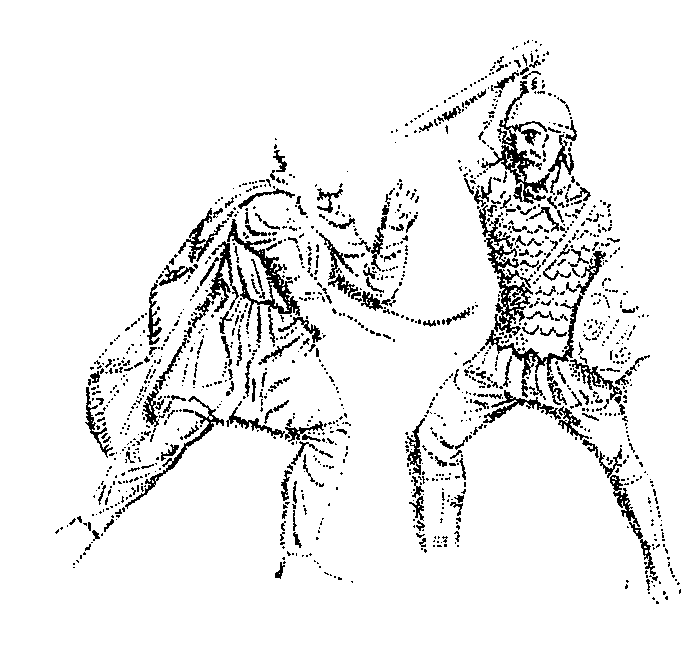
After the middle of the second century AD the spear became the primary weapon of the legionary. There are a large number of sculptures and some paintings showing Roman spearmen of this period in action. It would be impossible to examine them all and it has been necessary to be selective. The Column of Marcus Aurelius [10], sculpted at the beginning of the period, is typical. It shows sixteen scenes with spears being used for fighting. Of these, eight show the spear used over-arm with thumb back (Metopes XX, XXVI, XXX, XXXIV, XXXV, XL, XLIII, LXIII). The best example of the spear used over-arm in close combat is shown in scene XX (Figure 7). It is impossible to interpret the spear as a javelin in this scene.
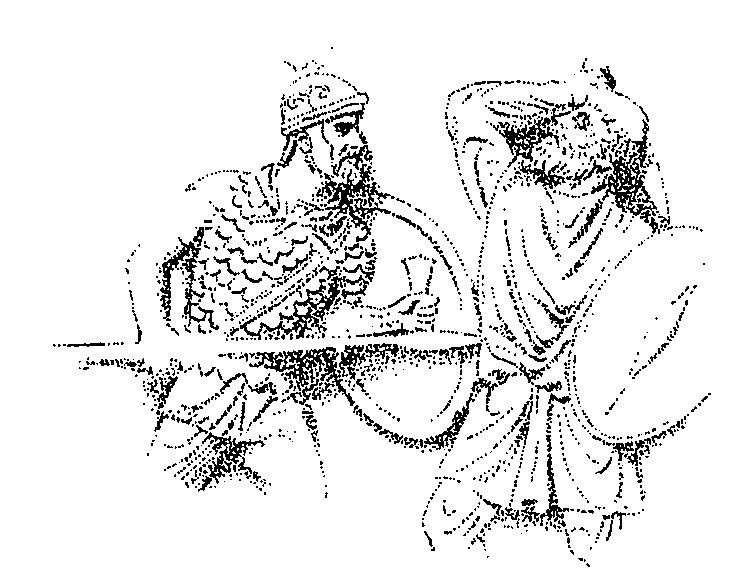
Six scenes show the spear being used under-arm with thumb forward (Metopes XXIII, XXXIV, XLII, XLIII, L, and LXXVII). All hold the spear at waist level. Two are clearly fighting cavalry (Metopes XXIII, XXXIV). A further two show single combat (Metopes XLII, XLIII), the better being in scene XLIII (Figure 8). Scene LXXVII shows a Roman dispatching a fallen enemy.
Summary of Historical Evidence
This review of the pictorial evidence shows that the Romans used the spear predominantly in the over-arm position. The under-arm grip at waist level was used only in loose formation, in individual combat or against cavalry. The authors could find no evidence whatsoever for the spear being used in the manner proposed by Stephenson. Whilst it cannot be stated categorically that the spear was never used in the way that Stephenson maintains, there is certainly no evidence for it.
Stephenson maintains that one advantage of holding the spear under-arm at shoulder level is that, supported by the forearm which acts as a cantilever, it is possible to grip the spear well behind the centre of gravity. This greatly increases the reach of the spear. This may be so but it creates a serious problem as it is essential for a spearman fighting in phalanx to be able to withdraw the spear point to within 15-20 cm of the shield wall. If it cannot be withdrawn, the enemy can brush aside the spearhead and move into close quarters having virtually disarmed his opponent. For this reason a spear much longer than 2.5 m is impractical. It could be argued the Macedonian phalangites used spears of twice this length, but these were pikes held with two hands and, according to Polybius (XVIII, 29,7), one would have to get past five pike points to reach the first rank of the enemy.
Spear Grip Field Trials
The data extracted from the pictorial evidence can only represent an academic view of the effectiveness of different spear grips. Therefore it was decided to conduct a set of field trials to determine whether there was any discernible difference between the three types of grip. These preliminary trials will determine if any differences are sufficient to warrant more detailed laboratory tests. As previously described there are a number of possible ways of holding a spear, this paper considers three known methods of gripping a spear. These are over-arm, under-arm, and the shoulder-level grip as shown in Figures 1, 3 and 4.
Experimental
The field trials were carried out by one of the authors who manufactured the spear and has extensive experience in handling ancient weapons. A copy of a spear with a leaf-shaped blade, a wooden haft and a pointed ferrule on the butt end as illustrated in Figure 9, was used in all the field trials.
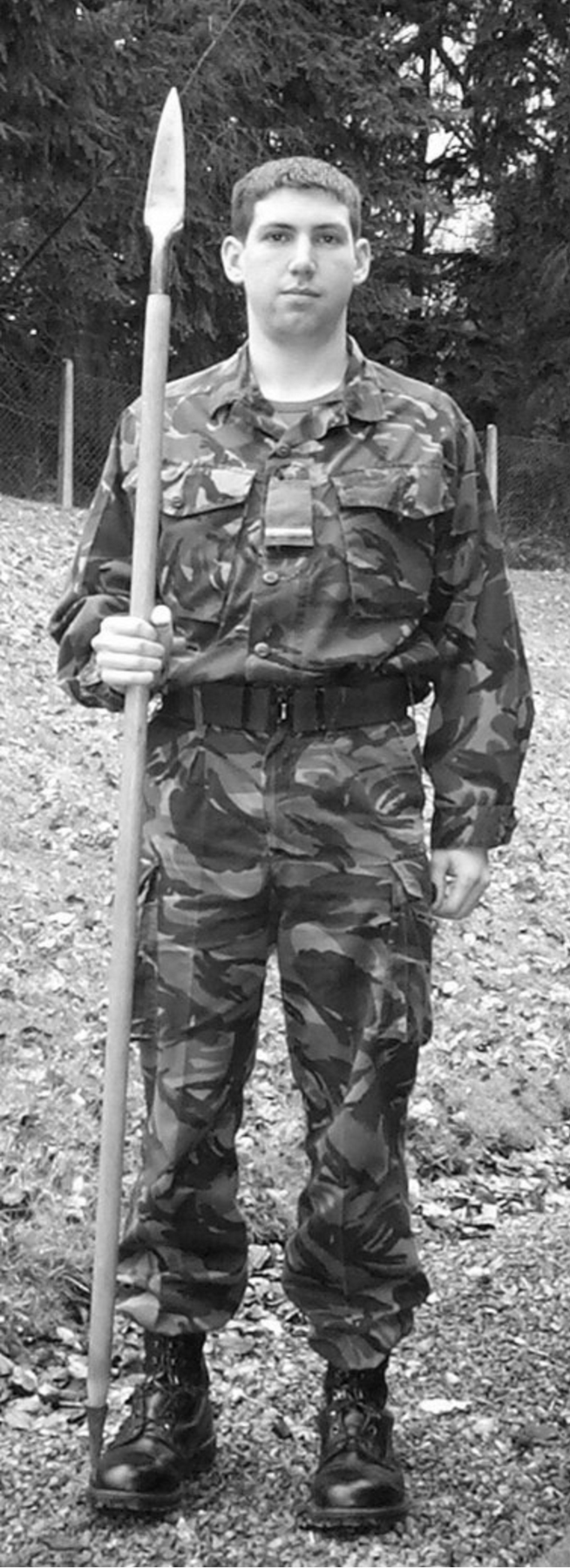
The length of the spear was 2.5 m. The target was a 12 mm thick, 1-m square sheet of plywood; it was positioned so the centre of the sheet was 1.3 m above the ground. The first experiment replicated an over-arm grip as shown in Figure 3. A series of twenty over-arm blows were struck at the target. These blows landed within a diameter of 500mm from the central point of the sheet. The over-arm movement allowed the maximum possible effort to be imparted into the stab, but the accuracy of aim was difficult to control. A second series of experiments was carried out using the under-arm grip, Figure 4. The blows using this grip landed within a diameter of 250 mm from the central point of the sheet. This showed an improvement in control of the accuracy, but it was not possible to put the maximum effort behind each blow. The third series of experiments used the shoulder-level grip illustrated in Figure 1. With this method it was very difficult to control the effort behind the blows and uncomfortable to hold the spear, although it was easier to aim than the over-arm method.
Field Trial Conclusions
The author observed that his aim was better using the under-arm blow, however he is a trained fencer and this may be a subjective view. Therefore the accuracy of the over-arm action could be due to lack of experience which could be improved with practice. He also observed that the shoulder-level grip shown in Figure 1 was uncomfortable and not an instinctive movement. There was an improvement in accuracy when this grip was compared with the over-arm action, but he found this grip was less accurate than the under-arm action. These field trials showed that there is a definite difference between these three methods. In order to quantify these differences, the field trials were repeated under laboratory conditions.
Laboratory Trials
Recent work by Horsfall et al [11] has shown that the energy and forces of a knife attack can be measured. This work has been extended to investigate the energies involved in spear attack. An instrumented spear connected to a data-capture system was used to evaluate the three methods of gripping a spear discussed above. These grips were compared in terms of impact forces and the total energy delivered in an attack.
Instrumented Spear and Data Capture
The instrumented spear in Figure 10 consisted of a 150mm long ‘commando-style’ knife blade clamped into a holder specifically designed so that a compression transducer could be mounted behind the blade. This holder was then connected to an aluminium sleeve which had an accelerometer mounted on it. The aluminium sleeve protected the accelerometer and connected the metal shaft to the wooden shaft. The spear had a total weight of 1.35 kg and a total length of 1.64 m.
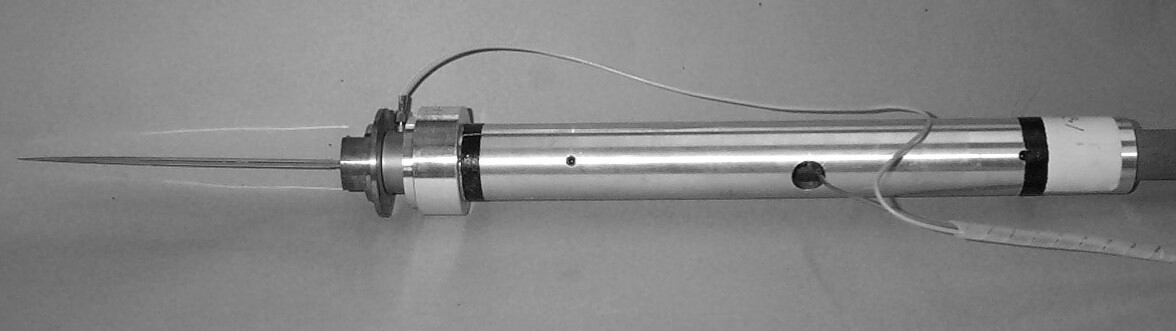
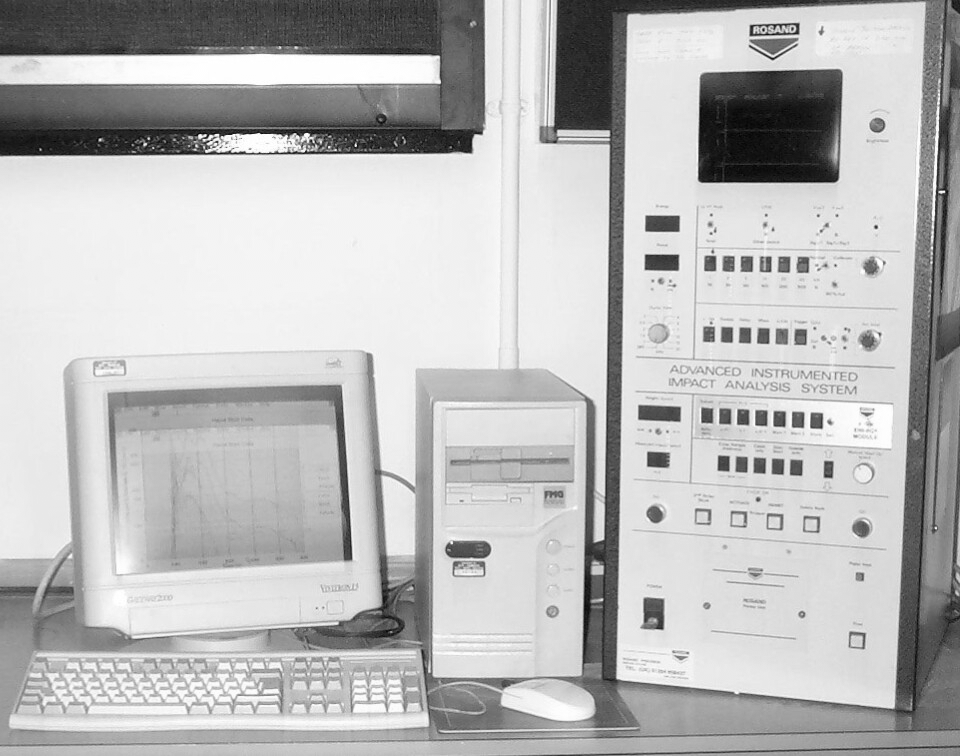
The transducer and accelerometer were connected to a Rosand Precision Ltd control system as shown in Figure 11. This system enables force and acceleration data to be collected in a pre-set time interval. These data were then transferred into a spreadsheet for further analysis, which is discussed in the next section.
AccelerometerAccelerometer150mm150mmForce TransducerForce Transducer
All tests used a standard target of 12-layer Aeroflex ® sheet this is a woven Kevlar® fibre composite in a thermoplastic binder. It was supported on a Plastolena ® backing block of a type used for the ballistic testing of body armour. This arrangement of target and support had been shown in previous work by Horsfall et al [11] to offer a degree of penetration resistance without interfering with the passage of the blade into the backing block. The target was mounted vertically on a frame so that the centre of the target was at a height of 1 m.
Types of Grip
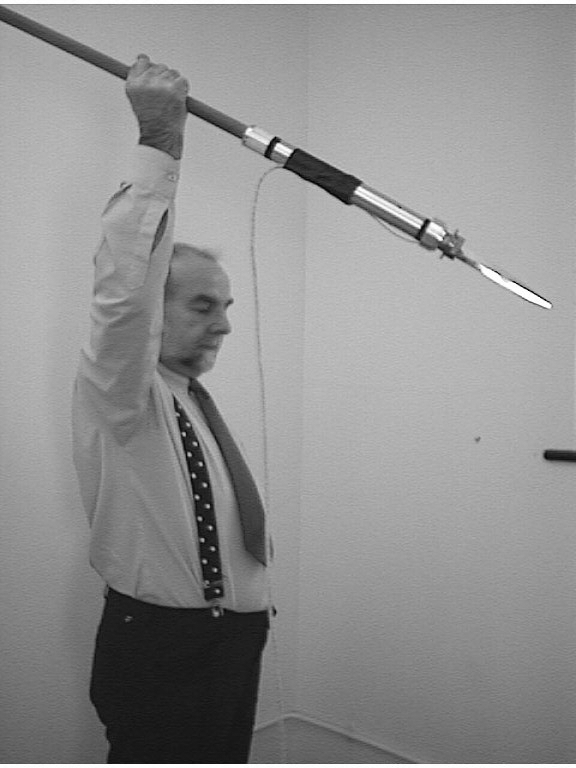
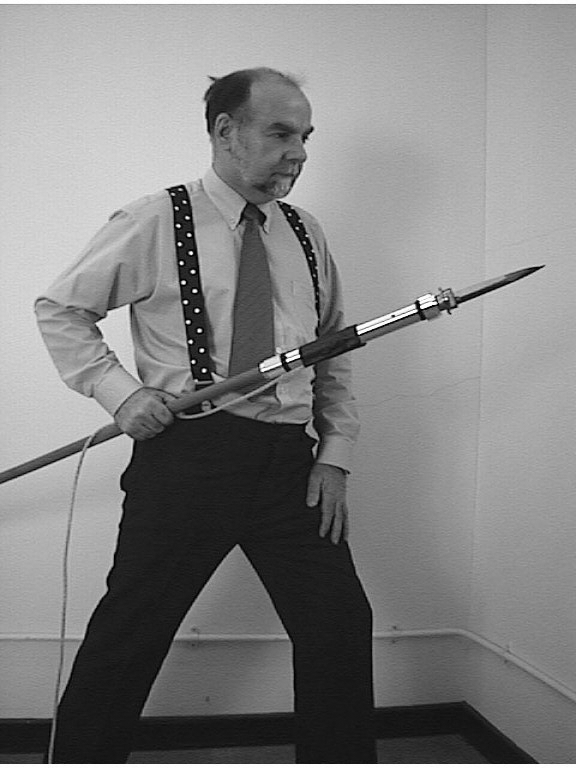
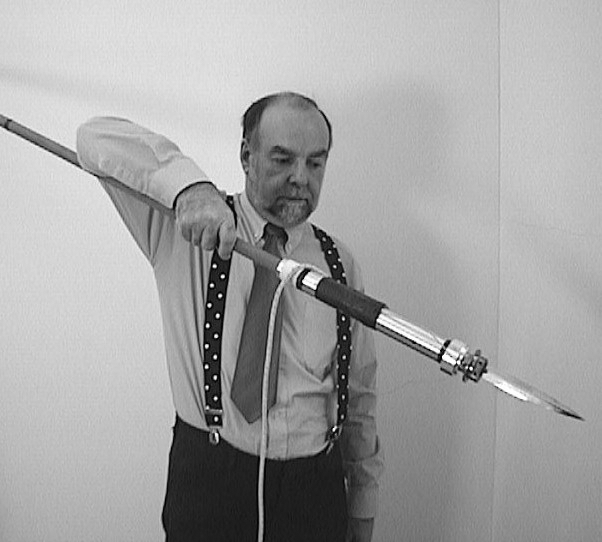
Figures 12 to 14 respectively illustrate the three types of grip used in the trials, over-arm, underarm and shoulder-level grip. Each type of grip was used for three attacks.
Data Analysis
The signal from the transducer was converted into force data using a calibration factor obtained by calibrating the transducer, after the method described by Money and Sims [12]. The accelerometer was supplied with a factory-fixed calibration. Earlier work by Horsfall et al [11] had shown that a 50-ms time interval was adequate to capture the whole attack sequence. The data capture system was able to take 340 samples of both force and acceleration during this 50-ms interval. After each test, the instantaneous values for force and acceleration were transferred to a spreadsheet for processing. The impact velocity or the velocity at any point
was determined by summing the acceleration data from the point backwards. The instantaneous velocity value was then multiplied by the time interval between the data points, to give the distance travelled, in each time interval. The instantaneous energy at each point could then be determined from the distance travelled, multiplied by the force. These values were then summed to give the total energy of the test.
Instrumented Spear Results
The force, velocity and energy results of all tests are compared in Table 1.
| Type of Grip | Peak Force (N) | Peak Velocity (ms-1) | Total Energy (Joules) |
|---|---|---|---|
| 1069 | 5.8 | 35 | |
| Over-arm | 1059 | 6.6 | 42 |
| 928 | 6.7 | 38 | |
| Shoulder- | 494 | 3.7 | 7.5 |
| level | 493 | 3.6 | 6.5 |
| right arm | 507 | 3.8 | 7.4 |
| Shoulder-level left arm | 556 | 3.3 | 6.0 |
| 711 | 4.3 | 14 | |
| Under-arm | 611 | 4.3 | 12.5 |
| 573 | 4.4 | 13 | |
| 472 | 4.8 | 13.7 |
The laboratory tests showed that the over-arm grip delivered the highest impact energy and this was reduced by half when an under-arm grip was used. The shoulder-level grip shown in Figure 14, delivered least amount of force and energy and the amount did not vary significantly when either arm was used. Over-arm tests gave the highest velocities, peak forces and energy delivered. Force values for underarm attacks were approximately 40% less than over-arm attacks, with the shoulder level grip giving values of approximately 50% less than the over-arm grip. The force profiles of three typical tests are plotted in Figure 15.
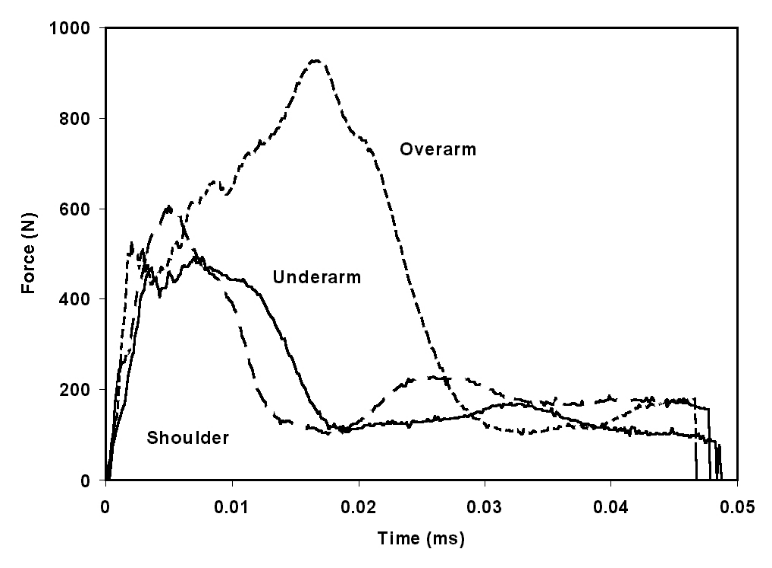
All three force profiles show a steep rise in force at the beginning of the curve to an initial peak. After this first peak, the force profile of the over-arm blow continues to rise steeply for 20 ms and the test is completed after 30ms. Whereas the force profiles of the under-arm and shoulder level blows show that peak forces cannot be maintained after 10ms and show a reduction in load after the initial peak with these tests being completed in 20 ms. The curves show that the higher velocities connected with over-arm blows, on average around 6.4 ms-1, resulted in higher peak forces that can be sustained for longer. This result is consistent with the type of action involved, as the over-arm action allows more time to accelerate the spear. Consequently the amount of energy delivered in an over-arm attack is greater, averaging around 38 J.
At around 4.5 ms-1 the velocities of under-arm blows were between 1.5–2 ms-1 less than over-arm velocities. The average energy of these attacks was 13.3 J which is about 30% of the energy delivered by a typical over-arm blow. Again this result is consistent with the limited time to accelerate the spear when using this movement.
On average the velocities for the shoulder level type of grip were around 3.7 ms-1, which is about 2.7 ms-1 less than the average for an over-arm attack. At 7.1 J the average energy delivered by the shoulder-level grip was approximately 20% of that found in over-arm attacks. The difference between the values for force and velocity in under-arm and shoulder-level type of attacks was not as great as the variation between blows struck using the over-arm grip and both of the other methods of grip. However when the energies delivered by the three types of grip are compared, the under-arm grip delivers double that of the shoulder-level grip, with the over-arm grip delivering five times the energy of the shoulder-level grip.
Conclusions
In conclusion, the authors found that pictorial evidence from Roman times shows that spears were predominantly depicted as being used in the over-arm position. The under-arm grip was illustrated being used mainly in loose formation for individual combat or against cavalry. Although a shoulder-level grip can improve the reach of a spear there was no pictorial evidence showing this grip being used in combat. The field trials concluded that the maximum amount of effort could be transmitted into an over-arm blow. Although the aim was not as accurate when compared with under-arm blows it is likely this could be improved with practice. The laboratory trials confirmed the results of the field trial with maximum forces and energy being measured for over-arm blows. The results from both field and laboratory trials have shown that for single-handed attacks the over-arm grip would be the most effective method of attack using a spear.
References
[1] I. Stephenson, Roman Infantry Equipment—The Later Empire, Tempus, 1999.
[2] R. Underwood, Anglo Saxon Weapons and Warfare, Tempus, 1999.
[3] J. Boardman, Athenian Red Figure Vases—The Classical Period, London, 1989.
[4] A. Pontrandolfo et al, Le tombe dipinte di Peastum, Peastum, Fondazione, 1998.
[5] P. Connolly, “The Roman Army at the Time of Polybius”, Warfare in the Ancient World, London, pp.149-152, 1989.
[6] H. Rolland, Le Mausolee de Glanum, Gallia, supplement XX1, Paris, 1969.
[7] Pigniol et al, L‘Arc d’Orange, Gallia, supplement XV, Paris, 1962.
[8] F. Lepper and S. Frere, Trajan’s Column, New Hampshire, 1988.
[9] F. Florescu, Monumentul de la Adamklissi, Tropaeum Traiani, Bucharest-Bonn, 1965.
[10] A. Colini and G. Grtti, La Colonna di Marco Aurelio, Rome, 1955.
[11] I. Horsfall, C. Watson, P. Prosser, and S. Champion, “An Assessment of Human Performance in Stabbing”, Elsevier, Forensic Science International, Vol. 102, pp. 79-8, 1999.
[12] M. Money and G. Sims, “Calibration of Quartz Load Cells: An In-situ Procedure for Instrumented Falling Weight Impact Machines”, Polymer Testing, Vol. 8, pp. 429-442, 1989.