
Volume 4, Number 1, March 2001
Towards Better Knowledge: A Fusion of Information, Technology, and Human Aspects of Command and Control
Abstract
The impending advent of digitization has fuelled interest in all components of military command and control (C2) and there is growing awareness of the importance of human issues relative to C2. A number of human behavioural aspects (such as individual and team decision processes, shared situational awareness, management of information) significantly impact upon the effectiveness of C2 but are, at present, poorly understood. This paper discusses these human aspects of C2 in some detail, assesses their relative impact, and presents a simple model of the interaction between the information, infrastructure and intangible issues associated within a command post.
In an age when new electronic marvels are being introduced almost daily and thus the gadgets in current military use are out of date, it is easy to forget (and it has often been forgotten) that command, rather than being simply an assortment of technological marvels around which organisations and procedures are built, consists of a series of processes - each of them as old as war itself - by which the technological means at hand are pressed into service. [1]
Introduction
The impending advent of digitization has lead to considerable interest in all aspects of military command and control (C2). Whilst digitization is a driver, it also presents constraints and opportunities. Some constraints may impose limitations on the way that military business is conducted. It is hoped that some opportunities will lead to significant improvements to operational effectiveness. Not least, the deployment of considerable quantities of information technology (IT) on the battlefield is forcing a detailed examination of C2 processes, since the IT must be designed to support these processes.
Current procurement plans include highly significant investment in battlefield IT. However, planned expenditure for research examining human aspects is on a considerably more modest scale. For reasons that will become apparent, this is not surprising. However, the rationale is not entirely sensible. Even a superficial examination of the ‘business’ of C2 reveals a number of human behavioural aspects that have significant impact on the effectiveness of C2 but are, as yet, poorly understood. Technology is never a be-all and end-all. As Van Crefeld states in arguably the most widely respected and quoted volume on command in war: ‘(S)ince a decisive technological advantage is a fairly rare and always temporary phenomenon, victory often depends not so much on having superior technology at hand as on understanding the limits of any given technology, and on finding a way around these limitations.’[2]
Scope and purpose
This paper discusses human aspects of C2, assesses their relative impact, and presents a simple model of the interaction between the information, infrastructure and intangible issues associated within a command post.
The purpose of this paper is to promote a better understanding of the human aspects of C2. The eventual purpose of C2 is to bring about military success. Consequently, the discussion presented in this paper is characterised by relevance to military outcome, a perspective that often seems missing from works on C2 development.
Emergent problems in C2
There is a growing awareness of the importance of human issues in C2. Were that not so, it is unlikely that RMCS Shrivenham would have commissioned a Symposium on People in Digitized C2; nor that the Royal United Services Institute would have run an event entitled Battlespace Digitization. The Human Factors in November 2000. Similar conferences have taken place in The Hague and Toronto within the last two years. This emphasis on human aspects probably implies that the solution to some capability requirements lies in better doctrine, training, or organisation, rather than in new equipment. This section highlights a number of emergent problems related to digitization and suggests that many have roots in human components of C2.
British Military Doctrine states that the three aspects of command are leadership, decision making and control of assigned subordinates [3]. Of those, leadership is not considered to be primarily relevant to information systems (IS) provision. Control in many ways reduces to making and enforcing second and third-order decisions relating to the co-ordination and synchronisation of subordinate’s actions. Hence, in many ways, the key aspect of C2 in this context is decision making.
However, there is increasing awareness of the inadequacy of formal decision making processes, such as the Estimate process stipulated within endorsed doctrine, within C2. There exists overwhelming evidence that experienced battlefield commanders do not make decisions using such processes [4]. How they do make such decisions is an important field of applied psychology, and is discussed below. What the impact of those decisions is, how that issue should be assessed and assessments of the value of formal versus alternate decision making methodologies are almost totally unexplored. The Estimate process is perhaps best viewed as a training vehicle that helps people reach ‘safe’ decisions when needed. In fairness, it has been appreciated as such by many for some while. In essence, decision making is a fundamentally human process that should be supported by technology, not driven by it.
The dominant model of C2 within western armies is the ‘OODA Loop’, an application of the Boyd Cycle as described by Lind [5]. The OODA Loop describes an iterative process of observation, orientation, decision and action. It seems an adequate description of the actions of a fighter pilot flying his aircraft. It is less fitting as a description of fighter combat. Similarly it may be a reasonable description of the actions of a single battlefield decision-maker, but shows significant shortcomings as a description of formation level C2. As with all models, it was developed with a particular context in mind but has subsequently been transferred to new, and perhaps inappropriate, contexts at the peril of individual users. Whilst the model may still be applicable, its limitations should be borne in mind. The exposure of these limitations appears absent from discussion of battlefield C2.
In formation CPs, observation and orientation are continuous; positive decisions occur at intervals, and action occurs at some distance in time and place. Due to time delays in combat reporting, observations of the effects of orders given in consequence of decisions occur considerably after the decision is taken—by a matter of hours and sometimes days. Thus the OODA loop, the cornerstone model of C2 within British military doctrine, is only an adequate model if the lags and losses within the overall process are accounted for. This is significant: it suggests some aspects of military thought remain poorly developed. These aspects, which are conceptual and to that extent human rather than technical, underpin our understanding of the ‘business’ that we seek to digitize. As Einstein said: ‘a model should be as simple as possible, but no simpler’. In this context, the OODA Loop is simplistic.
Human decision making depends largely on mental models of the situation within which the decision is to be made. These mental models usually take the form of enactive (mental) imagery. There is currently a largely implicit assumption that the best mental model in this context is an information-rich picture. This assumption leads to the provision of IT that focuses upon the delivery of increasing quantities of data. This can be observed in the continuing quest for greater bandwidth provision to Command Posts (CPs).
However, this assumption does not appear to be valid. All models are simplifications, and simpler models often give greater insight than ‘richer pictures’—‘seeing the wood for the trees’. The question of what sort of mental model best supports tactical decision making is highly significant and, critically, it is a human rather than a technical issue.
Tactical decision-makers will probably never have access to a complete picture of the battlefield, for reasons explored below. We should ask instead what would be an appropriate or a sufficient subset of the whole picture. Any subset should recognise that decision-makers probably have a desired ‘comfort zone’; a quantity of collateral information which is not strictly relevant to decision making but provides confidence in the validity of the mental picture. The size of the ‘comfort zone’ will vary between decision-makers. Consequently, the information requirement for a given decision will depend on the individual as much as the situation. Therefore, human aspects have significant impact on the information required for C2.
The widely acclaimed concept of ‘Information Dominance’ is often taken to imply perfect situational awareness of the battlefield. As discussed, that will probably never be available and, in any case, is probably unnecessary. A focus on operational outcome, and hence effectiveness, suggests that what is required is the possession of sufficient, or the appropriate, information relative to the adversary with which to generate operational advantage. As before, this information will vary according to the personality of individual decision-makers and, more globally, the military culture pertaining within the staffs involved.
Outside the purely military content of digitization, we can observe that several key digitization projects are experiencing difficulties. Underlying such problems is a difficulty in identifying the nature of ‘the business’; the military processes to be supported by IT. Cultural issues also impinge: the myths, values and beliefs of those who specify military equipment, of those who procure it, of those who scrutinise procurement proposals and of those who provide it. Many of those individuals can be expected to see C2 predominately as an issue of information provision. We have suggested that it be just as much, if not more, a matter of human issues.
Human aspects of C2 and their impact
The previous section exposed a number of emergent problems related to digitization, and suggested that many of these have roots in human aspects of C2. The present section summarises current and developing knowledge in a number of fields impinging upon this area. Where appropriate, areas are suggested for further research.
An overview of decision making theory
Decision making can be defined as the processes of thought and action that culminate in some type of choice [7]. Decision theory consists of both classical models of formal decision making and descriptive models of Naturalistic Decision Making (NDM).
Classical models are traditional, theoretical and (predominantly) prescriptive—they provide a framework for ‘how to do’ decision making. A decision-maker has available a range of potential options from which to select a Course of Action (COA). In order to select a COA, the decision-maker first generates a range of criteria against which to evaluate each option. For example, in choosing to buy a house, evaluative criteria might include cost, location, size etc. The decision-maker then assigns a weighting to each criterion (using a range of possible methods) in order to define the importance of each criterion. Each option is subsequently assessed against each criterion and assigned a score. This score is multiplied by the weighting, and the sum of the weighted scores calculated. This process is repeated for all options and the option with the highest end score is selected.
This classical, analytical approach is embodied in the Estimate Process (taught in Staff Colleges). However, the framework is fundamentally flawed in its failure to generalise to complex, real-world environments. First, typical decision making rarely encompasses situations that can be dealt with in terms of clear-cut, absolute information (that is, not all options can always be known in advance). Second, individuals rarely have time to generate a range of assessment criteria, and find it extremely difficult to assign numerical values. Moreover, determining all the potentially favourable and unfavourable consequences of all the feasible COAs would require the decision maker to process so much information that impossible demands would be placed upon his/her mental capabilities. Individuals will ‘satisfice’ rather than ‘optimise’—that is, will search for a COA that is ‘good enough’ or meets a minimal set of requirements [8]. Third, the approach ignores the fundamental role played by past experience in how an individual understands his or her environment and generates a COA.
An emerging movement in psychological research is seeking to understand better how individuals and teams make decisions in complex, field settings (NDM). Orasanu and Connelly identified eight factors that typify decision making in naturalistic environments [9]. Not all of these factors need to be present or at their extreme in any one setting for a decision to be considered naturalistic:
- ill-structured problems (not artificial, well-structured problems);
- uncertain, dynamic environments (not static, simulated situations);
- shifting, ill-defined, or competing goals (not clear and stable goals);
- action/feedback loops (not one-shot decisions);
- time stress (as opposed to ample time for tasks);
- high stakes (not situations devoid of true consequences for the decision-maker);
- multiple players (as opposed to individual decision making); and
- organizational goals and norms (as opposed to decision making in a vacuum).
In a past DERA study to examine the usefulness of NDM for explaining decision making in military C2, 87% of all the decisions studied were best accounted for by Naturalistic theories versus just 2% by Classical theories [10]. This supports the assumption that it is not so much the amount of information available to commanders that is imperative in the decision making process but exposure to the right elements at the right place and time. This has far-reaching implications for current UK MoD programmes, namely digitization. Provision of greater quantities of information will be effective as a command performance enhancer in some, but by no means all, situations. It is thus critical that such programmes should be tailored to user needs rather than the capability of the equipment.
Team decision making
Teamwork has always been at the core of operational effectiveness. However, emergent environments and operational requirements are posing new challenges to effective teamworking and team decision making. This section highlights some of these challenges, and emphasises strongly the primacy of the human in the successful enhancement and support of command effectiveness. The topics identified here draw from previous UK and US research on leadership development and training for distributed and ad-hoc command teams.
- The evolving nature of conflict. Growing participation of forces in peacekeeping and operations other than war poses new demands in terms of situational novelty. Novel situations demand innovation, and analogical reasoning to transfer knowledge and experience from one situation to another. Such situations also bring with them the risk of high levels of stress, including emotive stressors such as fear, shock, etc, and cognitive stressors, such as situational ambiguity and conflicting operational goals. Many such stressors are compounded by the increase in battlespace tempo.
- Operational imperatives. The emergence and adoption of knowledge dominance strategies for conflict resolution highlight the criticality of shared understanding among members of a command and control structure. Such understanding must include shared situational awareness, team awareness, command intent, and metacognitive aspects.
- Asymmetric threat. The threat posed to military teams now originates from a multitude of sources, and exists in a number of different forms, many of which may present themselves synchronously. Such threats demand the maintenance of multiple perspectives amongst team members, to avoid team fixation and groupthink effects.
- The discontinuous battlespace. The highly fragmented nature of contemporary conflict (brought about in part by the collapse of the strategic-operational-tactical hierarchy) requires non-linearity and the capability for dynamic visualisation as integral parts of the decision process.
- More open doctrine. The development of doctrine to promote increased openness and delegation of responsibility leads to the requirement for both team adaptation, and for better preparations as a foundation to team decision making.
- Distributed team formations. In contemporary conflict settings, forces are often geographically distributed when performing their operational duties. This can lead to remoteness within the team and makes it more difficult to maintain shared situational awareness, and to implement effectively critical teamwork behaviours.
- Ad-hoc teamworking. Teams operating in contemporary conflict settings often comprise composite forces, consisting of rapidly assembled and deployed personnel who may have had limited opportunity to train and work together previously. The result is that team norms and identity are slow to evolve, requiring more effort to achieve effective team co-ordination and cohesion. Such situations also serve to disrupt the formation of accurate shared teamwork mental models.
- Multi-national and coalition teams. Many operational forces and teams are now composed of units from many different countries, each of whom may bring cultural and linguistic barriers to effective team communication and co-ordination.
Many of the solutions to the challenges facing effective team decision making in contemporary conflict settings have little, if anything to do with technology. Indeed, as will be discussed in the next section, technology can actually exacerbate such challenges. It is strongly suggested that the development of effective strategies for supporting and enhancing command team decision making must rely on holistic approaches, which place equal emphasis on understanding and exploiting people, process, organisation and technology as the building blocks of change. Such exploitation may include enhanced training regimes (particularly leadership and team training), selection processes, organisational redesign and process re-engineering, in concert with technology introduction. Further, it is proposed that it is impossible to effect changes in any one of these areas without directly, and significantly impacting on the others. The starting point for the enhancement of command effectiveness must, however, always focus on understanding the human in command, over and above the technology itself.
The impact of it
Technology holds the very real promise of enhancing significantly command effectiveness. This promise is recognised widely, and is reflected in the ongoing procurement of large, and expensive digitization systems by the military. The scope of digital technologies currently being developed for the enhancement of command is enormous, and includes: digital mapping, display systems (large screen, immersive, and holographic), speech, gesture and handwriting recognition, haptic interfaces, wearable computing technologies, artificial intelligence and knowledge-based systems, agent-based and other information management technologies, computer-supported cooperative working systems (including whiteboards and video conferencing), virtual presence and synthetic environments, simulation technologies, etc. This is to say nothing of the many large and complex communications projects underway.
It would appear that many command enhancement initiatives (including research programmes) are, in reality, driven by technology. This situation is perhaps understandable, in so far as the promise held by these systems must clearly be assessed, and, wherever possible, realised. However, this approach potentially results in solutions looking for problems. The occurrence of such situations is considered somewhat paradoxical, given the relative lack of fundamental understanding about the very human process of command which technology aims to support.
Unfortunately, this lack of understanding about the human nature of command has, in the past, manifested itself in the development of command support technologies which, to date, have realised little of the enhancements promised. Indeed, many of the prototype command systems developed and evaluated have served to disrupt, inhibit, and otherwise reduce the effectiveness of previous manual command processes. Where genuine enhancements have been obtained, these have often been of less significance than the changes in effectiveness resulting from human variability.
Some of the typical problems observed when prototype support technologies have been introduced into human command systems include:
- user frustration at feeling ‘tethered’ to their workstations;
- digital mapping systems used in parallel with the paper systems they’re supposed to replace;
- automated position plotting on digital maps reducing user engagement, and thus situational awareness;
- systems directing users’ attention away from critical cues and indicators;
- teams having difficulty in brainstorming around a digital support system;
- systems enforcing procedural, analytical problem solving;
- teams having difficulties in using digital maps for situation and mission briefings;
- lack of understanding about where digital information comes from, and how it changes over time;
- generation of a single, workable course of action, with other courses only being generated as a doctrinal façade;
- command teams are unable to assign numerical weightings to assess the suitability of their plans; and
- individuals spending their time ‘driving’ these systems, which significantly reduces the amount of time available for talking about the problems they are dealing with.
These problems originate largely from a failure to understand adequately the subtleties, and inherent strengths of the manual command process. Technology is thus clearly a double-edged sword. Such issues highlight the pressing need for better consideration of the human aspects of command in the development of digital support systems. Past failures confirm the now urgent requirement for human factors to be brought into the very heart of the requirements, design, development and evaluation processes inherent in the procurement of future digitized command support systems.
Shared situational awareness
Effective team decision making requires adequate shared situational awareness (SA). Subjectively, having situational awareness is experienced as ‘knowing what is going on so that I can figure out what to do’. No-one can have perfect SA, however, so it is necessary to build and ‘run’ a mental model of the dynamic interplay of all known factors affecting one’s operational objectives. In the battlefield context, these factors refer to the position, movements, capabilities and intent of both enemy and friendly forces and, in addition, the state of the battle environment.
In essence, shared SA can be viewed as a common mental model; several individuals working together have the same understanding of the situation. In practice, it is also necessary that each of the individuals know they share that model. Therefore, the goal of shared SA requires that each individual actively supports it by sharing any relevant new information s/he encounters and each trusts the others to behave accordingly.
SA can be shared between individuals both horizontally and vertically. Horizontally shared SA involves individuals operating at the same hierarchical level or echelon; vertically shared SA involves individuals at different levels in the chain of command. Individuals within a team need horizontally shared SA if they are to co-ordinate their actions towards a common task objective. Across different levels, vertically shared SA is needed whenever subordinates must appreciate the perceptions and intentions of their commanders, and/or commanders must appreciate the interpretations and expectations of their subordinates.
In both horizontal and vertical sharing, different individuals are likely to have different tasks, and hence different SA requirements. Shared SA applies only to shared goals. Hence, having shared SA does not mean that all co-operating individuals have exactly the same awareness. Rather, it means that there is a portion of each individual’s SA that is mutually co-ordinated with other team members.
Shared SA arises out of the explicit co-ordinating interactions between individuals (and their communication/information systems). The effectiveness of shared SA is therefore a function of.
- team structure and organisation;
- team members’ training; and
- supporting technology, including digitization.
Battlespace digitization is widely regarded as a means to enhance shared SA by increasing the availability of detailed information to all friendly units. That said, it is important to understand that awareness of concrete details, such as tank positions, forms only one part of the contents of SA and will not be relevant to all individuals. Other, equally important SA contents include abstract interpretations, expectations and intentions. Thus, the provision of an abundance of low-level data across a network will not necessarily enhance shared SA. Considerable thought must be given to how digitization can best be used to accommodate real SA requirements. Novel techniques may be required, for instance, to enable individuals to share their changing intentions with each other. As yet, very few studies have actually been conducted examining the nature of shared SA and how it can be supported or enhanced.
Information management
It is information (data put into context) that provides teams with sufficient SA to make timely and effective decisions. This information has several characteristics. It has different forms, is available from a variety of sources, is distributed across the battlespace and has a varying rate of change. Consequently, information management needs to take place across an organisation. It is itself a distributed task in which individual Information Managers operate in relation to other Information Managers.
Within a headquarters, in addition to the Commander and his planning staff, there are a range of people requiring information, i.e. those responsible for actioning orders and those controlling current operations. The Information Manager gathers and distributes information across the network on behalf of his Commander and his Staff whilst maintaining information integrity and ensuring that information is where it is needed, when it is needed. This is in contrast to the Communications Manager whose responsibility lies in providing and maintaining the appropriate communications technology to transport the data. This distinguishes between ‘content’ and ‘container’ [11] allowing the content to be tailored to the needs of the decision-maker.
Critical issues with the management of information are the boundaries between the Information Managers and the ownership of information. For example, a Recognised Ground Picture (RGP) may be distributed by a Brigade HQ to its units and sub-units. Do lower level commanders update their Picture according to their own local experience? How is that matched with correlated, filtered information from the next issue of the RGP? If rules are set in place, are they then flexible enough to allow for the inevitable changes that arise in battle?
The Information Manager must also deal with historical information. Historical information can be used to identify trends and make predictions that will contribute to decision making. It can also be used for after-action review purposes to identify training needs or areas in which tactics and procedures or capability could be improved. This requires effective archiving and maintenance of information. In addition, the Information Manager needs to be aware of the capability of the available infrastructure used to gather or distribute information.
In sum, the primary tasks of the Information Manager are:
- Gathering information: the main role, gathering, filtering and collating those information gems that are essential to the decision making process, obtained from the most appropriate source.
- Maintaining information integrity: maintaining the decision-maker’s trust in the information, crucial to its effective use. Also maintaining the trust of the information supplier and handling the constraints arising from information sources, crucial to the continued availability of information.
- Distributing information: within the CP; to outside authorities in the command chain; to joint and coalition forces and other organisations; all managed according to the needs of the commander.
Effective information management across the whole organisation is one critical step in enabling the modern tactical headquarters to realise the power inherent in information from a diversity of sources to gain operational advantage.
Cultural aspects of command post behaviour
All human organisations have a life of their own; a shared set of beliefs, expectations and values to some extent held in common. The organisational culture within a CP will reflect the wider values of the nation, the army and the unit from which it is drawn. In turn those beliefs, expectations and values will be reflected in the performance of the CP. It can be observed that in reality there is huge variation between the performance of different CPs despite the ostensibly similar training and experience levels of the staff. Thus, perspectives addressing cultural and social systems should be examined.
A key problem in battlefield simulations is determining how cultural factors affect decision making. Such decision making will be based not only on the objective battlefield information provided by systems but also by what sociologists term the processes of ‘accountability’. These processes relate to how decision making in simulated environments is often based on the written criteria or ‘rules of good decision making’. Decision-makers are often keener to abide by these rules than to assess information in an objective manner. No research currently exists to suggest whether this is an issue in digitized battlespace.
Another consideration concerns how military personnel alter their behaviour depending upon the personal style and preferences of those in command, both within a small decision making group (i.e. a tank) and centrally in the command post. In one CP observed on exercise recently, the Second in Command routinely played a harmonica whilst the unit was engaged with the enemy. He continued playing even whilst his CO was giving orders. This appears to reflect a set of values about relaxed professionalism, gifted amateurism or perhaps mild eccentricity. The effect this had on the performance of the CP was not easily identified. In another CP the Intelligence Officer was highly skilled, but was a lieutenant commissioned from the ranks. He was largely ignored by his peers (regular captains) despite the objective quality of his contribution.
Analysis of these and other similar factors can only be undertaken with sociological and anthropological techniques, particularly ethnographic techniques of direct observation. These have yet to be deployed in the domain of digitized battlespace. However, evidence from other equally complex socio-technical environments, such as Air Traffic Control, indicate the aforementioned factors do greatly influence decision making.
The physical environment and its impact
The physical environment has significant impact on human and team performance, and hence overall effectiveness. (A description of a typical tactical CP is given in the Addendum.) There is relatively little physical flexibility of configuration, and layout is dominated by the requirement to work within closed-down vehicles if necessary. There are 2 staff shifts in most CPs; but given the requirement to move, to provide continuous C2 around the clock and numerous minor tasks for the off-duty shift, it is rare for anyone in an HQ to get as much as 8 hours uninterrupted rest in any 24 hours. Interrupted rest patterns are normal, and staff seem perpetually tired. Additionally CPs are, in practice, cold and poorly lit, and when it rains, water seeps in everywhere.
In these circumstances, mental performance is considerably suboptimal. Information is lost, forgotten or misinterpreted. Decision making degrades and slows down. Thus a further dimension to the term 'naturalistic' may be taken to include degraded performance as a function of suboptimal physical environment.
This presented description of physical environment has deliberately depicted a worst case scenario. In many circumstances, the physical environment may have less impact on C2, perhaps (for example) because the CP can afford to remain static for several days. However, the demands of high-intensity war affects the way CPs are organised, deploy, and move. These factors impact upon the physical environment as perceived by the staff, and thus the effectiveness of the CP as a whole. This effect should not be underestimated, and deserves further study.
A simple model of a command post
A senior military officer recently stated that ‘Digitization is nothing to do with technology’. Although an understandable sentiment, it overlooks two aspects. First, the IT revolution has prompted Digitization: to that extent, technology is a driver. Second, IT is the sine qua non; clearly we must have some equipment, and the benefits of digitization will only be realised through a successful melding of technology and other aspects.
What is absent, however, is any understanding of the relationship between those aspects as they contribute to the overall effectiveness of the C2 apparatus. This section proposes a simple model of a CP to suggest where relationships exist, and what effect they may have.
A simple CP model
The basic process of decision making within a CP can be described as follows. Information is sought or arrives. In some manner it becomes knowledge, that is to say it becomes known by a decision-maker. Decisions are taken, and orders are issued as a result of those decisions. At this stage the process within the CP ends. However, the orders result in some change to the external environment, normally through the actions of subordinate troops. The change is reported as information back to the CP. As discussed with regard to the OODA Loop, this is not a truly iterative process, but that is immaterial at this point. Externally, this process can be represented as in Figure 1.
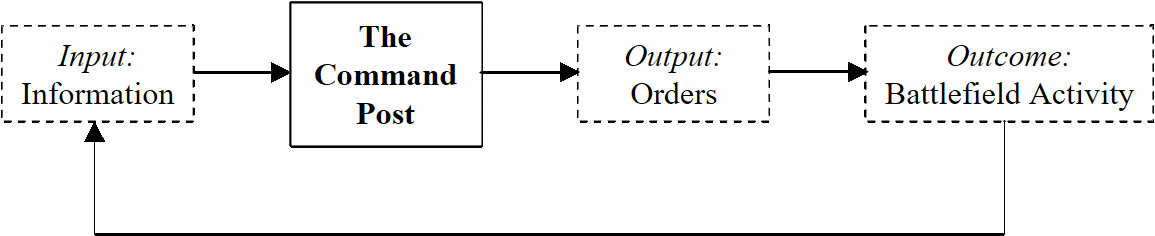
The ‘currency’ of this process is information: the incoming report has information content, measurable in Bits. The knowledge held by the decision-maker can be described in similar terms, with some simplification. The decision can be, and is, contained in words or graphics, and is conveyed as orders (with similar information content). However, information content alone does not describe C2. There is also the infrastructure, which must be taken to include the CIS but also the staff, the vehicles, and the wider supporting services (protecting, feeding and accommodating the staff; maintaining the CIS and vehicles, etc).
Yet even this summation of tangible assets does not adequately describe a CP. There are also largely intangible aspects that seem to have an impact on the effectiveness of the CP. These include the experience, and the experiential knowledge, of commanders and staff. They include the trust and teamwork demonstrated by CP personnel, and between them and other personnel elsewhere. Most if not all of these intangibles are human aspects.
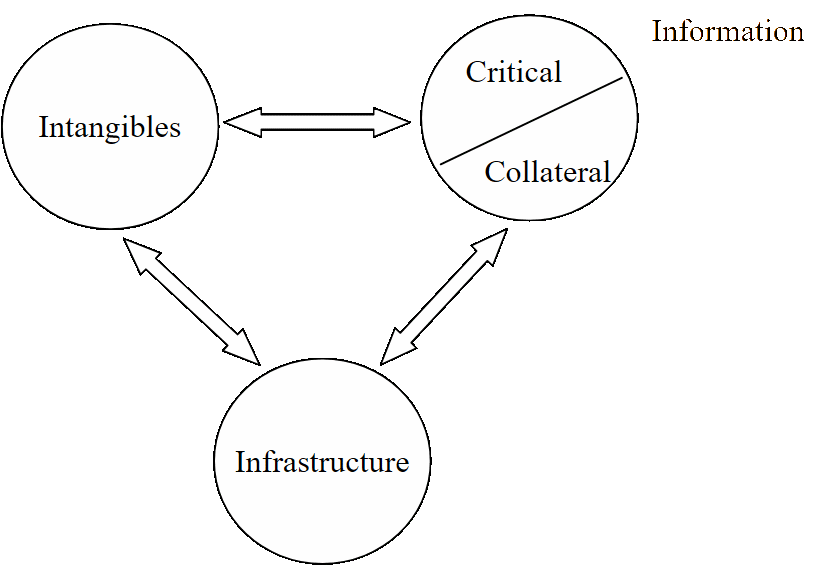
We therefore have three elements of a model: the information used, the infrastructure, and the intangibles. As suggested previously, some information will be strictly necessary (critical) for decision making; the remainder will be at best collateral. In reality, there is evidence that the latter is normally greatly in excess of the former.
The collateral information, coupled with the infrastructure, constitute the overheads to the system. The critical information and intangibles are the directly beneficial component of the HQ. Considerations of economy and efficiency suggest that overheads should be reduced where possible, but we should not be needlessly detrimental: the CP needs some staff and some CIS; decision-makers need some collateral information. The critical question is ‘how much’.
Some process is tangible: it can be captured and taught. Such process may be considered as procedural knowledge: encoded wisdom, known as ‘doctrine’ or ‘standard operating procedures’. However, each individual assimilates learning differently. Depending on human factors such as experience, he will modify formalised procedure. The extent to which he does that in practice depends on military culture: do staff officers actually ‘do things by the book’? Both modified (personalised) procedures and culture are in practice intangible.
The three elements (information, infrastructure and intangibles) have interrelationships. At a high level they can be described as follows.
- High levels of experience, trust, skill and teamwork (intangibles) appear to reduce the amount of information required and used by decision-makers. This can be seen as reducing the requirement for collateral information. However some intangibles (such as detrimental aspects of culture) may increase the requirement for collateral information.
- Reducing the total requirement for information reduces the need for CIS to handle it, staff to process it, vehicles to house and move the staff - in other words, reduces the infrastructure. Reducing the staff appears to have a secondary effect. The internal complexity of a CP appears to rise with the square of the numbers involved; hence so does the managerial effort and infrastructure required to co-ordinate it [12].
- Similarly, a smaller staff may be expected to be more socially cohesive, to learn faster, and to develop collective performance faster. That is, to lead to greater intangible benefits.
These relationships are suggested in the influence diagram at Figure 3.
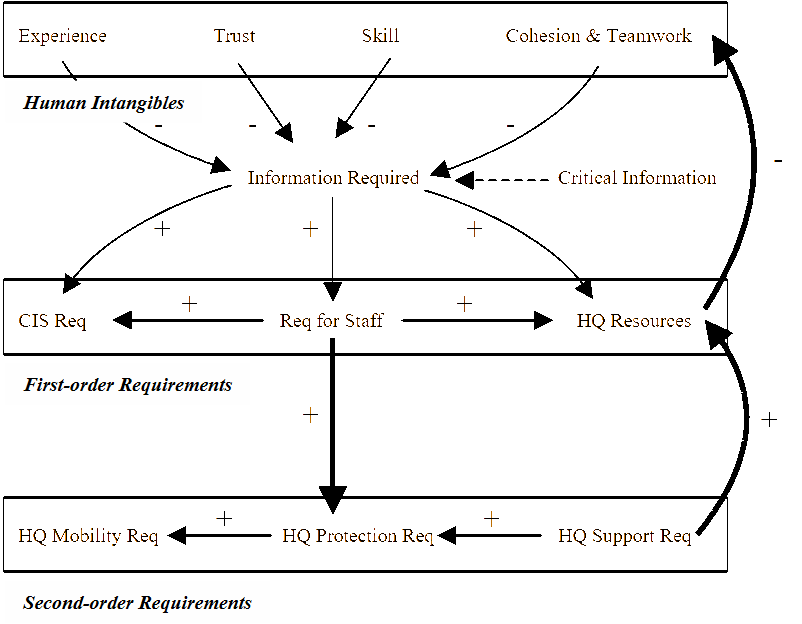
This does not pretend to be a valid, functional model of a CP; merely a useful description to enable a common understanding of the issues under consideration, and the relationships between them. However, and critically, it indicates the benefit of addressing human (and largely intangible) aspects of C2.
Consequences
Since the model contains a feedback loop, we can envisage a strategy to enhance effectiveness by harnessing intangibles. In essence, we should design C3 systems to pass knowledge not information. (In practice, using voice radio, we already do). The difference is germane.
If we pass information, we pass all of the critical and the collateral information to the end user: the decision-maker. Yet we observe immediately that this does not happen: it is summarised by intermediate staff, and presented verbally and graphically in briefings. The nub of the issue is where and when this summation takes place. Not least due to the limited transmission capacity of voice radio, most of the information reaching a CP from subordinates is already summarised. It is in reality knowledge to the sender: he ‘knew’ the information when he reported. However, significant quantities of the knowledge currently passed to superior HQs has no decision relevance. The key is to pass knowledge, not information, and as far as possible only pass knowledge of guaranteed decision relevance. Achieving this requires experience and skill: intangibles.
This strategy should be extended as far as possible. For example, one could pass raw data from an imaging sensor to the CP. This would normally require high-bandwidth communications media that add to the infrastructure overhead. It is also normally a line-of-sight system, which unduly constrains the location of the CP. Alternatively, one could deploy a qualified analyst near the sensor, and allow him to interpret the data and summarise it, typically in the same verbal or graphical form as given to decision makers. Such products have far less information content and require far less bandwidth; usually they can be accommodated over in-service CIS.
This strategy, however, has an intangible cost. If one reduces the information content (by stripping out much of the collateral), one must trust the sender. In this case, it is probably a non-commissioned officer many kilometres from the CP. To build up appropriate levels of trust requires mutual experience, shared military culture, and several other human interpersonal elements. It is difficult, but by no means impossible, across a formation as a whole, particularly if it is ad-hoc and multinational. However, concrete measures could be put in place, and the potential benefits would be considerable.
To a first approximation, the cost of bandwidth provision rises with the cube of the information to be passed, and every single military post required to man CIS equipment costs £1m in the ten-year long-term costings. Thus the capital and running cost benefits of materially reducing information flows to, and within, CPs are highly significant. After due consideration of human aspects, one could readily identify low-cost measures which enhance the benefits of intangibles, and accordingly drive down demands for bandwidth provision. Perhaps the greatest benefit comes from improved doctrine: effectively, it costs nothing. If it results in materially reduced demand for bandwidth, the cost/benefit payoff would be vast.
Operational effectiveness: characterising and quantifying the processes
The manpower within the formation-level C3 elements in an armoured division are largely contained in the divisional signal battalion and brigade signal companies. Their combined manpower roughly equates to two combat units. Would the division be more effective with, say, half as much manpower assigned to C3 but with an extra combat unit? At present we have no way of establishing the answer to this question with absolute certainty. However, we can use the methods and tools of operational analysis, including modelling, simulation and synthetic environments, to inform our assessment. Granted, there are difficulties in quantifying the benefit of C3 provision (in terms of information, infrastructure or intangibles) and characterising the human contribution to C3, hence assessing its benefit in comparison with other hardware components. That said, there are methodologies that allow us to inform our answers to these questions with a degree of insight.
Since the eventual purpose of C2 is to bring about military success, characterisation and quantification should have the aim of understanding how C2 contributes to military outcome. There are great difficulties associated with the modelling of combat, and we are certainly some way from being able to predict the outcome of conflicts through the use of models and simulations. What models and simulations can do, when used prudently, is give us a greater degree of confidence in the decisions that we take. This is the philosophical basis for operational analysis. We make three suggestions as to how qualitative and quantitative modelling may inform C2 process design.
Firstly, much work has been completed on the modelling of throughput of information. Unfortunately, much of this work takes information as the key resource of interest. As such the model tends to address questions of HQ capacity to deal with information. The central thesis of this paper is that quality of information (in essence knowledge) is what is important, not quantity. It is much harder to incorporate notions such as quality in quantitative models. Soft OA techniques, such as influence diagramming, however, at least allow the representation of the human intangibles and notions such as quality to be incorporated into models. System dynamics then allows these models to be developed into running simulation models that can link system structure to system behaviour. As with all modelling, the modeller must satisfy himself that the model is a valid representation of reality, but it may be that insights gained from such an exercise would raise awareness of the issues involved, allowing better decisions to be made relative to how to structure HQs.
Secondly, synthetic environments may allow the investigation of the issues involved in a novel way. A synthetic environment is a representation of the world that permits interaction between simulation users. It is generally seen as a combination of models, people and simulators, all populating some common space, and designed to address some specific question. Synthetic environments are prominent in the acquisition and development of new equipment, where it is hoped they will allow not only the physical development of weapon systems to be achieved more quickly, at less cost and with greater confidence, but also doctrinal integration into defence capability prior to entry into service. Thus we can make all of the mistakes—including engineering and utilisation issues—in a virtual world. The strength of SEs is that they allow concepts to be tested in novel ways. Thus it is quite conceivable that an experiment could be designed that would investigate the effect of smaller, faster HQs on the C2 process and, ultimately, on the likelihood of success in combat.
Thirdly, systems engineering is the application of engineering and management principles to complex systems. Hitchins makes much of applying a systems engineering perspective to C2 [14]. We can use the ideas of systems engineering to inform the organisational design process that allows the development of efficient and effective HQs. By viewing the HQ as a system, and considering issues such as connectivity, diversity and redundancy within it, we can bring to bear the tools and methods of systems engineering to the HQ. In essence, by employing a systems engineering perspective we may be able to throw light on the best design of the HQ to meet the requirement. This is likely to be the subject of research sponsored by the Systems Engineering Group within the Engineering Systems department at RMCS over the next year.
Summary and conclusions
Summary
To reiterate, the impending advent of digitization has fuelled interest in all components of military C2. For example, there is growing awareness of the importance of human issues relative to C2. A number of human behavioural aspects (such as individual and team decision processes, shared situational awareness, management of information) significantly impact upon the effectiveness of C2 but are, at present, poorly understood. The present paper has attempted to address these aspects in some detail and provide a model of a CP to enable a common understanding of the issues under consideration and the relationships between them.
Conclusions
Human aspects play a major, and probably critical, role in the effectiveness of C2 and probably of units and formations overall.
British military doctrine does not adequately characterize C2. Its predominant model (the OODA Loop) is simplistic as a representation of formation-level C2.
The assumption that the delivery of ever-increasing amounts of information to a CP will assist decision making and hence C2 is flawed. The real issue is the possession of sufficient, or the appropriate, information relative to the adversary with which to generate operational advantage.
Many of the solutions to the challenges facing effective team decision making in contemporary conflict settings have little, if anything, to do with technology. Indeed, technology can actually exacerbate such challenges. Consequently, the starting point for the enhancement of command effectiveness must always focus on understanding the human in command, over and above the technology itself.
It is evident that the provision of IT can of itself degrade C2. An understanding of a number of human aspects is critical to ensuring that the net impact of IT on C2 is positive rather than negative.
Generating appropriate SA across the commander and staff within a CP must consider abstract interpretations, expectations and intentions. The effectiveness of shared SA depends on team structure and organisation, and individual and collective training, as well as the supporting technology.
The management of information required to generate shared SA, both within a CP and elsewhere, has human as well as technical and procedural aspects. Trust, both of the source by the user and of the user by the (sometimes highly classified) source, is one such human issue.
Many aspects of CP effectiveness reflect cultural issues: values, expectations and beliefs. Understanding how such cultural issues arise, are transmitted and develop is just as important a process as delivering technical solutions to overt problems. Indeed it may be more important, because the issue of what constitutes an important problem itself has cultural aspects.
The demands of high-intensity war affects the way CPs are organised, deploy, and move. These factors impact upon the physical environment as perceived by the staff, and thus the effectiveness of the CP as a whole.
One view on a CP is a combination of the information used, the intangible human aspects, and the infrastructure that supports both. Of those, the intangibles are the least well understood. The relationships between those three elements are similarly poorly understood.
There is a strong suggestion that, in the immediate future, the greatest potential developments in C2 will come from developing an understanding:
- of how information contributes to knowledge, and hence better decision making; and
- how decision making contributes to operational effectiveness.
There are at present no explicit methodologies to allow us to neither ascribe a value to information nor assess the effectiveness of a CP. However, soft systems methodologies, synthetic environments and systems engineering concepts allow us some insight into these issues, and provide avenues for further research.
Research into human aspects merits considerable further investment, perhaps even to the detriment of the development of technology.
Addendum: tactical command posts
CPs for land tactical units typically comprise a series of armoured vehicles coupled together to provide protected working space for the staff. A representative configuration for a CP is shown in Figure A1. The enclosed space between the vehicles is typically a large tent. The vehicles provide shelter, communications, power and lighting, and are used to move the CP when required.
Figure A1. A representative configuration for a CP.
During the Cold War, staff worked inside their armoured vehicles. The tent was largely used to allow secure and lit physical access between vehicles. Since the end of the Cold War, the open space has increasingly been used for common functions such as briefings and planning. Large, flat map displays (‘bird tables’) are now erected to allow all members of the staff access to a common map representation of the situation. Under threat of enemy bombardment, air or NBC attack the staff would be forced to operate from inside their vehicles, with all doors closed and possibly wearing NBC protection.
A formation HQ typically contains four CPs. The Main CP is the focus of operational planning, intelligence, operations and combat support functions. The Rear CP is the focus for personnel and logistic functions. There is usually an alternative (‘step-up’) CP to enable continuity of C2 whilst the formation is moving, and to provide some redundancy against battle damage to the Main CP. If the formation commander moves away from the Main CP, he will normally take two or three key advisors with him in a further small group of armoured vehicles. This is known as the Tactical or Forward CP.
References
[1] M. Van Creveld, Command in War, Harvard University Press, Cambridge, MA, 1985.
[2] M. Van Creveld, Command in War, Harvard University Press, Cambridge, MA, p. 231, 1985.
[3] Army Doctrine Publication No 2, Command, Army Code 71564, Figure 1.1, pp. 1-5.
[4] J Scmitt and G Klein, “A Recognitional Planning Model”, Proceedings of the C2 Research and Technology Symposium, US Naval War College, pp. 510-521, June 1999.
[5] W. Lind, The Maneuver Warfare Handbook, Westview, London, p. 5, 1985.
[6] B. Wilson, Systems: Concepts, Methodologies and Applications, John Wiley, Chichester, 1990.
[7] K. MacCrimmon, “Managerial Decision Making”, in J. McGuire (Eds), Contemporary Management: Issues and Viewpoints, Englewood Cliffs, NJ, Prentice Hall, 1973.
[8] H. Simon, Administrative Behaviour: a Study of Decision-making Processes in Administrative Organisation, Macmillan, New York, 1976.
[9] J. Orasanu and T. Connolly, “The Reinvention of Decision making”, in G. Klein, R. Orasanu, R. Calderwood, and C. Zsambok, (eds), Decision Making in Action: Models and Methods, Ablex: Norwood, NJ, 1993.
[10] R. Pascual and S. Henderson, “Evidence of Naturalistic Decision Making in Command and Control”, in C. Zsambok, and G. Klein, Naturalistic Decision Making, Lawrence Erlbaum Associates, 1997.
[11] D. Aldrich, Mastering the Digital Market Place, Wiley, 1999.
[12] J. Storr, “Alternative Concepts for Battlefield C2 Organisations’, Proceedings of the C2 Research and Technology Symposium, US Naval War College, pp. 1045-66, June 1999.
[13] R. Coyle, “A Model for Assessing the Work Processing Capabilities of Military Command and Control Systems”, Euro Journal of Operational Research, Vol. 28, pp. 27-43, 1987.
[14] D. Hitchins, Command and Control, [online, page last updated Feb 2000], available at URL: http://www.hitchins.co.uk/ [accessed 17 Oct 2000].
© British Crown copyright 2001 Published with the permission of the Defence Evaluation and Research Agency on behalf of the Controller of HMSO.