
Volume 4, Number 1, March 2001
An Investigation of Hand-Held Pen-Based Computing for Combat Soldiers
Abstract
This paper describes the design and evaluation of a mobile computer system that has the potential to support the Australian Army’s dismounted infantry command and control functions. Whilst commercial systems have made significant improvements in hardware, it has been observed that current software has not been designed to cater specifically to Australian Army needs. The work described in this paper represents the first step in identifying user and system requirements for this application. A concept demonstrator of the hand-held computer (based on the Apple Newton 2000) was prepared for use during a field exercise in February 1998. The objectives of the study were to identify requirements of the hand-held computer as well as to investigate the methodology for evaluation of such systems. User feedback from the 1998 study is discussed as well as the future directions for this work. This includes the transfer of knowledge to a Windows CE based computer and the planned use of this system in the investigation of human performance and computer interaction issues.
Introduction
Australia’s program in soldier modernisation, Project WUNDURRA, was initiated in late 1993. At that time an enabling program of research was instigated by the Land Operations Division of the Defence Science and Technology Organisation (DSTO) in order to provide the necessary scientific support. Project WUNDURRA relates to the evolutionary process of soldier modernisation through the incorporation of appropriate technologies and the adoption of improved procedures. A major theme to this research is the principle of the Soldier Combat System (SCS) that is a part of larger systems ranging from the section to the company level.
In October 1995, Australia initiated a series of evaluation studies with the primary aim of establishing a robust methodology for evaluation of SCS enhancements. The methodology, referred to as the ‘battlelab’ methodology, involves a combination of modelling and field studies [1]. The studies compared baseline and enhanced sections engaged in a variety of operational situations. An infantry section is comprised of nine soldiers and is commanded by a non-commissioned officer (NCO), usually a corporal. The infantry section has been identified as the smallest discrete unit for analysis. During the studies the baseline sections were equipped with current equipment whilst enhanced sections were provided with a variety of technological enhancements including thermal weapon sights, hand-held computers and intra-section communications.
During the field component of early studies the potential of hand-held computers to enhance the capability of an infantry section was identified [2,3]. This impact would be realised not only through enhancing the direct actions of the section, but also through improving the degree of cooperation between the section and adjacent units. However, potential improvements were not realised during these trials, due to the immature nature of the system employed. This was evident in several key features. First, the system was not intuitive, given the soldiers’ previous experience and training. Second, the system could not operate at night without excessive illumination, this being a threat to section security. Third, soldiers using the system considered the weight and power requirements excessive. Unlike headquarters at battalion and above that have access to relatively controlled environments in which to operate (command post or vehicle), section and platoon commanders are required to carry any command-support equipment used. This equipment would be required to operate in all weather conditions from hot/humid to cold/wet, during both day and night. A fourth issue was the lack of suitable mechanisms for recording user interactions with the system for evaluation purposes.
The current schedule for Project WUNDURRA has a planned acquisition phase post-2005. It has been assumed that within this time frame commercial portable computing systems will solve many of the hardware-related problems identified in early studies. Hence the focus of the current research is on identifying the functional requirements and user interfaces for this system. The vehicle for this research is a concept demonstrator based on commercial hand-held computing devices and other components.
This paper outlines the design and implementation of a concept demonstrator of a hand-held computer for combat soldiers. It then presents the results of an observational study carried out to evaluate the effectiveness of this system. The results are then discussed in terms of future enhancements.
Enhancing SCS performance
Initial work on Project WUNDURRA provided a framework for analysis of the system, based on the observation of a series of eleven generic infantry section and platoon activities and eight core skills [4]. During field studies and other analytical work this framework has proved useful in analysing the impact of new technologies and procedures on small unit capabilities. An initial hypothesis that new technologies have a direct impact on the application of core skills has been confirmed during these studies. An initial analysis of the benefits of any new technology can be investigated by considering its impact on the core skills. The potential impact of a hand-held computer on infantry core skills and associated functionality are outlined in Table 1.
As described previously the infantry section is the smallest tactical unit on the battlefield. An infantry platoon comprises three sections plus a headquarters; a company comprises three platoons; and a battalion has a strength of between three and four companies. While this structure in which the section operates may change, and in fact the composition of a section itself may change over time, the basic tasks of an infantry section are assumed to be relatively constant. Currently, a foot-mounted infantry battalion has access to the following internal means of communication:
- combat net radio (VHF and HF);
- land line (unit local telephone system);
- text (written instructions passed by courier such as a dispatch rider); and
- verbal orders (face-to-face contact such as briefings and orders groups).
With regard to the passage of information, the method used will depend on the timeliness, relevance and accuracy of the information. Currently, several studies are under way to investigate the impact of battlefield digitisation at the higher command levels (battalion and above). The WUNDURRA study fills an important gap in the knowledge at the lower level by examining the impact of digitisation below sub-unit (company). At this level information is passed by either combat net radio (voice) or direct verbal communication. Information originating from a section would be interpreted and retransmitted several times before reaching a battalion intelligence officer.
Digitisation [5] in this case refers to the exploitation of digital technologies in the areas of sensors, data transfer, manipulation and visualisation to enhance the situational awareness of commanders and hence assist in the planning and execution of military tasks.
The benefits of battlefield digitisation identified in Table 1 can all potentially be provided through the functionality of a hand-held computer. It can also be seen that such a system has the potential to impact on all eight of the core skills. This assumes that the computer has access to GPS (Global Positioning System), or other navigational aids, and wireless communications with other units.
From the information in Table 1 we identified some critical functionality required by the hand-held computer employed in support of digitisation at the sub-unit level and below. In summary, these are:
- Pre-formatted text-based messages. The majority of messages, as described by the Standard Operating Procedures (SOPs), follow a pre-defined format and as such can be produced in a template and used with information currently available from the GPS (Figure 1).
- Digital Map with Integrated GPS and route planning tools. As soldiers would have a GPS unit as part of their communications suite, critical information about where the soldier is positioned is made available on a digital map of the area, thus providing accurate information all the time without the soldier relying on using a magnetic compass and paper map. An example of this can be seen in Figure 2.
- Access to database information (including Geographical Information System). The ability for a soldier to plan and execute navigation tasks requires a vast amount of information. This information, which would reside on a central server, would be made available to the soldiers upon request. This would also include overlay information about terrain characteristics and other relevant information that would be stored on databases about the underlying area.
- Real-time access to information from battlefield sensors. Real-time access to battlefield sensors such as Unattended Ground Sensor (UGS) and Unmanned Aerial Vehicle (UAV) is paramount in the situational awareness of the soldier. The availability of data from sources outside the soldiers’ area of influence also plays an important part in their situational awareness.
- Orders, planning and execution tools. Manoeuvre warfare is essentially based on the theory that whichever side in a conflict is able to go through the ‘OODA Loop’ the fastest will gain a significant advantage over the other. ‘OODA’ stands for ‘Observe-Orient-Decide-Act’. It is further proposed that only a decentralised military force can have a fast OODA cycle [6]. This means that units at all levels must be informed and able to act appropriately to situations as they arise.
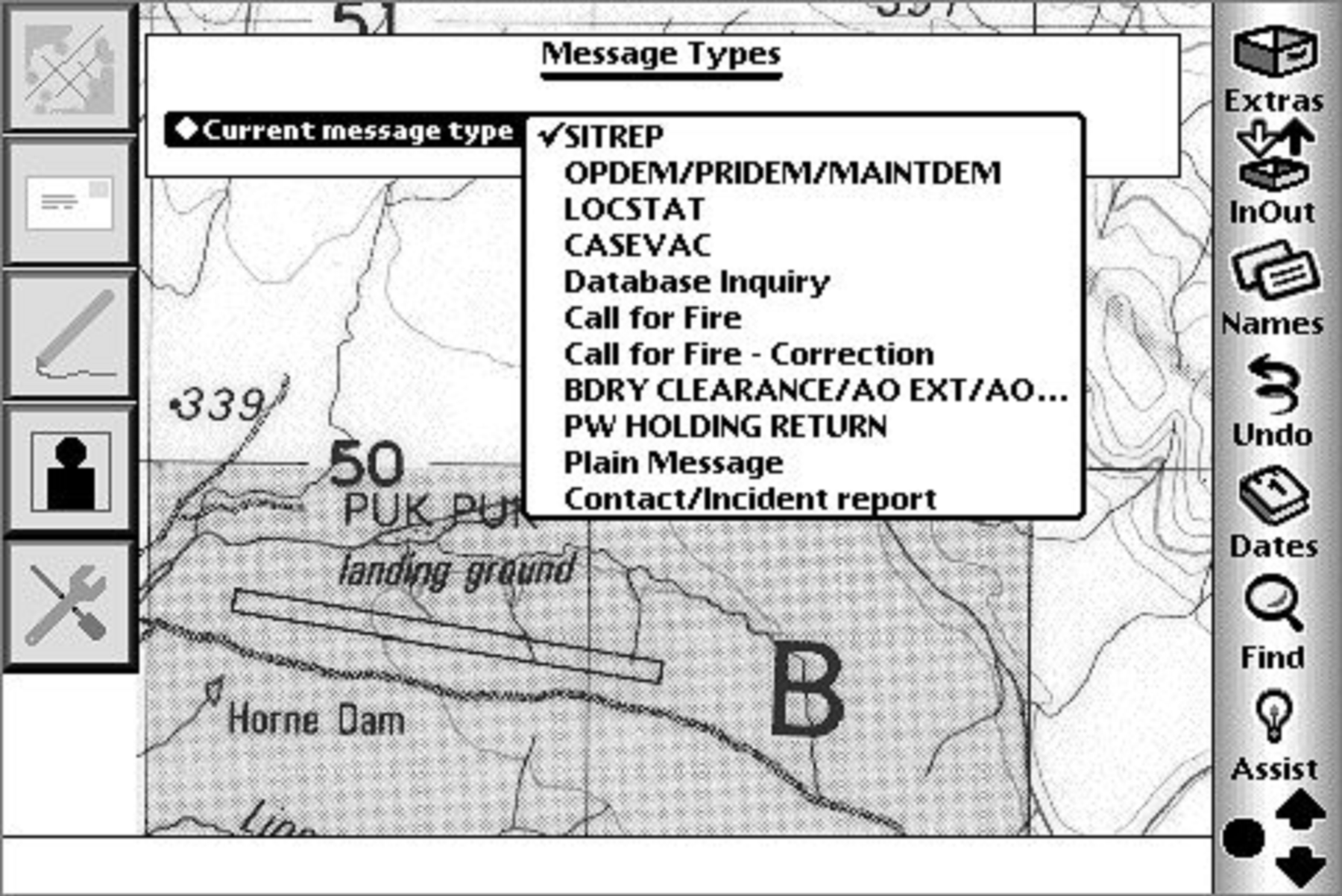
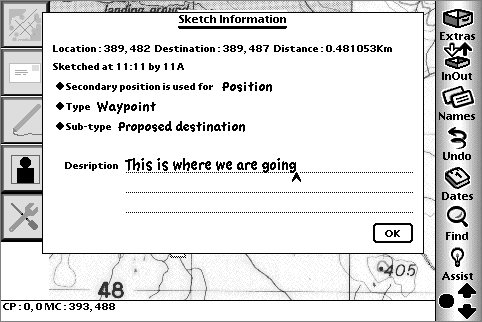
This initial list of desired functions has been used as the basis for the design of a concept demonstrator for the combat soldier’s hand-held computer. In the recent studies associated with Project WUNDURRA not all of these functions have been enabled; however, sufficient functionality was established to elicit user feedback on the merits or deficiencies of such a system.
Design considerations and implementation
The basic design philosophy has been an iterative design-test-design process using feedback from user trials to guide requirements after an initial design was implemented based on subject matter expert input and documentation on standard operating procedures. Due to the need to maintain a redundant capability and obtain initial user acceptance it was important for the initial system to replicate current procedures. In this way training time could also be significantly reduced. If the technology is accepted into service, re-engineering of processes to make best use of the system is possible. Whilst re-engineering may reduce the redundant capability it is also possible that a tactical unit that does not have a ‘presence’ on the digital battlefield (that is, a real-time representation on the commander’s situational awareness picture) will be restricted from performing any meaningful tasks.
The system described in this report was constructed for initial investigations during the Soldier Combat System Enhancement Study (SCSES) conducted in February 1998 in Townsville, Queensland. The system constructed for this study was based around the Apple Newton Message Pad 2100. As a concept demonstrator the Newton provided the desired functionality in relation to size and weight, with a screen size and other features (that is, pen-based computing and PCMCIA slots) to enable investigation of the desired functionality. The Newton provided a cost-effective solution that enabled the required degree of control over software development. The equipment consisted of the following components:
- Apple Newton Message Pad 2100,
- Sony GPS unit,
- Maxon data radio and modem, and
- 12 V dry-cell battery.
Message templates
During Army field exercises the use of a pen and paper system for preparing messages was observed. At the heart of this process is a folder containing information on message templates referred to as a ‘vuee tuee’. Eleven message templates were available in the initial demonstrator including:
- Situation Reports (SITREP);
- Casualty Evacuation (CASEVAC);
- Location Status (LOCSTAT); and
- Contact Report.
The replication of these templates into the Newton created a ‘digital vuee tuee’ capability. This functionality provided an intuitive system that replicated current capabilities whilst:
- increasing efficiency of message transfer;
- decreasing error rates associated with the compilation of text messages (especially where codes are concerned);
- being acceptable to the customer because of its familiarity; and
- mimicking the current manual mechanism, thus maintaining redundant capability and reducing training time.
Navigation
Section commanders currently navigate by using map and compass. While some hand-held GPS units are used, these are not yet standard issue. The elements of the navigation skill are:
- identifying position (relating map to ground);
- determining distance (on a map as well as on the ground);
- determining direction (grid and magnetic bearings); and
- interpreting terrain features (relating map to ground).
Access to the GPS and digital maps enables the display of current locations of friendly units and other intelligence information on the map. A stand-alone GPS will enhance navigation capability to some degree, however, the true benefits of digitisation are realised only when this information is used to contribute to the commander’s situational awareness by providing real-time movement tracking to assist in planning, target identification and engagement.
The digital map employed on the Newton demonstrator (4-colour grey scale 953x811 pixels, scanned at 100dpi resolution) resulted in the loss of some map features such as contour lines. An example of one of the maps used during the study is shown in Figure 2. The primary objective of the mapping system on the demonstrator was the display of icons representing location of friendly units and special features (such as unattended ground sensors).
An observational study
The primary objective of the 1998 SCSES was the refinement of the methodology for the evaluation of enhancements to the SCS [7]. Hence, while activities involving the hand-held computer were limited by the lack of a reliable wireless link, they did provide an opportunity to observe the technology being used by soldiers and to assess the way in which the equipment should be evaluated in future. The demonstrator was used in three experimental situations during the Townsville study. These are listed in Table 2, along with the functionality used.
In addition, informal interviews were conducted with soldiers after training on the demonstrator to assess their impressions of the utility of the technology. In order to remove the issue of the weight and bulk of the equipment it was carried by the Subject Matter Expert accompanying the section until required. In this way feedback could be obtained from the soldiers on the application of the technology without comments associated with an immature system. The ‘fragile’ nature of the equipment also necessitated its portage by someone outside of the section so that this did not interfere with other aspects of the trial.
| Experiment | Functionality | Data Collection |
|---|---|---|
| Vehicle Check Point and Observation Post | Access to database of suspicious vehicles and persons. | Interviews |
| Fighting Patrol | Use of pre-formatted text messages. | Time to compile and transmit messages recorded |
| Building Clearance | Access to the Floor plans of the buildings used during the planning phase. | Interviews |
Training on the demonstrator was conducted with all section commanders (corporals) and section 2ICs (experienced privates or lance corporals) involved in the study as well as the platoon commander. This was a total of seven subjects. Each subject was provided with a unit for the training session which involved approximately one hour of formal instruction followed by a further 30 minutes of informal question and answer. One of the most satisfying aspects of the demonstrator was the ability of the soldiers to master the full functionality of the system in this limited time. This was attributed to the fact that the design was based on their current unit SOPs. Labelling the system the ‘Electronic Vuee Tuee’ (EVT) may also have been significant as it provided a verbal metaphor [8] linking the new technology to a tool already familiar to the soldiers.
The experiments detailed in Table 2 were conducted only once by each of the baseline and enhanced sections. During each experiment however, several opportunities arose in which the hand-held computer was used. A summary of the results of these experiments as well as the after action reviews and post-training interviews is given in Table 3. A separate report focussed on the impact of the EVT on command and control in an urban environment has also been produced [9].
In general, the feedback on the demonstrator was very positive. The majority of discussion during interviews focussed on how the message template functions could be enhanced. This included:
- placing some templates critical to a task on the ‘desktop’ where they required only a single pen touch to activate;
- automatic filling of some data fields based on available digital information;
- operator should be informed of incoming messages (could require link to radio ear-piece);
- ‘contact-wait-out’ panic button possibly provided by hardware solution rather than the touch screen; and
- Uupgrading of CASEVAC template to include a more intuitive user interface as well as incorporating medical history of soldiers in any transmitted message.
In all, fifty-three suggestions were made for improvements or extensions to the functionality of the demonstrator. This feedback has been invaluable in the development of a user requirement for this capability.
| Functionality | Comment |
|---|---|
| Text Messaging | Standard reports from the baseline section required 10–15 minutes to compile and transmit. The same messages required less than two minutes each for the enhanced section. |
| Data base access | During the vehicle check point the computer was used to access information on recent suspect vehicles and persons. No conclusive data was obtained on the performance of this system compared to pen and paper based information. |
| Access to floor plans | The availability of floor plans was identified as a useful tool during the study. However, the lack of familiarity with MOUT (Military Operations in Urban Terrain) operations distracted from identifying any quantitative benefits. |
Many of the issues identified were related to hardware. Whilst some of these issues, such as weight and power, are expected to be solved by commercial systems, examination of issues such as suitable viewing devices are considered worthy of examination using the demonstrator. During the trial, the thermal weapon sight was linked to a helmet-mounted display worn by the user. The helmet-mounted display could also be used as a means for viewing the computer system; however, the use of such displays by soldiers is still uncertain [10]. The use of a touch screen with a head-mounted display could also present problems requiring a reassessment of the input device. This will be discussed later. Amongst the hardware-related issues identified were:
- use of a higher resolution colour map,
- low visibility viewing options,
- establishment of links with other battlefield systems,
- weight and power requirements,
- larger screen size,
- smaller overall footprint for easy stowage in belt pouches, and
- separate screen and computer components to reduce the number of cables.
Discussion
The demonstrator and field trial provided two key outcomes with regard to the development of a hand-held computer for section and platoon use. First, they emphasised the need to conduct a controlled Command Post Exercise (CPX) experiment to investigate the functionality of the device under controlled conditions. Second, they provided an extensive list of software modifications and issues that need to be solved before such an activity should be undertaken. One of these issues is the need for the automatic recording of user interactions for evaluation purposes. In the meantime a more detailed task analysis needs to be conducted to investigate current practices.
The CPX experiment would focus on the activities of an entire company rather than the actions of a single section. It was identified during the trial that the majority of the benefits to be realised from such a system related to the integration of its functions within the company (that is, a common situational awareness picture and immediate access to intelligence information) [3]. Using a CPX environment in which to conduct the experiment would give researchers sufficient control to investigate these issues. A CPX would also enable the investigation of the required functionality of the demonstrator without relying on military hardware. A CPX is conducted only with the command element and during periods of inactivity time can be advanced to subsequent events. In this way the cost and time associated with the study can be minimised.
Phase 2A of Project WUNDURRA began this financial year and will run for approximately three years. The objective of this phase of the project is to identify the system requirements and architecture for the next generation of Australian Combat Soldiers. The demonstrator program outlined in this report is one of a number of programs that will contribute to this system definition. The research conducted to-date highlights the non-trivial nature of finding the correct solution to fulfil the requirements of soldiers at section and platoon level. It is likely that without the current program ‘off-the-shelf’ software and hardware will be unable to satisfy the specific user requirements.
The recent dropping of support for Newton products by Apple has necessitated a move to the more popular Windows CE platform as a basis for the demonstrator. The current work schedule is focussed on:
- transferring of acquired knowledge from the Newton to the CE platform (that is, message templates);
- updating the message template software based on user feedback from the trial;
- upgrading the wireless communications capabilities;
- investigating navigation planning and execution tools;
- investigating an ‘automated’ orders process for studying issues of intra-company communications;
- linking of hand-held computers to current war games for use as CPX drivers; and
- investigating the user interface.
Research has shown the touch screen to be the fastest but least accurate pointing device for computer input [11]. Feedback from the 1998 field study demonstrated that whilst it is not considered an ‘accurate’ pointing device, the design of the graphic user interface (GUI) resulted in few input errors. The use of touch screens versus other input and visual display devices will be considered in future studies especially in regard to the requirement for night operations.
Conclusions
The demonstrator prepared in response to the requirements of the 1998 SCSES has proved a valuable tool in identifying the user and system requirements for hand-held computing below the company level. The use of non-military commercial hardware has been shown to be a cost-effective mechanism for obtaining user feedback on potential future components of the Soldier Combat Systems.
As a result of these studies the next generation of demonstrator is now being investigated. This system, in addition to the improvements suggested from user feedback, will also be optimised for the conduct of a company-level CPX and will include in-built data collection tools.
Acknowledgements
The authors wish to acknowledge the contributions of; Matthew Smith, Philip Hawthorn, Chris Pilgrim and Dmitri Sivan, towards the research reported in this paper.
This article is based on a paper presented at the Australian Battlefield Digitisation Symposium, Salisbury Australia, July 2000.
References
[1] D. Bowley, N. Curtis and W. Hobbs, Science and Technology Framework for Soldier Combat System Evaluation Studies, DSTO-GD-0122, 1997.
[2] W. Hobbs and N. Curtis, An Analysis of Infantry Activities and Technologies Based on Results from the Infantry Technology Study, Singleton 1995, DSTO-TR-0637, 1998.
[3] Report on Defence Trial No 6/851 Project WUNDURRA Soldier Combat System Enhancement Study 8, AR-009-523, AT-001-542, 1997/199.
[4] N. Curtis and W. Hobbs, Characterisation of Infantry Section and Platoon Activities, DSTO-TR-0482, 1996.
[5] M. Baldonado, C. Chang, L. Gravano and A. Paepcke, “The Stanford Digital Library Metadata Architecture”, International Journal Digital Libraries, Vol. 1, pp. 108–121, 1997.
[6] H. Hayden, Warfighting: Manoeuver Warfare in the U.S. Marine Corps, Greenhill Books, London, 1995.
[7] W. Hobbs and G. Fowler, “Non-Intrusive Techniques for Monitoring Soldier Combat System Activities During Field Studies”, ITEA Test Instrumentation Workshop, Lancaster, California, 23-26 March 1998.
[8] J. Preece, Y. Rogers, H. Sharp, D. Benyon, S. Holland and T. Carey, Human-Computer Interaction, Addison-Wesley, Sydney, 1995.
[9] N. Kempt, J. Horsfall and M. Rees, An Assessment of the Hand-Held Data Terminal Concept Demonstrator Used During the Soldier Combat Systems Trial, DSTO-GD-0222 1999.
[10] “Tactical Displays for Soldiers: Human Factors Considerations”, National Research Council (US) Panel on Human Factors in the Design of Tactical Display Systems for the Individual Soldier, National Academy Press, Washington, 1997.
[11] B. Shneiderman, Designing the User Interface: Strategies for Effective Human-Computer Interaction, Addison-Wesley, Reading MA, 1987.