
Volume 4, Number 1, March 2001
Digitisation of the Battlespace (Land) and the Principles of War
Abstract
Digitisation is expected to deliver operational benefits. However, it may prove a three-edged sword. Commanders will be better informed, but so will their subordinates and their enemy. The commander’s greater comprehension of events is an opportunity. The task of leading an information-rich formation is a challenge. The possibility of information transparency is a threat. Some sophisticated and perhaps brave thinking will be required in order to seize the opportunity, meet the challenge and counter the threat. Technology will never substitute for good generalship and human qualities and moral issues will, if anything, be increasingly decisive in this environment. Commanders will need to be able to focus on critical issues in a wealth of data. Roles and responsibilities should change to emphasise leadership over management. Creativity will be rewarded and predictability heavily punished. Experience suggests that armies will be unable to make radical philosophical changes during peacetime. The next major war will teach some hard lessons. Being ready to learn fast is more important than having the answers in advance.
Opportunity, challenge and threat
When a Roman governor was sent off to administer some distant province, the emperor had little option but to choose a reliable person and hope for the best. There was no telephone. An exchange of letters might take days or weeks. The governor would have to deal with any issues largely on his own initiative [1]. Modern communications have changed this situation. The American government is as much in control on the other side of the continent as it is in Washington DC. Digitisation might be expected to have a similar kind of effect. In the past, the commander’s knowledge of his formation’s circumstances has been limited and lagging behind events. He has left the spatio-temporal detail to subordinates who are on the scene. In the future, the commander may be as well-informed about events in some distant part of the formation as within his own headquarters. In principle, digitisation will allow him to exercise more immediate and direct control.
Digitisation does not just mean better information for the commander. It should also create a shared information space across the formation. The commander’s subordinates may acquire as clear a picture of the overall situation as he has himself. This implies their potential empowerment. It is said that the fall of communism in 1989 was precipitated by the fax and photocopier, which made eastern Europeans better informed and harder for their governments to keep under control. It is also no coincidence that Luther and others began to challenge church authority shortly after the printing press had made bibles much more widely available. While army officers are presumably not going to start rebelling against their generals, the wider availability of information may alter the logic of the latter’s authority.
Digital technologies, in contrast to fighter aircraft and nuclear weapons, are relatively cheap. This may make it harder for the armies of leading nations to maintain an edge in the electronic battlespace. Some sophisticated equipments are available off the shelf. Mozambique’s renamo guerrillas used Psion organisers to plan their operations [2], while mobile phones have given Chechen rebels a command and control infrastructure which is superior to that of the Russian army [3]. In today’s media-drenched world, up-to-date, in-depth coverage of an evolving operation may also be available through civil channels. Supposedly, President Bush
preferred CNN to the CIA as his source of information during Desert Shield. CNN had a shorter reporting cycle. An aim for digitisation is to achieve information superiority, but operations may end up being conducted in a state of information transparency.
Digitisation is not about doing things in the traditional way only a little bit faster. It creates a new set of factors, new possibilities and new provocations. As the military adapts to the electronic battlespace, there are choices to be made. How they are resolved will determine the military’s effectiveness in this environment. These choices are constrained by the fact that the rest of the world is digitizing on all sides. They are also constrained by whatever may be considered to be the objectives of digitisation. These might be to reduce the costs of war, achieve greater frontages for a given formation size, or diminish predictability. These objectives will need to be clarified and kept in mind when commanders develop techniques, tactics and procedures for the new capabilities.
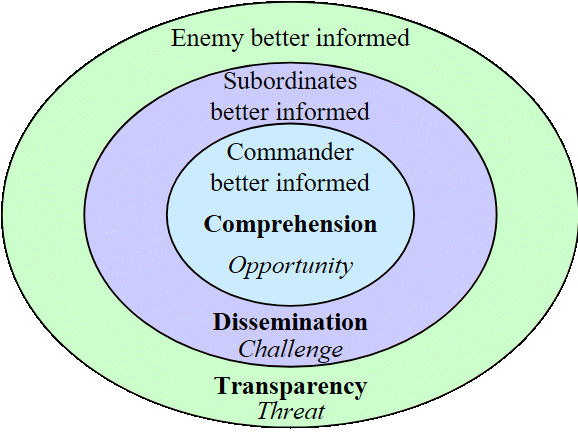
Figure 1 illustrates three themes emerge concerning the control of information in the digitized formation and the choices and constraints implied.
These are:
- Comprehension. Commanders will comprehend more fully the state of their resources and the courses of action available to them. In this way, digitisation will support and extend current thinking, provided its capabilities are fully exploited. This theme represents mostly opportunity.
- Dissemination. Differentials between the operational pictures available to commanders and their subordinates will be reduced. This may imply the need for new ways of thinking if the benefits of digitisation are to be fully realised. This theme represents mostly challenge.
- Transparency. Opposing forces will have a clearer picture of each other’s disposition and capacities. Digitisation could actually backfire and harm the ability to dominate unless new ways of thinking are worked out for such a situation. This theme represents mostly threat.
The British army has previously adapted successfully to the information conditions of the traditional battlespace. It has evolved a command and control hierarchy in which there is considerable devolution of responsibility to junior commanders. This may be understood as a response to limitations on information flow akin to, but not as serious as, those that affected Roman emperors. It may be contrasted with alternative strategies such as causing junior commanders to follow plans blindly even when they have been invalidated by events on the ground, or bringing operations to a paralysing halt in the case of unexpected contingencies until the anomalous information has been passed up the command chain and new orders have been generated and received. These alternative strategies have been associated with other modern armies whose operational record is less impressive.
The army’s command and control philosophy has implications for its structure and for the kind of people that it seeks to occupy the relevant roles. These have corresponding implications for fundamental issues of recruitment and training. Adjusting to the new constraints and choices of the electronic battlespace will have a significant influence on these fundamental issues. Some brave and creative thinking may be needed to meet the opportunities, challenges and threats of digitisation.
Military technology depends for its success on the human element. In the case of digitisation, this is especially true. By bringing people into greater communication with each other, it will accentuate the personal aspects of command. The fact that the commander has greater than ever visibility of his formation will only increase the importance of his ability to inspire and mould those under his command as they implement his concept of operations. The fact that he has better information may also mean that more is expected of him. In a state of information transparency, a premium will be placed on being the best strategist. This is not to mention the pressure that will come from knowing one’s troops share one’s information space and are monitoring one’s actions. In the digitized era, the ultimate battle-winning factor will continue to be the quality of those who lead.
Digitisation can be viewed as just the latest twist in humanity’s long saga of getting more information, more quickly to more people. The Roman cursus publicus or postal system used a system of relays to carry dispatches from one end of the empire to the other at the rate of a horse’s gallop. In recent centuries, communications have steadily accelerated with innovations ranging from sprung carriages and tarmac to the telegraph, telephone and radio. Digitisation continues this process. It is not as revolutionary as it is sometimes painted, and the fundamental, moral issues of warfare may be expected to remain dominant.
The principles of war
British military doctrine enunciates ten principles of war [4]. These have a long pedigree. They are human oriented and do not depend on any particular technology. They will remain valid in the digitized era when human qualities continue to be important. The question to be addressed now is how these principles fare, or should be interpreted, in light of the greater comprehension, dissemination and transparency of information in the electronic battlespace.
Presumably one is looking for a more sparing and more effective use of the commander’s assets. The First World War is associated with an attrition mentality and the making of huge sacrifices for tiny gains. In a comprehensive survey of allied strategy during the Second World War, John Ellis argues that the role of manoeuvre and mobility has been overemphasised, and this war of supposed blitzkrieg was also characterised by much slow, persistent battering with massive effusion of ammunition. Among other things, he points out that the aircrew fatality rate during the allied bomber offensive was double that of the Scots Guards battalions who spent the whole of 1914-18 on the western front. The same use of naked attrition has been evidenced in more recent conflicts [5].
The principles of war encapsulate a philosophy that steers commanders away from brute force. The frequent re-emergence of this strategy, for one reason or another, indicates why the principles need to be continually reasserted. They exist to combat a classic pathology of human decision-making in which there is an urge to discount discrepant information and rescue failing plans by a formula of ‘more of the same’.
Increasing commanders’ comprehension should help to some extent. If they have a better grasp of both their own and the enemy’s capabilities, they ought to be able to detect sooner when an engagement is degenerating into the attrition mode, but this still depends on their discernment and resolve. Information dissemination, coupled with devolution of responsibility for the conduct of the battle, represents possibly a more effective route. Resources might be used more sparingly when the decisions are in the hands of those who are taking the risks. The question here is whether troops will actually fight if they know the scale of the odds against them. The answer is probably yes, so long as they are suitably motivated. Committed troops have in the past knowingly taken great risks and even sacrificed themselves. Many posthumous medals have been won by soldiers throwing themselves on grenades to protect their friends.
The following paragraphs discuss a selection of the principles of war to bring out some of the implications of digitisation. These do not represent hard and fast conclusions but rather indicate some of the reasoning that could take place as the military responds to digitisation.
- Selection and Maintenance of the Aim. This is the master principle in British military doctrine.
- Comprehension supports this principle since a commander who has better communications will be more able to impose a single, consistent vision on his formation. Automation of information management may also lead to leaner, tauter headquarters where decision making is not so distributed and is less cumbersome. The commander along with his staff will function as a highly focused plan integrator, controlling execution in real time.
- Dissemination challenges the current understanding of this principle to the extent that decision making responsibility is pushed downwards. Aims expressed at a given level of command could become less detailed, allowing greater scope for innovative solutions further down. The aims of the formation would emerge from the informed reasoning of subordinate headquarters as much as being imposed upon them.
- Transparency means that the force’s ability to achieve its aims will be obvious to both the commander and his opponent. The potential for misjudgement will be reduced, and along with it the chance of following unrealistic aims to defeat. This might mean improved deterrence and the ability to prevail with few ‘hot’ engagements.
- Maintenance of morale. British military doctrine notes that there is a material element to morale. Hunger, tiredness and cold have straightforward physiological effects on motivation. Primarily, though, morale is a psychological issue. Humans can endure considerable privations when they are inspired to do so. The thing that detracts most from a group’s morale is the feeling of being unappreciated and of efforts going unrecognised.
- Comprehension supports this principle because commanders will not only be more aware of the material conditions of their troops but will also have greater visibility of their contribution to the battle and will appreciate the difficulties they have overcome.
- Dissemination may put subordinate formations in control of their own destiny and make them more aware of their position within the overall context. These are factors tending to increase morale.
- Transparency may be harmful to morale if it creates a feeling of exposure and helplessness in a force whose advantages relative to the enemy are less than overwhelming.
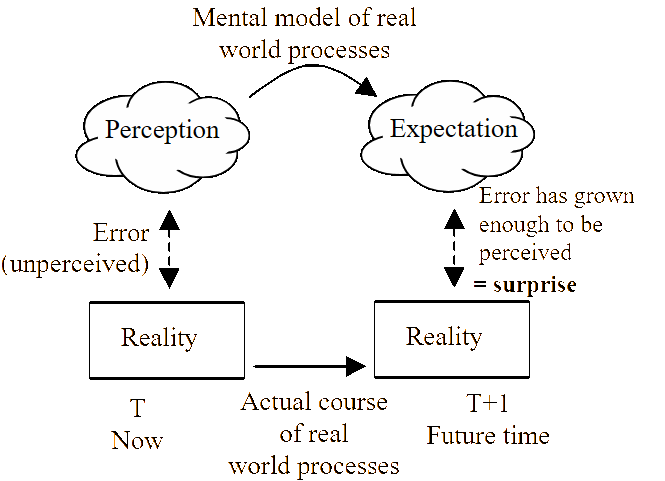
- Surprise. Surprise can be thought of as arising from the deviation between an individual’s expectations about a situation and the actuality, which in turn derives from an inadequate model of the real world. See Figure 2. The surprise occurs because (i) the original understanding of the situation includes unperceived inaccuracies and (ii) the mental model does not properly reflect real world processes.
- Comprehension is supposed to allow the commander to operate within the enemy’s decision cycle, thus preventing the enemy from perceiving the situation before it has changed and allowing the enemy insufficient time to generate well-reasoned expectations. This will support the achievement of surprise while reducing the chances of being surprised. Decision making needs to be not just faster but also good, so the commander’s ability to judge the enemy’s options and likely reactions will still be important.
- Dissemination could support an alternative interpretation of this principle. It may not be meaningful to talk of getting inside the decision loop of out of control militias typically encountered in asymmetric operations. The problems faced by US Rangers in Somalia stemmed in part from the Somali failure to operate in a conventional manner and their use of tactics forbidden to the Americans, such as un-uniformed gunmen being surrounded by crowds of women and children [6]. A possible response to such situations would be to be ‘out of control’ oneself, implying decentralisation and unpredictability. Surprise would arise because the opponent would be unable to form a clear picture of one’s decision-making behaviour.
- Transparency will reduce the potential for surprise by reducing the discrepancy between perception and reality. The force that is least susceptible to surprise will then be the one with the best understanding of how the world works and of how the enemy reasons. In the intelligence function, analysis will be increasingly emphasised over data collection.
- Concentration of force. Over the centuries, battle casualty rates have remained remarkably consistent, despite vast increases in weapon lethality. This is because the force has become increasingly dispersed. Dispersion may be expected to increase still further in future wars, with their possible NBC conditions. Concentration of force means concentration of firepower rather than of assets.
- Comprehension will imply good communications, accurate time/movement calculations and effective traffic control. This will allow the formation to assemble and disperse rapidly, delivering brief concentrations of force while avoiding excessive presentation to the enemy.
- Dissemination will make possible horizontal communication between formations, allowing local deconfliction of firepower without the involvement of a higher headquarters.
- Transparency will mean exposure of vulnerabilities. Concentration of force reflects the fact that it is impossible to be strong everywhere. The gaps will now become obvious to the enemy. A premium will be placed on mobility and the proficient use of ground.
- Offensive action. This means avoiding reactivity and taking the battle to the enemy.
- Comprehension supports the principle, with commanders having a better, faster appreciation of their options and the threat against them. However, the prospect of effective offensive action will depend on the commander’s ability to detect patterns in events and respond appropriately; the commander must avoid being a bottleneck.
- Dissemination may increase the ability of subordinate formations to exploit opportunities that arise briefly and locally. Large formations have considerable inertia, which limits their offensive capability. This inertia will be reduced if subordinate formations are given greater situational awareness and more responsibility for their own activity.
- Transparency will make the commander’s alternatives clear to the enemy. The optimal tactical move may become sub-optimal simply because it is expected. Information transparency changes the situation from that of poker, where each side has incomplete knowledge of the other’s options, to something more like chess, where the options are clear on both sides and the skill is in anticipation of an action’s consequences. Both are games requiring intelligence and psychological insight, where bluff is important, but there are differences in detail. The commander will need to think deeper into the operation, pre-positioning assets in such a way that a desired future configuration may be achieved without alerting the opponent.
Certain motifs arise in this discussion. Through the theme of comprehension, digitisation should make it easier for commanders to observe the principles of war along straightforward, existing lines. This will occur at least so long as commanders supply the relevant human skills. Digitisation will never substitute for good generalship. There will be a renewed importance on tactical reasoning, focus, decisiveness and the ability to identify mission critical issues within a wealth of data. One practical manifestation of this may be a reduction in headquarters bureaucracy and a smaller, closer-knit team around the commander.
The theme of dissemination is unlikely to produce any significant benefits without suitable changes in the structure and role of the formation. One response could be to prevent dissemination and cause subordinates to operate within the same information constraints as in the past, observing the same limited autonomy and responsibilities. More promising would be a preparedness to reconsider some fundamental assumptions about the army’s existing organisation and operating methods. The issue may be summarised as emphasising leadership over management. The commander’s role would be to provide the essential motivation without dictating solutions. The style of leadership would be characterised by insight, trust, and to some extent an ability to ‘thrive on chaos’.
The theme of transparency means that emerging technology could actually work to the army’s detriment unless new philosophies are developed for the exposed and unforgiving environment of the electronic battlespace. This environment is especially likely to reward subtlety, creativity and originality. It will be increasingly important to out-think rather than out-shoot one’s opponent. This may be thought good news for the British army, where the quality of the personnel is a particularly prominent asset.
Disasters waiting to happen
Digitisation suggests the need for the army to rethink itself, and at least give consideration to some fundamental changes in its structure and command and control processes. In practice, there is likely to be little response to the more far-reaching possibilities in the short to medium term. A ‘big bang’ approach would be inappropriate anyway since the army’s existing practices have been developed through much experience and been proven in many successful operations. Given its responsibilities, the army is rightly conservative and changes cautiously and incrementally. Realistically, the doctrinal response to digitisation will be evolutionary not revolutionary.
The army can also expect significant ongoing problems with its digital infrastructure over the next decade or two. There will be procurement delays, equipment will fail to live up to expectations, and muddle and confusion will exist. The digitisation process may even hamper military effectiveness. No special insight is needed to guess that this will be so. Delays and failure are common in large information technology projects, affecting industries from the ambulance service and passport office to air traffic control. The army’s digitisation trials brigade has already reported ergonomic deficiencies in the current generation of equipment and confirmed that the worst fears of digitisation’s effects, such as information overload, are fully justified. There will be little point in trying to optimise the army’s operational methods for digitisation so long as its infrastructure remains highly flawed.
In the near future, this may not matter very much. The army will find itself in asymmetric operations and operations other than war that do not test its warfighting skills (though they present real difficulties of their own). For a long time, the army prepared for World War 3. It got the Gulf War and Bosnia. Today, when it is inclined to prepare for more Gulf Wars and Bosnias, it may be destined to find itself fighting World War 3 after all. The present lull in great power war is not unique in history and there is no clear reason why it should continue indefinitely. Eventually, a macrowar is most likely to occur. Several commentators believe that the chances will rise significantly in the time frame after 2020 [7-9]. Experience suggests that some hard and rapid lessons will then be learned. It might be ideal if the lessons were learned beforehand, and the British army is certainly setting up a process to look at these issues [10], but experience suggests that the fundamental issues will not really be resolved until the necessity arises. Humans learn best from their mistakes. Arguably, it is only from their mistakes that they learn.
Conclusion
The electronic battlespace implies increased comprehension by the commander, dissemination of information to subordinate headquarters, and transparency of own forces and enemy dispositions. To operate successfully within this environment, there will continue to be a considerable, if not increased, emphasis on the commander’s personal qualities, including the capacities for inspiring troops and out-thinking the enemy. There is an implicit need for new structures and command/control processes, without which forces may actually find themselves disadvantaged, or at least not exploiting their digitized capabilities to the maximum. It would be desirable for the army to resolve all these issues in advance, but reality suggests it will not be fully adapted to the conditions of the electronic battlespace until it is genuinely tested in a war of national survival.
References
[1] A. Lintott, Imperium Romanum: Politics and Administration, Routledge, London, 1993.
[2] P. Moorcraft, African Nemesis: War and Revolution in South Africa 1945-2010, Brassey's, London, 1994.
[3] P. Baev, The Russian Army in a Time of Troubles, Sage Publications, London, 1996.
[4] D/CGS/50/8, Design for Military Operations – the British Military Doctrine.
[5] J. Ellis, Brute Force: Allied Strategy and Tactics in the Second World War, Andre Deutsch, London, 1990.
[6] D. Bolger, Savage peace: Americans at War in the 1990s, Presidio Press, Novato CA, 1995.
[7] A. Murray, Flashpoint: World War III, Pluto Press, London, 1997.
[8] V. Bornschier and C. Chase-Dunn, The Future of Global Conflict, Sage Publications, London, 1999.
[9] H. McRae, The World in 2020: Power, Culture and Prosperity: a Vision for the Future, Harper Collins, London, 1995.
[10] ADSG/P(98)3, The Command and Control Development Centre.