
Volume 4, Number 1, March 2001
Protection of Vehicles Against Landmines
Abstract
Research has been conducted into the survivability of occupants of military vehicles from landmine detonations. This research has focused on understanding the mechanism of how occupants of vehicles involved in landmine detonations are injured or killed by landmines. Experiments have been conducted using a range of military vehicles with and without additional armour protection. A range of instruments including anthropomorphic test devices (Crashdummies), pressure gauges, accelerometers and the newly developed frangible synthetic leg (FSL) were used in these experiments. This paper concludes that the effects of landmine detonations on occupants of vehicles can be reduced. However, for light vehicles such as Landrovers, little can be done to protect occupants from serious injury. Add-on armour stops lethal fragments penetrating light vehicle floors, but does not protect occupants from injurious blast overpressures and dangerously high translational shock loads. The paper also discusses the mechanisms that caused injuries to occupants and methods to reduce their effects.
Introduction
Research has been carried out into the protection of vehicles from landmines; the main thrust of the work has been to understand the following:
- Techniques to improve the survivability of occupants in army soft-skinned vehicles.
- The development of a capability to evaluate new vehicles with built-in blast resistance.
- An understanding of the physical loads to a vehicle from the detonation of a blast landmine.
- Identification of the kill and injury mechanisms to occupants of vehicles from landmine detonations.
Anti-vehicular (AV) landmines are a real danger to military operations as well as a great concern to Humanitarian de-miners. For example, the reported [1] percentages of USA military losses attributed to landmines in past conflicts are as follows:
- WWII 22%,
- Korea 55%,
- Vietnam 70%,
- Persian Gulf 59%, and
- Somalia 60%.
The Rhodesian war, which was mainly a guerrilla war, reported [2] from December 1972 to January 1980 two thousand four hundred and five incidents of vehicles detonating terrorist laid landmines. This resulted in the death of six hundred and thirty two people and the injury of four thousand four hundred and ten people. .
The Australian Defence Science and Technology Organisation (DSTO) has carried out a study on landmine effects on non-combat vehicles, which included the following:
- Landrover series III,
- Landrover 110,
- International 5 Tonne truck, and
- Mack 7 Tonne truck.
Techniques used to determine injury to occupants of vehicles
Blast landmines generate very high shock loads on vehicles, which impart dangerous translational forces and extreme accelerations to the occupants. The effects of these accelerations on human occupants are determined by using anthropomorphic test devices (ATD), usually called crashdummies. Other gauges to measure blast overpressure and acceleration are also used.
Crashdummies.
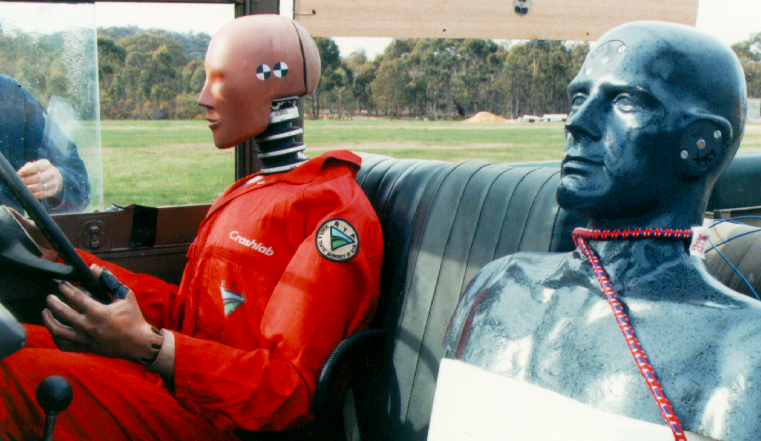
Hybrid 3 ATDs are state-of-the-art crash-test dummies used by the automotive vehicle industry for crash safety testing of new car designs. Although not designed to assess injuries from landmine effects, they are used by defence organisations for injury prediction for occupants of vehicles from landmines. The New South Wales Road Traffic Authority’s (RTA) Crashlab is Australia’s foremost authority in the application of these devices and has been engaged under contract by DSTO to participate in landmine research. The following injury mechanisms are recorded in landmine vehicle protection testing:
- Head: Injury Criteria (Head strikes)
- Resultant Acceleration
- Neck: Longitudinal Neck Shear
- Lateral Neck Shear
- Leg: Right Femur Compression
- Left Tibia Compression
- Right Tibia Compression
Hybrid 3 crashdummies have one major problem when used in landmine studies. They cannot respond appropriately to lower leg injuries because of their solid aluminium construction. To overcome this problem, DSTO have developed a frangible synthetic leg.
Frangible synthetic legs
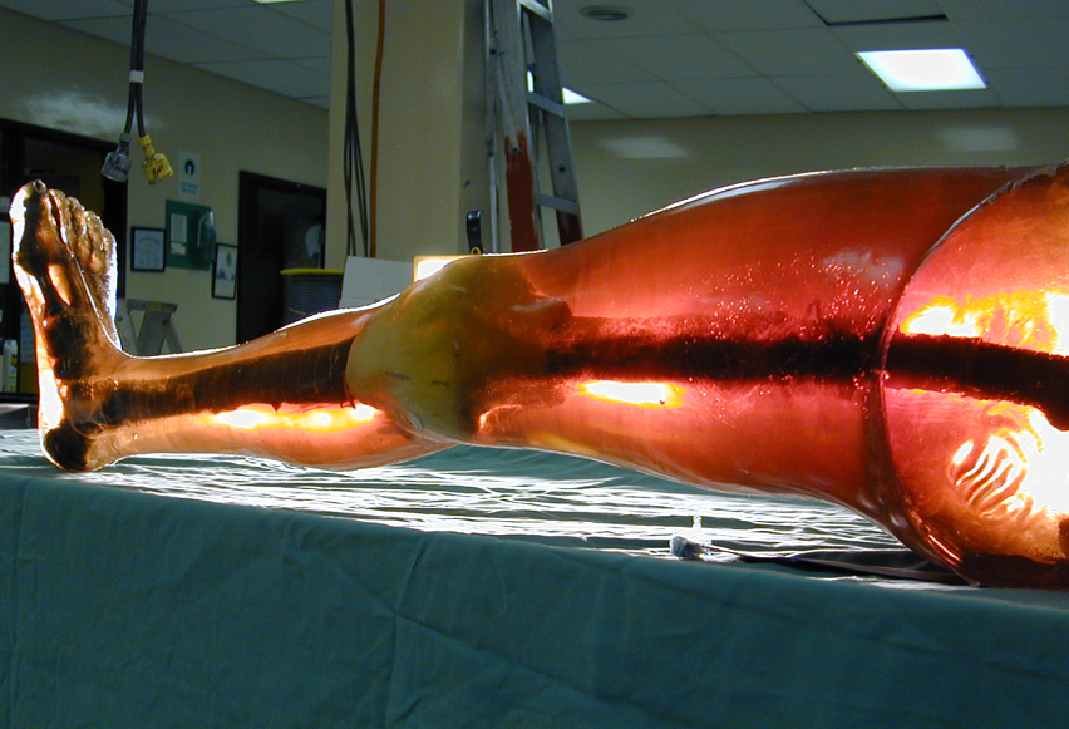
DSTO has developed frangible synthetic legs (FSL) for injury assessment [3] (see Figure 1). FSLs were used in this study to compensate for the fact that the Hybrid-3 technology was not designed to assess blast-generated shock injury. The FSL is part of a larger project to develop an entire body simulant, from polymer materials exhibiting similar properties to human flesh and bone, which will be used to analysis injury in different combat environments. FSLs are constructed from synthetic bones made from composite plastics, and use ballistic gelatine or polymers as a flesh simulant. The synthetic legs break and fracture under the same loads that occur for real human legs, and have been found superior to Hybrid 3 dummies for assessing lower-leg injuries caused by landmine detonations. They can be used by themselves or as part of a Hybrid 3 as a replacement for the solid aluminium legs. FSL can also be fitted with strain gauges to analyse the composite bone’s response to rapid shock loading.
Blast overpressure injury
The blast overpressures exerted on occupants of a vehicle from a landmine detonation are measured using blast gauges fitted into a surrogate head and chest. DSTO use purpose built human-sized torsos manufactured from fibreglass shell with foam filling which are fitted with Piezo resistive pressure transducers in the ear positions (see Figure 2).
Shock-acceleration
- Relative shock responses from the landmine detonation to various parts of a vehicle are measured using Piezo electric accelerometers, which are mounted on the floor, roof and seats. To reduce ringing effects caused by the explosive shock, DSTO used Endevco, model no 7255 accelerometers, mounted on metal filter base.
Floor displacement caused by the blast
High-speed displacement of the floor is the principal reason for lower-leg injuries. Linear Voltage Displacement Transducers (LVDT) were used to measure the floor displacement (movement) caused by the landmine detonation. The LVDTs were fitted on the floor and time-resolved displacements were recorded using Digistar III recorders.
Vertical vehicle displacement
The vertical displacements of each vehicle caused by the landmine detonation are recorded on both standard and high-speed video, the latter having framing rates to 2000 fps. Horizontal displacement was measured after the event through comparison of pre- and post-detonation fixed reference points.
Fragment Capture
Fragmentation screens made from layers of 1-mm aluminium sheet and separated by layers of polystyrene foam sheets are used to capture fragments and to estimate fragment lethally.
Vehicles tested
Landrovers
Both Series III and the newer 110 model Landrovers have been tested against simulated landmine ranging from 1kg to 4kg of plastic explosive PE4. Figure 3 illustrates a Landrover Series III after 3kg PE4 landmine detonation.
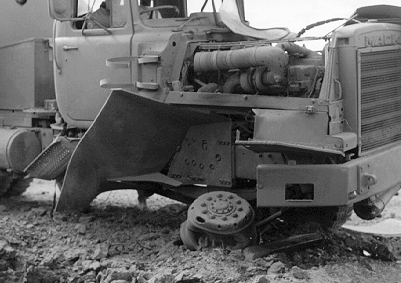
Landrovers have aluminium bodies, and even a small landmine will cause fragments from the tyres and wheels to penetrate the floor with sufficient velocity to kill an occupant. Steel deflector plates can stop this fragment hazard. However, even Landrovers with armoured protection cannot survive the lethal translational shock loadings from landmine charges of 3kg or more. Anti-vehicle landmines range from 5kg to 10kg and for this reason it is recommended that this class of vehicle not be used if an AV mine threat exists.
Trucks
International f1 6x6 (5 tonne)
Ex-military International trucks were tested with simulated landmines containing 5kg of PE4. Tests were conducted to evaluate expedient methods of providing protection against landmines and included:
- sand bagging; and
- half-filling tyres with water.
Sand bagging of the tray (as illustrated in Figure 4) stopped the generation of dangerous timber fragments from the tray of the International truck. However, the weight added considerable payload, which in turn would affect vehicle mobility.
In tests where water was filled into tyres, the vehicles recorded reduced shock acceleration and exhibited less vertical displacement. The techniques of adding water to tyres were reported by South African researchers [2] and have been used by the South African Army. There are two theories [2] put forward:
- The water takes the heat out of the hot gases produced by the exploding landmine.
- The water deflects the shock wave and causes the blast to flatten out and disperse away from the vehicle.
Mack m3c dump truck (7 tonne)
Extensive testing was carried on this vehicle which included:
- 7.3kg PE4 protected with wheel well blast deflector and 6mm armoured steel on cabin floor (Figure 5);
- 7.3kg PE4 against rear wheel;
- 7.3kg PE4 against wheel half filled with water; and
- 7.3kg PE4 unprotected vehicle.
Occupants of Mack trucks are considerably better off than those in lighter vehicles such as Landrovers, or on the back of trucks with wooden trays such as International F1 6x6. Additionally, although injuries will occur, death is unlikely.
When tested with 7.3kg PE4 (equivalent to 10kg TNT) high overpressures are produced, which will cause occupants permanent ear damage.
Discussion
Kill mechanisms and their mitigation
Conventional mines injure and kill vehicle occupants by the following mechanisms:
- fragmentation,
- blast overpressure,
- vehicle shock acceleration and deformation,
- loss of vehicle control, and
- gross vehicle movement.
Fragmentation
Results obtained from our program indicated that lethal fragments are generated when landmines are detonated under tyres. Fragments estimated to be lethal were found in the fragmentation packs from steel-belted tyres.
The survivability of occupants in light-skinned vehicles can be increased with add-on armour. Deflector plates installed under wheel wells can stop lethal fragments such as large pieces of the tyre or parts of the wheel or brakes from penetrating the floor and killing an occupant.
The installation of armour plate to interior floor can also stop fragments. If designed as a false floor they can also mitigate translational loading that result in lower leg injuries.
Blast overpressure
The blast overpressure from anti-vehicle mines can be dangerous to occupants of vehicles. Ear damage is caused above 35kPa, [4] lung damage is caused above 210kPa, and lethal effects are observed at 700kPa.
It is very difficult to stop blast overpressure reaching an occupant in soft-skinned vehicles. Landmine blasts enter though the floor, firewall and blow out windows. The only way to provide protection is with full armour including armoured glass.
Vehicle shock acceleration and deformation
The floor acceleration and deformation from landmine detonations even in armoured vehicles, causes substantial lower leg injuries to occupants. Three methods are employed to overcome this:
- False floor—an internal floor with an air cavity of ~100mm can be successful in larger vehicles such as a Mack truck.
- Energy absorbing systems—rubbers and foam can decouple shock loadings.
- Water in tyres—deflects the blast and reduces the damage to some vehicles particularly where the wheel is under the vehicle main structure. This method is not recommended for use to any great extent because the extra weight from the water reduces vehicle mobility and service life.
Loss of vehicle control
All DSTO landmine tests have been conducted with the test vehicle stationary over the mine. Front-wheeled detonations have resulted in vehicles being rotated by over 90 degrees by the landmine blast. It is highly likely that for vehicle with a reasonable forward momentum, the sudden change of direction caused by a landmine will result in a roll-over accident. Speed reduction is recommended as a mitigation measure and this will vary depending on the vehicle; lighter vehicles are at greater risk. A speed of less than 25 kmph has been suggested [1] however DSTO have not addressed this issue.
Gross vehicle movement
Large gross vertical movement cause occupant injuries such as lower leg, spinal and head injuries if the occupant is not restrained. Injuries also occur as a result of deceleration forces when the vehicle returns to earth. This effect was recorded for landrovers where the Hybrid 3 dummies recorded lethal head strikes by the occupant when the vehicle hit the ground following the mine detonation.
The underneath of typical commercial vehicles and flat bottomed military vehicles tend to trap the high velocity, high pressure gaseous reaction zone and soil ejecta resulting in ruptured of or buckling of the floor, causing injury and exposure to lethal fragments. Dangerous accelerations caused by load transfer also endanger the occupant.
To reduce loads on occupants blast deflector plates fitted to vehicles, or for new vehicles Vee shaped hulls are used. Vee hulls allow the high velocity gas and soil ejecta to flow past and reduce the energy transferred to a vehicle, compared to a vehicle with flat hull or complex underneath.
The Bushranger vehicle, developed in Australia for operations in mined areas, and has a Vee hull, was only propelled vertically a third of the height. compared to Mack trucks when tested under similar conditions.
Conclusion
Methods are now available to significantly reduce the number of casualties produced in wheeled vehicles by anti-vehicular (AV) landmines. The most efficient of these in terms of maximizing protection are, in decreasing order of performance:
- special-purpose vehicles primarily designed to resist mine blast effects with design features such as Vee hulls;
- mine protection consideration designed in vehicles prior to manufacture;
- mine protection adapted to existing vehicles at a factory or top level depot; and
- mine kits applied by troops or logistic personnel in the field.
Research is continuing to improve the protection of occupants of vehicles against landmines.
References
[1] Private communication with Mr R Gonzalez of the Tank-automotive and Armaments Command (TACOM), US Army.
[2] P. Stiff, Taming The Landmine, Galago Publishing, RSA, 1986.
[3] A. Krstic, Provisional Australian Patent—Frangible Synthetic Leg for the Assessment of Landmine Injuries.
[4] D. Richmond, and C. White, Biological Effects of Blast and Shock, Technical Report on Contract No. DA-49-146-XZ-055, Lovelace Foundation for Medical Education and Research, Alb. New Mexico, 1966.
Roy Bird is a Senior Professional Officer in the Terminal Effects group of the Weapons Systems Division at the Defence Science and Technology Organisation (DSTO) Salisbury, Australia. He is the task manager for research into landmine countermeasures and is a graduate of the Royal Melbourne Institute of Technology in applied chemistry.