
Volume 2, Number 3, November 1999
HF Surface-Wave Radar and Its Role in Littoral Warfare
Abstract
The pace of modern military operations and the over-the-horizon range capability of many weapons systems impose heavy demands on real-time surveillance and intelligence support. For operations in the littoral zone, there is a clear requirement for a relocatable, shore-based sensor which can provide reliable all-weather detection of small surface and aerial targets of interest out to ranges in excess of 100 kilometres from the coast. HF surface-wave radar (HFSWR) may well provide the most cost-effective solution to this requirement, given the results of recent trials of an experimental system developed by the Defence Science and Technology Organisation (DSTO) in conjunction with Telstra Applied Technologies and the Cooperative Research Centre for Sensor Signal and Information Processing in Adelaide. This project, code-named ‘Iluka’, involved the design and deployment of an HFSWR near Darwin, together with support from various elements of the ADF and other agencies which provided information on air and surface movements of cooperating platforms as well as civilian ‘targets of opportunity’ within the area monitored by the radar. In this paper we review the technology of HFSWR and discuss its capabilities and limitations in the context of littoral warfare.
Introduction
Of all the precepts that guide military operations, none has had a longer pedigree than the exploitation of the element of surprise. On the modern battlefield, the ability to strike at over-the-horizon ranges, coupled with the speed and mobility of forces, leads one to conclude that the means of achieving surprise have been vastly augmented, while the advantage conferred by surprise has in no way diminished.
In the face of the threat posed by these developments, a heavy responsibility rests with the surveillance arm of any defensive deployment. Numerous surveillance technologies have evolved to meet the increasing demands for detection at progressively longer ranges but, in almost all cases, the resulting systems have been horizon-limited relative to the defender. Those which are not, such as satellite-borne sensors, may not be able to detect the classes of target of concern, or be too expensive, or simply unavailable. As a consequence, offensive operations are frequently planned to exploit the earth’s curvature as a concealment measure, since the geometry of detectability is easily exploited.
Figure 1: Comparative maximum detection ranges for co-located microwave and surface-wave radar systems. Typically R2, the HFSWR detection limit, is up to ten times greater than R1, the horizon-limited range.
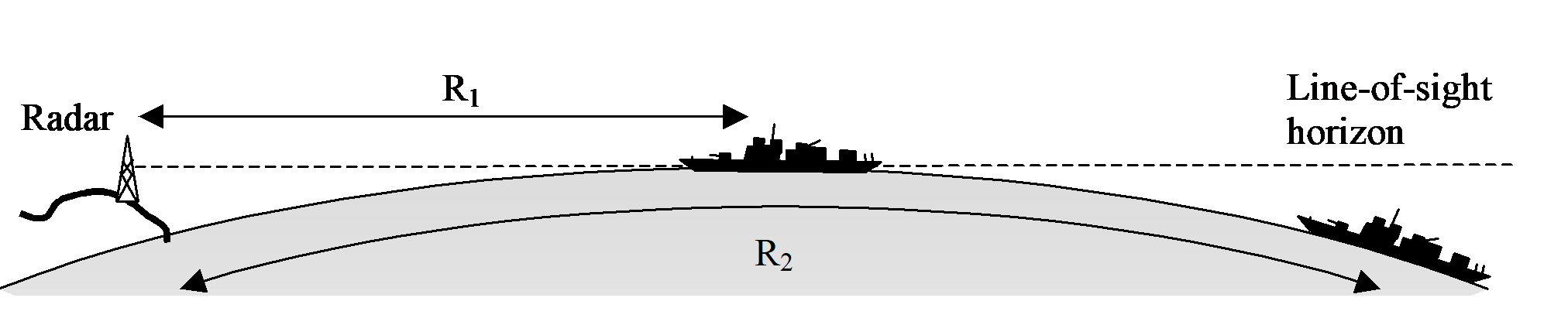
HF surface-wave radar (HFSWR, also referred to as HF ground wave radar) is a technology for achieving an over-the-horizon surveillance capability over sea water at ranges out to perhaps 250 - 300 kilometres. It is based on the physical principle that, in addition to normal line-of-sight propagation, which is exploited by microwave radars, there is a propagation mode which exists for much lower radar frequencies which can best be described as a surface wave,
clinging to the sea surface (for example, see [1]). Although this surface wave decays with distance rather faster than the normal inverse square law of line-of-sight propagation, sufficient sensitivity may be achieved to provide a uniquely capable sensor. Figure 1 illustrates the comparative detection ranges for low-altitude or surface targets offered by microwave and surface-wave radar systems.
Research into this technology has been pursued in over a dozen countries, but only a few have devoted sufficient resources to be in a position to deploy a militarily useful HFSWR. Of these few, Australia, Canada, the US, the UK, China and Russia stand out, with France, Japan and Turkey not far behind. Targets of declared interest include low-flying aircraft, surface vessels of all types, sea-skimming missiles and sea surface conditions.
In this paper we examine the potential of HFSWR to provide reliable, timely and accurate surveillance and intelligence support to littoral operations of the kinds likely to be encountered in the Australian theatre.
Surface-wave radar
Principles of operation
When an electromagnetic wave illuminates a conducting surface at grazing incidence, an appreciable fraction of the energy may be propagated along the surface in the form of a wave which ‘adheres’ to the surface and is hence able follow the curvature of the supporting structure. This phenomenon has long been recognised as a means of communicating beyond the horizon with radio waves, especially in the case of propagation over the ocean because seawater is a good conductor at HF frequencies (3-30MHz). It is equally true that this surface-wave mode can be used for radar purposes, that is, a two-way process wherein transmitted signals travel to a distant target beyond the horizon, reflect and travel back to a receiver. This propagation mode is different to the ionospheric reflection used by skywave over-the-horizon radars. It should be noted that surface-wave propagation is not confined to frequencies in the HF band, however signals at higher frequencies suffer too much attenuation to achieve worthwhile ranges, while frequencies lower than 3 MHz will propagate to very long ranges but require impracticably large antenna structures.
As a consequence of the underlying physical mechanisms responsible for HF surface-wave propagation, a stronger signal is received when the radiated signal is vertically polarised, so that HFSWR transmitting antennas tend to be structures of up to 10-40m height (about quarter wavelength at HF) for maximum efficiency. Receiving antenna elements can often be smaller, vertical monopoles, however the ability of the receiver to resolve echoes from targets closely spaced in azimuth (bearing) depends on the aperture of the receiving antenna array, with a typical array having a length of 200-500m. In most cases, an array orientation parallel to the water’s edge is preferred. Although these length scales sound daunting, the design of the antenna elements may be very simple, so that a substantial array may be erected in a matter of a day or two.
The system configuration will dictate the options for transmitted radar waveforms. If the transmitter and receiver are collocated, an intermittent pulse mode of operation must be employed so that the sensitive receivers are not overloaded by the transmitted signal, which is typically of several kilowatts mean power. For this reason, bistatic systems with 20–100km separation between sites are sometimes preferred, so that continuous transmission giving higher average powers is possible.
Evolution of the technology
Early HFSWR research was carried out in the UK and the US, with a small number of systems being deployed in quasi- operational roles, though these radars had limited capability because of the rudimentary electronics of the day. With the advent of digital generation and processing of signals, with low noise and high dynamic range, radar performance improved dramatically and prospective military applications of the technology attracted more interest [2].
Within Australia, the Surveillance Systems Division (SSD) of DSTO (formerly Wide Area Surveillance Division) has been investigating the potential of HFSWR for littoral surveillance and other applications. This research was pursued initially using a modest HFSWR developed by SSD and deployed at Port Wakefield, SA [3]. Between 1994 and 1997, numerous experiments were conducted with this system, achieving detection of commercial shipping, RAN frigates and destroyers, yachts and other pleasure craft, at ranges up to 180 km, the limit of the field of visibility due to the occluding effects of Kangaroo Island.
Project Iluka
In 1996, Telstra Applied Technologies (TAT) was offered an exclusive license to commercialise DSTO’s HFSWR technology. After exploring various options, TAT and SSD embarked in 1997 on a collaborative undertaking to develop, deploy and test a prototype HFSWR system under the name Project Iluka. The Darwin region was identified as a suitable location for the deployment for several reasons:
- the desire to test the system in a tropical environment, where the effects of thunderstorm activity could be assessed;
- the convenience of Darwin from a logistics viewpoint;
- the availability of suitable targets of opportunity; and
- the proximity of the RAAF’s 2CRU facility for validation of detections and the chance to explore sensor fusion issues.
The Cooperative Research Centre for Sensor Signal and Information Processing (CSSIP) in Adelaide was enlisted as a partner in this enterprise, with particular responsibilities in the areas of antenna design, noise investigations and signal processing, complementing the DSTO radar expertise and TAT’s experience with remote site engineering, management and communications. TAT subsequently contracted Daronmont Technologies, a small Australian specialist company, to implement its HFSWR research and development activities under TAT direction.
The experimental Iluka radar was deployed near Darwin and operated for two campaigns - May-June 1998 and November 1998. Trials were conducted with the support of RAAF and commercial aircraft and RAN and chartered ships and boats. This program, in which the TAT, SSD and CSSIP worked closely together,
- demonstrated and quantified the ability of HFSWR to detect and track surface and air targets at significant ranges via surface-wave propagation;
- measured and characterised the environmental and system factors that constrain the performance of HFSWR, and
- demonstrated a working ‘prototype’ HFSWR to interested parties including ADF sponsors and other potential customers for HFSWR systems.
Iluka radar system design
The Iluka radar operates primarily in the 5-15MHz range, with a reduced capability from 15-25MHz. The radar is based on the architecture of the Jindalee over-the-horizon radar system and uses a frequency modulated continuous wave (FMCW) waveform. As discussed earlier, an FMCW waveform requires a bistatic system configuration. In the case of the Iluka deployment in Darwin, two transmitter sites were used with a single receiver site, enabling complementary coverage of the Beagle Gulf and eastern Timor Sea. The low power Gulf transmitter was located approximately 18km from the receive site while the high power Timor Sea site was located 96km away.
The high power transmitter site used a log-periodic antenna to transmit from either 1kW or 10kW transmitters. A more modest 100W transmitter was used with a simple dart antenna at the low-power site.
At the receive site, a uniform linear array of 32 (+2) receive antennas, some 500m in length, provided inputs to a 32-channel HF receiver connected to a sophisticated real-time signal processing and display system.
Demonstrated and projected HFSWR capabilities
Illustrative results from Iluka
A credible baseline for prospective HFSWR performance can be obtained from the results of the Iluka trials. Of particular interest are (i) those trials which simulated realistic threat scenarios, as well as (ii) experiments aimed at exploring the factors which presently limit radar performance.
In the former category, unalerted detections of 42m patrol boats were achieved routinely at ranges of 150km. Many of the craft used to smuggle illegal immigrants are of roughly this size. Larger ships were occasionally detected at ranges in excess of 250km while, at the other extreme, a number of yachts were detected and confirmed by cooperating ADF platforms.
During tests using low-flying aircraft the radar detected a small aircraft flying at a mere 20m altitude at a range in excess of 200km, and other small aircraft at similar range. Commercial jets at cruising altitude were tracked to greater ranges, demonstrating that one cannot fly under or over HFSWR coverage.
Environmental factors which were found to impact on HFSWR performance include the HF noise background, clutter echoes received via skywave propagation or even directly from ionospheric irregularities, sea state and the siting details of the antenna systems. In order to understand these phenomena, numerous scientific experiments were conducted in conjunction with the detection and tracking trials.
Some results of great practical significance were derived from these experiments. The advantage of using efficient receiving antenna elements to enhance HF interference rejection efficacy was determined [4], as was the impact of array positioning relative to the water line. Transmissions from boats were employed to measure propagation loss and its dependence on sea state, while a special radar cross section (RCS) calibration device was developed and used to study the scattering characteristics of the sea, as well as to determine the RCS of several types of vessel [5].
Projected developments in HFSWR
Following Iluka, under TAT direction, the joint team has focussed on developing a more ‘commercial’ HFSWR known as SECAR, based in many aspects on Iluka but with a greater emphasis on the use of commercial-off-the-shelf (COTS) equipment.
In addition to its SECAR involvement, the SSD team is directing effort into the development of a Capability Technology Demonstrator (CTD) with funding approved under the Defence Department’s CTD scheme. This experimental radar will be quasi-monostatic; that is, distinct transmit and receive facilities will be located at the same site (see Figure 2). Obviously the possibility of single-site deployment expands the geographical options for deployment, though at some cost in performance.
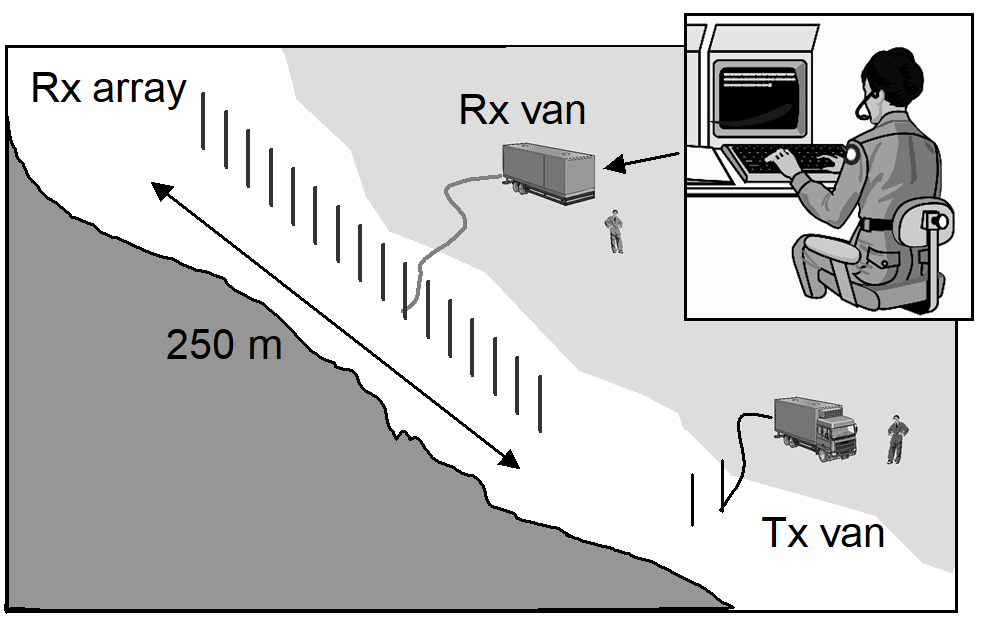
Figure 2: Artists concept of a HFSWR Capability Technology Demonstrator deployment.
Prospective new HFSWR concepts and capabilities
The results of the Iluka trials, together with other HFSWR research presently underway, make it possible to speculate on the form and likely capabilities of future HFSWR systems. The key developments anticipated in the short-to-medium term include:
- more sophisticated antennas, able to discriminate between ground wave and skywave signals;
- more compact RF and computing hardware, specifically designed to facilitate operational deployment at short notice;
- development of monostatic and multistatic HFSWR systems, yielding higher track accuracy; and
- improved performance at longer ranges, out to 250-300km or further, as techniques for suppressing unwanted clutter and interference are refined.
HFSWR’s roles in littoral warfare
Even if HFSWR technology was to remain static in terms of capability, an impressive diversity of roles and missions can be accomplished with high reliability. The following selection is representative.
Point and area defence
The most obvious application of HFSWR is to provide a comprehensive air and surface picture over a broad area centred on a strategic coastal facility such as a port, or offshore resource assets such as oil and gas production platforms. In the latter case, the radar would probably be located on the mainland, though compact versions for mounting on offshore structures are possible. The radar product would take the form of a map showing aircraft, ships and boats moving through the surveillance region, perhaps spanning 10,000-20,000km2, updated on a timescale measured in seconds or minutes rather than hours.
Intelligence on ship and aircraft movements
The large area surveyed by an advanced HFSWR could well include sea lanes, straits and other choke points, prohibited zones, marine parks, ports and military bases. Detailed analysis of traffic patterns around or through such regions could constitute militarily useful information.
Over-the-horizon targeting
In a hostile tactical situation, the surface picture provided by an HFSWR could serve as a target designator for over-the-horizon attack weapons, especially anti-ship missiles. In one scenario, coastal defences could be alerted to the presence of a candidate target, and given accurate positional information for input into strike options. Another possibility is for HFSWR to pass its surface picture to friendly ships so that they can be made aware of potentially hostile forces in their general vicinity and, if desired, use the information provided as targeting data for organic anti-ship or even surface-to-air missiles.
Remote sensing of wind and sea conditions
Much of the published literature on HFSWR describes the use of the HF echoes from the sea surface as a means of estimating sea state and inferring the surface wind field. This remote sensing capability has been explored in great detail by DSTO in the context of HF skywave radar, as well as in the HFSWR case. Military operations often depend strongly on meteorological and oceanographic conditions, so the availability of high quality real-time maps of these variables can have substantial operational value.
Longer term prospects
Although the general physical principles underlying surface-wave propagation are well known, the detailed spatial and temporal structure of the propagating radio signals is still the subject of research (for example, see [6]). Clearly our imperfect understanding of these subtleties has not stopped the development of militarily useful HFSWR systems, but in order to extract the full potential of the technology, a strong continuing research effort is needed.
Based on the assumption that this eventuates, we predict that a limited capability for target classification will emerge within ten years. Another likely advance is the ability to determine aircraft altitude at over-the-horizon ranges. The variety of targets able to be detected should expand to include certain types of missiles, both cruise and ballistic. We foresee a growing diversity of missions which include active roles being played by a variety of cooperating platforms and perhaps a limited ability to operate in a passive mode, relying on transmissions of opportunity provided by other HF systems [7].
Conclusion
On the basis of the demonstrated capability of HFSWR, highlighted by the achievements of the Iluka radar trials, it is clear that this technology has enormous potential to support military operations in the littoral region. The detection of patrol boats at ranges in excess of 200km on some occasions has shown that the effective coverage of a single HFSWR may be far in excess of that achievable with alternative land-based sensors.
The impressive capabilities of HFSWR must be tempered with its limitations, in particular its restriction to paths which lie entirely over the sea. For most potential applications, a little flexibility in site selection renders this constraint quite manageable. Other limitations, such as unwanted skywave returns, can sometimes pose difficulties at extreme ranges, but even these effects may be avoidable if current research into mitigation techniques is successful.
Acknowledgments
We are deeply indebted to our many colleagues in SSD, CSSIP and TAT who made the Iluka radar project such a success.
References
[1] S. Rotheram, “Ground wave propagation. I Theory for Short Distances”, Proceedings of the IEE, Part F : Communications, Radio and Signal Processing, Vol. 128, No. 5, pp. 275-284, May 1981.
[2] G. Millman and G. Nelson, “Surface-Wave Radar for Over-the-Horizon Detection”, Proceedings of the IEE International Radar Conference, pp. 106 - 112, 1980.
[3] S. Anderson, G. Brimble, L. Durbridge, A. Forbes, P. Roberts and G. Warne, “HF Surface Wave Radar Observations of Waves and Currents in St Vincent’s Gulf”, Proceedings of the Australian Physical Oceanography Conference, Lorne, Victoria, Feb 1995.
[4] Y. Abramovich, N. Spencer and S. Anderson, “Experimental Trials on Environmental Noise Rejection by Spatial Adaptive Processing for Surface-Wave Over-the-Horizon Radar”, Proceedings of the First International Symposium on Physics in Signal and Image Processing, Paris, pp. 86-92, Jan 1999.
[5] R. Dinger, E. Nelson, S. Anderson, F. Earl and M. Tyler, “High Frequency Radar Cross Section Measurements of Surrogate Go-Fast Boats in Darwin, Australia”, SPAWAR System Centre Technical Report 1805, Sep 1999.
[6] S. Anderson, I. Fuks and J. Praschifka, “Multiple Scattering of HF Radio Waves Propagating Across the Sea Surface”, Waves in Random Media, Vol. 8, No. 2, pp. 283-302, Apr 1998.
[7] M. Ringer, G. Frazer and S. Anderson, “Waveform Analysis of Transmitters of Opportunity for Passive Radar”, DSTO Technical Report 0809, Jun 1999.