
Volume 2, Number 3, November 1999
A Methodology for Analysis of Australia's Future Soldier
Abstract
This paper outlines the development of an analytical methodology for Australia’s soldier modernisation program, Project LAND 125 – Soldier Combat System (Project WUNDURRA). The methodology utilises a combination of field studies and modelling in what has been termed the Soldier Combat System ‘Battlelab’. Aspects of this methodology are discussed including the identification of system variables, development of a hierarchy of performance measures, and the investigation of modelling tools and field trial techniques. Initial impressions of technologies utilised by soldiers during field studies are also given. The paper concludes with a discussion of potential Soldier Combat System enhancement options and an outline of work to be conducted during the next Phase of the Project.
Introduction
The Australian Army’s program in soldier modernisation, Project WUNDURRA, was initiated in late 1993. The aim of the program is to optimise the capability of the combat soldier and combat unit through the incorporation of appropriate technologies and the adoption of improved tactics, techniques and procedures. Phase 1 of this Project, a Capability Definition Study (CDS), has recently been completed.
A critical part of the acquisition of new technologies and their introduction into service with the Australian Army is the provision of quantitative analysis to support Defence Committee submissions. In the case of Project WUNDURRA a sound analytical methodology had to be developed that would allow a means of evaluating competing Soldier Combat System (SCS) options.
When the project was initiated, an examination of soldier modernisation efforts in other countries identified significant effort in investigating potential technologies but a poorly defined regime for analysing the impacts of these technologies on capability. Hence an enabling research program was begun by the Land Operations Division (LOD) of the Defence Science & Technology Organisation (DSTO) to develop the required analytical methodology.
Battlelab analytical methodology
The analytical methodology developed for evaluating the impact of new concepts and enhancements on the combat effectiveness of the SCS involved a ‘Battlelab’ approach comprising four main components:
- defining the system under investigation,
- deriving performance measures,
- an iterative model-test-model evaluation, and
- deriving conclusions from study results.
These steps are discussed in more detail below. In the analysis of new concepts and technologies using this methodology, it is fundamental that both the ‘baseline’ and ‘enhanced’ systems are considered. Currently there is insufficient confidence in model and field study results for absolute measurements to be considered reliable.
Defining the soldier combat system
Initial analysis of the SCS involved determining a set of generic activities for which measures of effectiveness could be defined. These activities include administration, ambush, assault, crowd control, defend, fire support, observation post, occupy harbour, orders, tactical movement and vehicle check point. These generic combat activities were derived from strategic guidance, rifle company doctrine, and workshops conducted with the sponsor and subject matter experts [1,2].
Each of these activities was further broken down to identify a series of six core skills. These skills include communication, engagement, movement, navigation, protection and surveillance. These skills describe the majority of individual soldier actions and enhancements to these skills add value to the capability of soldiers to perform the generic activities.
Characterisation of the SCS in terms of generic activities and core skills was successfully tested against observations made during attachments to infantry units during Army field training exercises as well as during field experiments [3,4]. It was possible to de-construct the observed operations into combinations of the above activities, for example, the conduct of a patrol task given in Figure 1.

System variables
There are a number of system variables that impact on the SCS and the performance of activities; these have been organised into several broad categories including:
- Human Performance. The soldier in the loop has an impact on how efficiently and effectively activities can be carried out. The soldier also provides a degree of flexibility not evident in other purely mechanical systems. Characteristics include strength, size, sustainability, senses, stress, morale, experience, speed, skill and information processing.
- Technology. Technologies are available that will improve baseline soldier characteristics and skills. However, the introduction of technologies can also adversely impact on some human performance parameters (for example, reduced field of view when using some Head Mounted Displays).
- Standard Operating Procedures (SOP’s). SOP’s will impact primarily on activities and the process by which they are conducted. This will influence the manner in which technologies are utilised.
- Training. The quality of training will have a direct impact on the application of new technologies, human performance characteristics and the soldier’s ability to perform activities.
- Environment. This includes issues such as vegetation, climate, noise, threat and mission requirements. This could introduce time constraints and issues associated with working as an individual or as part of a team.
In any attempt to quantify differences in performance between enhanced and baseline soldiers all of these variables need to be recorded or controlled. In a field environment it is virtually impossible to control these variables and maintain a realistic environment in which to collect meaningful data. This is one of the key advantages of modelling compared to field studies.
Performance measures
In order to assess soldier performance, a hierarchy of performance measures was derived [1]. There are four levels to this hierarchy:
- Measure of Performance; used for assessing the performance characteristics of specific items of equipment or human performance characteristics. It includes measures such as range and penetration for weapon systems, or stamina and strength for humans.
- Measure of Effectiveness; used for assessing the improvement in soldier skills afforded by enhancements (eg percentage hits on target). Measures of effectiveness are also used to define criteria by which activities are assessed. For example loss exchange ratio for an assault or an area covered by a patrol.
- Measure of Outcome; used to assess the effect of enhancements on generic activities. For example, for the assault activity, was the objective achieved within the required time and casualty constraints. Time and casualty constraints represent potential measures of effectiveness by which the outcome is assessed.
- Measure of Capability; represents the capability of the entire system considering performance in all SCS activities. This measure is focused on the entire system up to the company level.
In general the ability to determine a quantitative performance measure decreases from measure of performance to measure of capability [5,6]. Relating objectives of field studies and modelling to the hierarchy of performance measures is essential if results are to be placed in the correct context and if appropriate data are to be collected.
Model-test-model evaluation
Once appropriate performance measures were derived the model-test-model process was initiated to collect data for evaluation. The process involved the development and application of analytical tools and techniques, in particular modelling and field studies.
Modelling was used initially to identify critical issues for examination during field studies [7,8]. The primary model used was the Close Action Environment (CAEN) simulation [9]. Field studies were then conducted to verify model results as well as for the collection of significant data for input back into the models. Modelling was then repeated with refined input and increased confidence.
The focus of these studies has been the infantry section, which has been identified as the smallest discrete unit suitable for analysis. An infantry section comprises nine soldiers and is commanded by a non-commissioned officer, usually a corporal. The studies compared baseline and enhanced sections engaged in a variety of operational situations based on the generic activities. During the studies the baseline sections were equipped with current equipment whilst enhanced sections were provided with a variety of technological enhancements including thermal weapon sights, intra-section communications and hand-held computers.
Over the course of Phase 1 of the Project a wide range of monitoring techniques has been investigated. These included a laser based Tactical Engagement Simulation System (TESS), video cameras (helmet, weapon and wall mounted as well as mobile) and digital compasses. Subjective data collection such as after-action reviews, debriefs and interviews have also proved to be essential when evaluating collective performance as they place quantitative data into the correct context. The use of head-mounted video for collection of data for task analysis has also proved to be effective. The sum of these techniques provides the required data to quantify the impact of enhancements on system performance in the majority of environments [10-12].
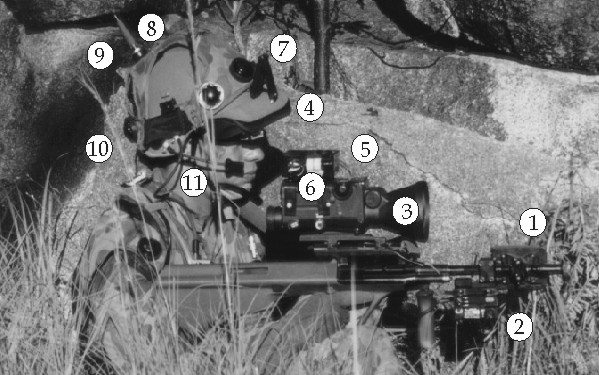
Figure 2 shows an enhanced soldier wearing a combination of technologies and monitoring equipment used during the field study conducted in February 1998.
Field study results
As stated previously the objective of Phase 1 of the project was the development of an analytical methodology. Investigating the impact of enhancements was a secondary consideration and was restricted by the fact that many of the technologies used were ’concept demonstrators’ created for the trial. Despite these restrictions some useful results were obtained with a sufficient degree of confidence to warrant certain conclusions.
1) Tactical Engagement Simulation System (TESS) Laser
2) Night Aiming Device (Laser)
3) Thermal Weapon Sight (TWS)
4) Helmet Mounted Display (HMD)
5) Radio Transmitter - TWS to HMD
6) Video Camera
7) Bracket for Night Vision Goggles
8) TESS radio transmitter
9) TESS GPS antenna
10) TESS laser sensors
11) Intra-section radio headset
Specific conclusions regarding the technologies involved in the trial include:
- Intra-Section Radios. This capability provided a significant enhancement to the command and control of the section during the majority of activities. It will be an essential component of the WUNDURRA SCS.
- Thermal Weapon Sights. The performance of these sights varied significantly between activities depending on the environment and level of training. In those scenarios where it did provide a benefit however it was a substantial enhancement over baseline equipment.
- Commander’s Data Terminal. The performance of the hand held computer was hindered greatly by the lack of mature software tailored to the requirements of dismounted soldiers. Investigations to date have indicated however that a mature capability will be an essential component of the future soldier. Note that the functionality of the computer includes GPS and digital mapping facilities, formatted message templates as well as planning tools.
During the next Phase of the project the methodology described above will be used to evaluate a range of proposed enhancement options ranging from fully integrated systems to discrete items of equipment.
SCS enhancement options
In order to focus on technologies having the greatest potential for enhancing capability, it was first necessary to determine the relative priority of core skills. To do this, an Analytical Hierarchy Process (AHP) was conducted. The AHP is an operational analysis technique used for solving multi-criteria decision-making problems [13]. Contributions to the hierarchy were obtained from military personnel with an infantry background.
The relative priority of each of the six core skills was determined from this analysis and is presented in Figure 3.
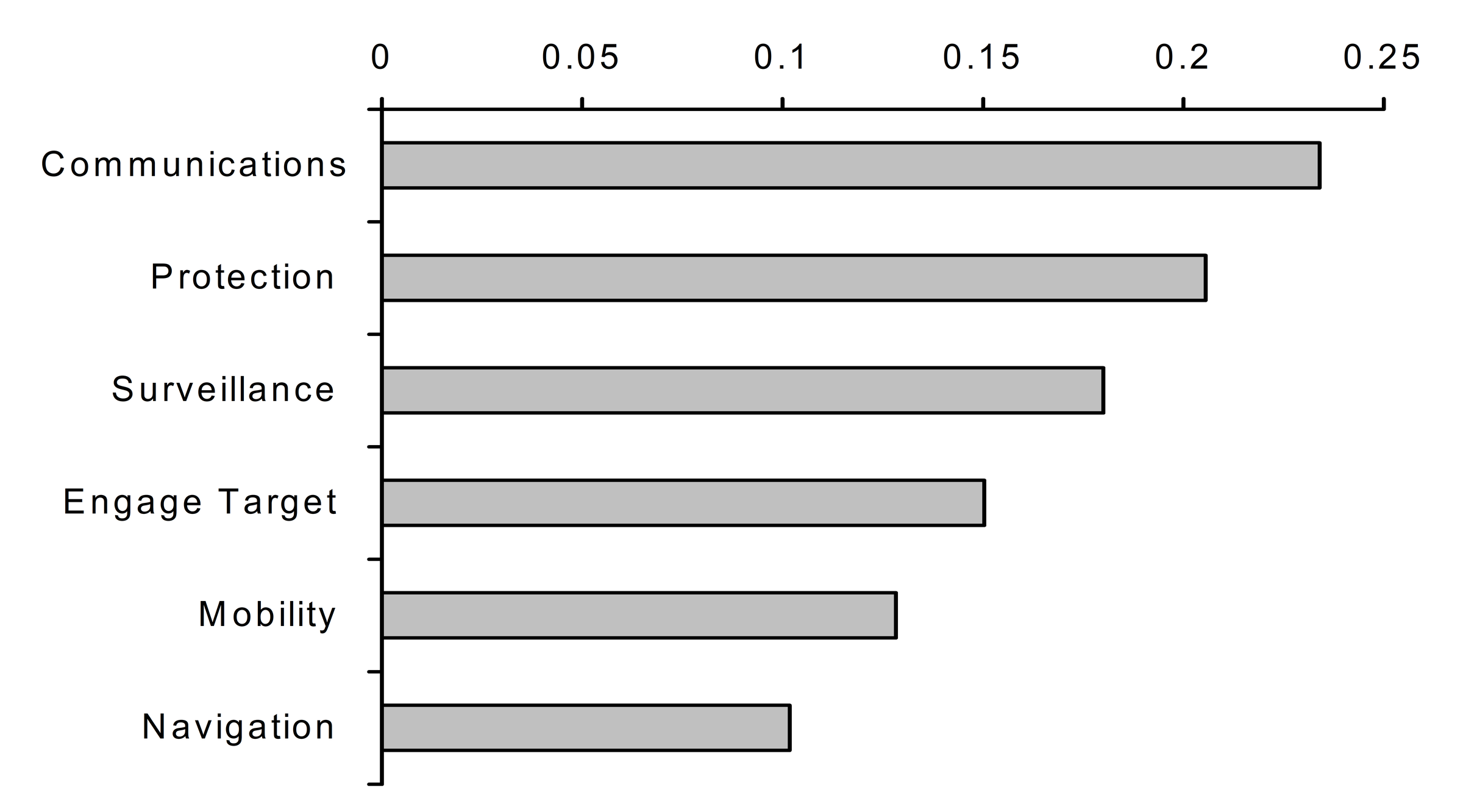
It should be noted that all of the identified core skills are important to the SCS and need to be considered in the final systems analysis. The process above merely provided a mechanism for identifying those factors where increases in performance would have the most significant impact. A similar analysis was conducted using human factors experts focussing on human performance issues associated with the SCS.
An assessment of the impact of each enhancement (technology) on the capability of the SCS was determined using this data. This was achieved by multiplying the AHP weighting by the ‘impact’ of the technology on the individual skills and then summing over all skills. The technologies assessed in priority order are given in Table 1. The assessment of impact was based on the opinions of the authors where field trial or modelling data was unavailable.
A similar assessment was conducted on the human performance characteristics, which highlighted training and ergonomics (that is, systems integration) as key issues.
Some debate has occurred as to whether technologies such as head mounted displays and power sources should be listed in Table 1. The rationale for not including them is that on their own they do not provide a direct enhancement to capability. They are used to enhance the performance of other specific technologies by providing longer usage time or an improved user interface. As such it is not appropriate to compare their impact with other technologies that have a direct effect on a specific core skill.
Technologies with a high rating in Table 1 tended to be those that impacted on a wide range of skills. Those technologies at the lower end of the scale whilst only impacting on a single skill, were, in some cases identified as being essential in specific scenarios or environments (for example, NBC Protection).
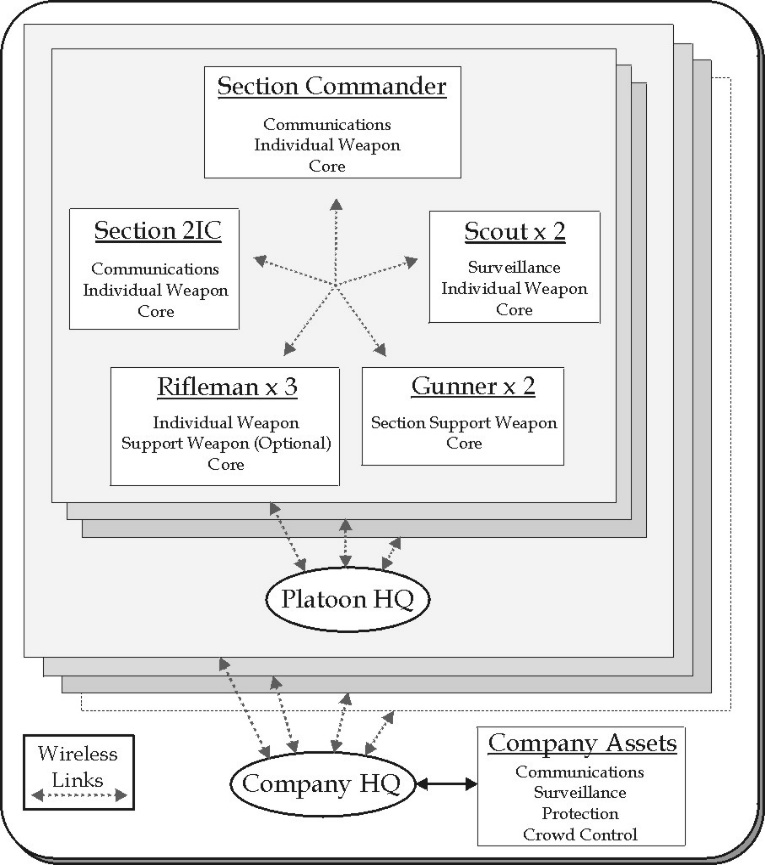
The second approach used to define the system focussed on the use of each technology by different soldiers within a company group. Those technologies potentially used by all soldiers were considered core, whereas those employed by selected individuals were sorted into functional modules. An initial allocation of technologies to modules is given in Table 1. Note that when the AHP was conducted, improvements to the weapon system were listed as a single technology. When assigning modules however, it became apparent that individual, support weapons and non-lethal options should constitute separate modules.
1 Includes individual, support and non-lethal modules
2 Includes Surveillance and Target Acquisition
Table 1. Priority of technologies based on enhancements to core skills.
The degree of integration that can be achieved, or is desirable, with the technologies listed in Table 1 is unknown. Hence whilst there are a range of technologies listed in some modules, for example surveillance, this could be a single item of integrated equipment or a selection of kit designed for specific tasks. An initial allocation of modules based on current infantry doctrine is given in Figure 4.
In general the interfaces that need to be considered within and between modules can be described as:
physical interfaces between technologies,
user interface,
data interface, and
power supply interface.
When these linkages have been examined in detail the results will provide the basis for the identification of potential constraints on system specifications. The selection of technologies to be considered in this initial system definition will also depend to a large extent on the maturity of proposed technologies. If the majority of technologies are included then preliminary analysis indicates the need for a common data and power bus. This is supported by results from field studies that highlighted the potential problems associated with poorly integrated equipment [11]. If the technologies are limited however by maturity or cost then compatible stand-alone systems may be sufficient to fill requirements.
Future work
It should be emphasised that the result presented in the section above is the starting point, not the final solution. During the next phase of the project this system will be subjected to the model-test-model evaluation process described in the opening sections of this paper. Initial modelling will focus on a user workshop during which the system described above, after further refinement, will be debated in regards to potential changes in doctrine and procedures. The relative merit and feasibility of including specific technologies into the system will also be discussed.
The results of the user workshop will guide subsequent modelling and field trial work. Both baseline and enhanced Infantry Companies will be modelled to examine more closely issues raised during the workshop. This analysis will represent a trial run of the methodology prior to tender evaluation.
Initial field studies will concentrate on focussed experiments to investigate measures of performance for specific new technologies. This input is essential for accurate modelling of the system. The lack of an integrated system for evaluation at this stage prevents the validation of modelling results (related to measures of effectiveness and outcome) however a prototype system will be produced during the next phase of the Project.
During Phase 1 of the project several deficiencies were identified in the tools required to support the analytical methodology. These deficiencies include the modelling and field evaluation of activities in urban terrain as well as the representation of human performance issues in models. The continued development of these tools will occur over the next two years with the objective of providing validated tools for the evaluation process.
Conclusions
The aim of Project WUNDURRA is “…to optimise the capabilities of the combat soldier and combat units as effective integrated systems…”. This paper has provided a summary of work conducted during Phase 1 of the project in support of this aim, the development of an analytical methodology. Whilst some deficiencies still exist in the tools supporting this methodology, to be addressed early in Phase 2, it has been shown to be a robust process for evaluation of new concepts and technologies.
References
[1] N. Curtis and W. Hobbs, Characterisation of Infantry Section and Platoon Activities, DSTO-TR-0482, 1997.
[2] D. Bowley, N. Curtis and W. Hobbs, Science and Technology Framework for Soldier Combat System Evaluation Studies, DSTO-GD-0122, 1997.
[3] W. Hobbs, N. Curtis and F. Principe, Exercise KANGAROO 95 - Infantry Soldier Activity Analysis, DSTO-TN-0079, 1997.
[4] W. Hobbs and N. Curtis, An Analysis of Infantry Activities and Technologies based on Results from the Infantry Technology Enhancement Study: Singleton 1995, DSTO-TR-0637, 1998.
[5] W. Hobbs and G. Fowler, “Non-Intrusive Techniques for Monitoring Soldier Combat System Activities During Field Studies”, ITEA Instrumentation Workshop, California, 1998.
[6] W. Hobbs and N. Curtis, “Field Experiments in the Analysis of the Soldier Combat System”, 24th Meeting of QWG AOR, Adelaide, 1998.
[7] D. Bowley and J. Millikan, Measuring the Effectiveness of Small Unit Ambushes Using Combat Simulation, DSTO-TN-0151, 1998.
[8] W. Hobbs, “Section Surveillance Patrol Model”, 23rd Meeting of QWG AOR, Ottawa, Canada, 1997.
[9] D. Bowley and J. Millikan, “Analysis of the Attack, Defence and Ambush Operational Situations”, 23rd Meeting of QWG AOR, Ottawa, Canada, 1997.
[10] W. Hobbs and J. Coleby, Report by Land Operations Division to DTRIALS, Defence Trial No 8/646, 1997.
[11] W. Hobbs, Report by Land Operations Division to DTRIALS, Defence Trial No 8/851, 1998.
[12] M. Drobnjak, “Using Head Mounted Video Camera to Aid Recall of Events During Military Activities”, 39th Annual Conference of the International Military Testing Association, Sydney, Australia, 1997.
[13] T. Saaty, The Analytic Hierarchy Process, McGraw-Hill, New York, 1980.