
Volume 2, Number 1, March 1999
Error-Induced Performance Problems on ATM-Based Satellite Tactical Trunks
Abstract
This paper presents a discussion of the effects that transmission over error-prone media, such as a tactical satellite trunking system, has on the operation and performance of Asynchronous Transfer Mode (ATM) and other protocols being transported by it. The possible approaches that can mitigate the effects of these errors are then summarised. This includes consideration of the techniques employed by two different commercial products that serve this purpose. Finally, a perspective is given on how these capabilities could affect battlefield communications.
Introduction
Asynchronous Transfer Mode (ATM) is a protocol that was created with the view that it would be used primarily on optical fibre networks. Since fibre-based links generally provide extremely low (better than 10-9) bit error rates (BERs) ATM contains very little in the way of error protection. It provides protection against single bit errors occurring in the five-byte cell header through using one of those bytes to contain a header error checksum (HEC). The 48-byte cell payload is unprotected.
Since this initial development, there has been interest in making the benefits of ATM available on other, more error-prone networks, including those involving satellite links. These benefits include ATM’s ability to deliver multiple services, each with their own quality of service (QOS) requirements, in a way that efficiently utilises the available bandwidth. It is currently being investigated whether ATM is capable of providing these benefits within military tactical trunking networks.
However, due to the relatively high degree of transmission errors that can be introduced by error-prone media such as satellite systems, these benefits can quickly be nullified by error-induced protocol inefficiencies. The significant benefits of ATM will not be available on these types of links unless techniques are available that mitigate the effects these errors have on ATM and any other protocols it is transporting.
The effects of transmission errors on ATM operation
Errors on a trunk that is carrying ATM can cause problems in three areas – interference with the delineation of cells, errors in the cell header causing cell delivery problems, and cell payload errors which have a direct effect on higher level protocols.
Loss of cell delineation
The first thing that a network node must do when receiving an ATM bit stream is to ascertain where each cell begins in this stream. In an error free environment, once this boundary has first been found it is easy to keep track of it since ATM cells are of fixed length. But if errors occur, the receiver may lose track of the cell boundaries and must go through a process of re-acquiring them. The cells that pass through during this re-acquisition process are not recognised and are lost resulting in reduced network performance.
There is a standardised model, contained in ITU-T I.432 [1], used for delineating cell boundaries from a bit stream. The ATM cell header consists of five bytes, with the fifth byte providing a checksum (HEC) for the preceding four. By searching through the stream, bit by bit, checking if the fifth byte provides a valid checksum for the previous four bytes, the receiver can latch on to the cell boundaries. In order that the receiver can be sure that synchronisation has been achieved or lost, the model defines the state diagram shown in Figure 1.
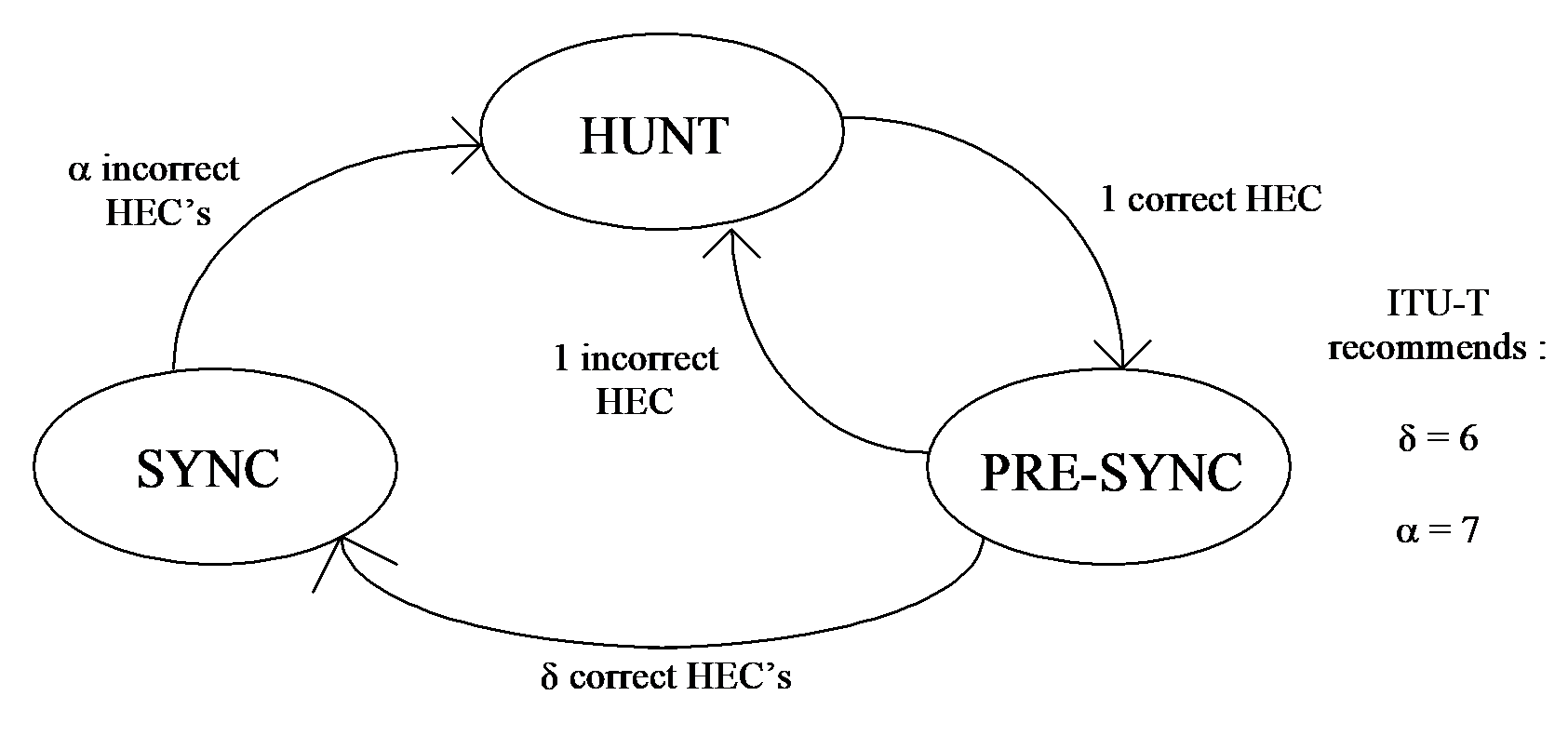
This basically says that, in order for the ATM receiver to declare that it has lost synchronisation, the headers of seven consecutive cells must be corrupted. When trying to regain synchronisation it waits for seven consecutive correct headers before it is sure.
With this in mind, the relationship between the BER (when randomly distributed) occurring on a link and the expected time period between loss-of-synchronisation events can be investigated. This has been done in [2]. When considering a 2Mbps trunk and a 10% probability of loss-of-synchronisation it was found that, even at a BER of 10-3, this period is in the order of two days. At a BER of 10-2, it is around 70ms. Hence, in moving between these two BER values the effect on synchronisation goes from being inconsequential to having a large negative impact on the operation of the link. Thus it can be said that BERs of 10-3 or better will not cause any significant degree of synchronisation loss.
It was also found in [2] that, at BERs of 10-3 or better, even when loss of synchronisation does occur there is a very good chance it will be regained by the end of the first seven cell periods that follow, thus minimising disruption to the network.
An increase in the value of α could be used as a means of improving the probability of remaining synchronised when the BER is near 10-2. However, because of the high probability that cell headers are errored (around 33%) there is still a very low probability of regaining synchronisation, even with a reduced value of δ. This makes the cell delineation process unreliable and provides little benefit.
Cell header errors
Errors in a cell header can cause it to be discarded or incorrectly routed. If a single bit error occurs this can be detected by the receiver as well as corrected so that the cell may then continue through the system. Double bit errors can be detected. If other error patterns occur in a header, they may or may not be detected. When they are detected the whole cell is discarded to prevent it being mis-routed. Errors are not detected if they change the header in such a way as to make the received HEC valid for the received header. If the changed header contains a valid virtual path indicator/virtual channel indicator (VPI/VCI) then the cell is routed to that channel and ends up as an extraneous cell in a user’s stream. If the VPI/VCI is invalid, the cell is discarded.
The result from the point of view of the users is that their stream may either have missing cells, or extra cells intended for another destination. The ATM protocol does not attempt to cope with such possibilities, leaving it to the higher layer protocols to deal with the problems caused. With this in mind, it may be appropriate to provide extra protection to the header, at the ATM layer, so that the Cell Loss Rate (CLR - the proportion of cells dumped due to header errors to those which are retained) is reduced to an acceptable level if the BER of the link is causing cells to be lost at a rate that these higher protocols can’t cope with.
Effect on TCP/IP based data transfer
The loss or mis-routing of an ATM cell will affect the performance of any higher layer protocols that the ATM stream is transporting. A common example of this is where ATM is used to transport TCP/IP data connections. An IP packet of size 1024 bytes is mapped into 24 ATM cells and carried in an ATM Adaptation Layer – 5 (AAL-5) frame. If any one of these cells is missing by the time the frame makes it to the receiving end then the frame will be discarded and the packet cannot be properly reassembled, rendering all the information in the other 23 cells unusable.
The TCP protocol will cause the sender to retransmit this packet as well as other subsequent packets that are already in transit. Long Fat Networks (LFNs) with a high bandwidth x delay product contain a relatively large volume of data that is in transit at any instance. The above retransmission mechanism will obviously have a larger impact on throughput in such networks. For example, a 2Mbps, 250ms delay ATM satellite link could contain up to 50 IP packets, of 1024-byte length, at a time. Thus a single cell loss can cause a much greater reduction in system throughput than is at first apparent. Exacerbating this problem is the fact that TCP interprets the loss of packets as being due to network congestion and therefore reduces its transmission rate.
There are efforts [3,4] that endeavour to minimise the retransmission of packets and/or cells that have safely been received. However, if cell loss is occurring often it may also be necessary to implement an error correction function to cover the ATM header to ensure cells reach their desired destination.
Effect on voice transport
The loss of a cell from a virtual circuit (VC) containing voice information can affect that service in various ways, depending on how the voice is being transported within that VC.
If a single voice call is being transported on the VC then the voice segment contained in the cell payload will be lost. The ATM Adaptation Layer (AAL) used allows the receiving entity to detect that the cell has gone missing and it can fill up that time period with null information so that the timing of the surrounding voice information is maintained. The user’s perception of this loss will depend on how the voice has been encoded. As discussed in the following section, the more compressed the voice is the more noticeable the disturbance is likely to be.
Thus the loss of a cell containing voice will not cause the throughput problems that the loss of a data cell can but it may still result in deterioration in the perceived call quality.
Cell payload errors
The ATM protocol itself does not provide any protection against errors in the cell payload. The overall effect of these errors on a particular service depends on the protocol layers which that service employs above the ATM level.
Effect on TCP/IP-based data transfer
TCP/IP Maximum Transfer Units (MTUs) are often thousands of bytes long and hence when transported using ATM a single MTU is carried by several dozen cells in an AAL-5 frame. Even if we ignore the possibility of cell loss, at any particular BER, there is still a considerably greater chance that the contents of an MTU/AAL-5 will be errored than that of an individual cell. An error anywhere in an AAL-5 frame will result in the frame being discarded in the same way that a missing cell could cause rejection. The TCP/IP protocol causes the MTU to be retransmitted until it is received error free. This results in degradation of the data throughput rate, with the worst case being a throughput of zero. This problem is exacerbated when the end-to-end delay that TCP/IP encounters is increased.
It is possible to make modest gains in the throughput by tweaking the TCP/IP protocol parameters such as MTU size and window size. However, the benefits of doing so are really limited to error free or low error rate links. Increasing the MTU size reduces the overhead of acknowledgments but if errors are present the probability per MTU of an error is increased. Increasing the window size means more information can be sent before an acknowledgment is required, and so can increase the performance over links with a long delay. If errors are present there is still the same chance that any particular MTU will be errored and so congestion due to retransmission will be much the same.
The discussion in [2] shows that the poor performance of TCP/IP over ATM on an errored link (even at a reasonably low BER of 10-6) is due to errors in the ATM payload, not loss of cells due to errored ATM headers. These payload errors cause a great deal more MTU retransmissions to take place than does the loss of cells.
For the protocol to work well, the error rate seen by TCP/IP needs to be improved. If nothing can economically be done about the fundamental BER of the link, then the solution entails some form of protective coding. The degree of protection provided must be traded off against the bandwidth/delay overhead it incurs.
Effect on voice transport
Real time network voice services do not have the same stringent requirements for error-free delivery of information as data services. Voice information is sent into the network only once and no mechanism is employed to overcome lost or errored information.
In an ATM network, the quality of a voice service (QOS) can be affected through cells being lost or through errors in successfully delivered information (network delay and delay variation are also factors which affect QOS but are not the focus of this discussion). The end result of how this affects a particular voice call depends on a number of things.
Generally, the more heavily compressed a voice stream is (as a result of the encoding scheme used), the more noticeably it will be affected by errors. A simple PCM voice stream contains a sequence of bytes that represent the amplitude of the analogue voice signal at each sample interval. If a bit becomes errored its resultant effect on the reconstructed voice signal only lasts for the duration of a sample period. This effect may not even be noticed by the listener and so ultimately doesn’t affect the QOS perceived by the user.
When a voice signal is heavily compressed for transmission through the network, the data rate is reduced. In doing so however, each bit has significance over a greater period of time and so the effects of errors can last longer and be more noticeable. Hence it is of increased importance to protect against errors in the encoded data stream. The type and degree of error protection that is used depends on the voice coding scheme that has been employed, the BER of the underlying link and the user’s expected quality of service.
Approaches to mitigating the effects of errors
No additional protection
If sufficient link power is used for a satellite connection (for any specific modulation scheme) the resultant error rate can be reduced to a level whereby the ATM protocol performs well over the link without any underlying coding having to be used. The power level required to achieve this performance may be beyond the range of the satellite terminal or the satellite operator may not allow this level to be used.
Bulk trunk protection
The data content of a link may be protected by blindly encoding the whole bit stream. This method does not require the encoder to have any knowledge of the protocol that the data stream forms. It incurs a constant overhead on the link bandwidth. The coding can take the form of block codes (such as Reed Solomon), convolutional codes (such as Viterbi) or a combination.
The main drawback is that the degree of coding used needs to cater for the requirements of the least error-tolerant service that is using the link. Other services that with can withstand higher error rates are thus over-protected and bandwidth is wasted. Also, no advantage can be taken of the times when the link BER is better than its worst case, reducing the degree of protection that is actually required.
ATM-aware proprietary techniques
The above approaches are capable of producing workable systems but are obviously not the most efficient way of tackling the problem. There are a couple of companies that have produced products that attempt to provide efficient solutions to the problem of error-prone ATM links. The products use mechanisms that are proprietary and require the manufacturer’s equipment to be used at both ends of the satellite link.
One of these products is the Comsat ATM Link Accelerator (ALA), which is designed to improve ATM network performance over satellite and terrestrial wireless links operating at bit rates of between 2.4kbps and 8Mbps. It places all cells into its own frame format and then performs frame-based Reed-Solomon forward error correction (FEC) coding and frame interleaving. The framing is employed to reduce the loss of cell delineation problem and the FEC coding addresses the problem of errors occurring in the cell header and payload. It is capable of adaptively altering the degree of Reed-Solomon coding it uses based on the BER value that is present over the link. This adaptive coding incurs a bandwidth overhead that is in the range of 1 to 8%.
Thus when the link conditions are good it employs minimal FEC coding, maximising the bandwidth available for ATM traffic. As the link conditions deteriorate the FEC coding level is progressively increased until it reaches its maximum level. The ALA’s Reed-Solomon coding is designed to work in conjunction with convolutional coding contained within the satellite modems.
The ALA also includes other functionality such as the ability to perform header compression, data compression and priority queuing.
The other product that attempts to overcome the effect of errors on ATM is the Lucent AC120 ATM switch (previously known as the Yurie LDR200). This incorporates its ATM resilience functions within an ATM switch. It connects directly to the satellite modem.
Like the ALA, the AC120 also uses its own framing mechanism to maintain cell delineation even at very bad BERs. To protect against errors in the header it uses a redundant addressing scheme within the existing VPI/VCI header bytes. For any actual VC traversing the link the unit can automatically set up multiple redundant VCs. The addresses of these redundant VCs are within a predetermined error distance of the actual VC address. The receiving AC120 maps any information received on this set of addresses back into the single actual address before switching it through to its destination.
Obviously this process limits the number of actual VCs that can be set up over the link. However, this is unlikely to be a problem since the link is low bandwidth and hence the number of desired connections would generally be limited.
To deal with errors in the payload, the AC120 allows the network manager to add FEC coding to the cell payloads of selected VCs. This way, the overhead produced by the FEC coding is only incurred by those services that actually require it.
Selecting the most appropriate approach
Any of these approaches may be considered attractive, depending on the circumstances in which an ATM satellite link is being used.
If there is some degree of freedom available in various satellite system parameters, the simplest approach may be to add no extra error protection to the link and instead just alter one of these parameters until acceptable performance is obtained. For example, it may be possible to increase the transmitter power, use a higher gain receiving antenna or lower the link data rate. Any of these changes would decrease the overall efficiency of the satellite system but can be implemented with little or no additional equipment.
Using bulk trunk protection would be appropriate when the sacrifice of a fixed percentage of bandwidth for the purpose of protective coding is considered acceptable. As mentioned earlier, the level of coding used would need to be sufficient to protect the most error sensitive service being transported as well as catering for the worst case BER that the link would regularly encounter. As such, the coding level (and thus the bandwidth it consumes) would often be greater then necessary.
Using one of the more intelligent but proprietary solutions can offer the most efficient use of bandwidth by applying error protection when or where it is most needed. It requires the purchase of specialised equipment that must be used on each end of the satellite link. The ALA approach uses a time-varying coding mechanism to overcome errors adaptively whereas the AC120 approach is based on a service-varying coding mechanism. Which of these approaches is more appropriate is influenced by the characteristics of the link and the profile of different services it is carrying. It may be more attractive to use the ALA on a link that is often affected by rain fade, causing large and ongoing variations in the BER over the link. The AC120 may be a better choice where the BER is more stable and the link is transporting only a small proportion of connections requiring additional FEC protection.
Benefits of implementing resilient ATM in battlefield communications
Communications within, and to and from, the battlefield environment often involves using trunks that are of low bandwidth compared to fixed networks. With the ever-increasing volume of traffic these trunks need to support it is therefore important to make the most effective use of the capacity that is available. In the military tactical environment, one of the main bearers used are point-to-point satellite links. The use of ATM on these trunks can contribute towards achieving more efficient use but care needs to be taken to address the issues discussed in this paper.
In satellite systems, the Eb/No parameter is often used to provide a common basis for comparing different modulation and coding schemes. This parameter represents the ratio of energy per digital bit to noise power spectral density at the receiver and is represented in decibel (dB) units.
Techniques such as those employed in the ALA and AC120 products can enable a reduction in the Eb/No value at which acceptable error performance is achieved.
Consider the situation where the Eb/No is reduced by 3dB. The improvement in this parameter could then be traded off in order to influence beneficially other system parameters. For example, the receiving parabolic dish antenna could be halved in area (that is, 70% of the diameter), or the transmitter power could be halved, or the data rate could be doubled.
An alternative interpretation, is that for a situation where a link is achieving a BER of 10-2 (using Viterbi ¾ coding in the satellite modem) without any other error protection, these techniques could provide improvement to a BER of 10-7 with a corresponding improvement in effective data throughput, by sacrificing about 10% reduction in raw capacity (in the case of the techniques used by the ALA).
Thus the benefits which are achieved become tangible in terms of the equipment necessary to implement a reliable ATM satellite link. This, in turn, can improve the communications capability available within the battlefield environment.
Conclusions
It has been shown that ATM, being a protocol that includes very little built-in ability to overcome transmission errors, requires specific attention in order to deal with this issue. In the case of a satellite connection, it is possible to generally avoid problems through using sufficient link margin to reduce the BER to a workable level for most of the time.
However, in order to improve the performance of an existing system or maximise the cost effectiveness when implementing a new system, it is a realistic requirement that some form of ATM resilience capability be included. This is particularly true in the battlefield environment where it is crucial to achieve highly efficient communications networks within budgetary constraints.
The two products mentioned have different approaches to the common problem. Each has its advantages and disadvantages depending on the link conditions and traffic types involved. The main point of discussing them is to highlight the range of methods available to protect the ATM cells efficiently.
Errors in the ATM cell payload can reduce end-to-end communications throughput at BERs that pose little problem to the ATM layer itself. The types of functions included in the ALA and AC120 products are not only important to the effective operation of the ATM protocol but are also essential to the optimum performance of the higher layer protocols which ATM supports.
References
[1] ITU-T Rec I.432, B-ISDN User-Network Interface – Physical Layer Specifications, Helsinki, Mar 1-12, 1993.
[2] D. Wilksch, ‘Project Parakeet – The Performance of Asynchronous Transfer Mode Over Network Trunks’, DSTO Technical Report DSTO-TR-0551, Nov 97.
[3] M. Mathis, J. Mahdavi, S. Floyd, and A. Romanow, ‘TCP Selective Acknowledgement Options’, Internet Proposed Standard RFC 2018, Oct 1996.
[4] V. Jacobson, R. Braden, and D. Borman, ‘TCP Extensions for High Performance’, Internet Proposed Standard RFC 1323, May 1992.