
Volume 2, Number 1, March 1999
The Roles of Artificial Intelligence in Battlefield Command Systems
Abstract
As the pace of modern battle has increased, headquarter staffs have had to process increasing volumes of information in a decreasing amount of time. Assistance in this critical task must be provided by computer-based command systems that can automate time-consuming tasks. However, conventional computer-based systems provide only limited assistance in the intellectual tasks of planning and decision making. Potential to assist in these areas is provided by artificial intelligence (AI), which is vaunted as the next great revolution in information processing. This paper addresses the potential roles of AI in battlefield command systems. AI is briefly introduced, as are the relevant command and control tasks. The potential roles of AI are then discussed for each of these tasks and three operating modes are proposed to provide a framework for the consideration of new AI applications as they are developed.
Introduction
The number and sophistication of battlefield sensors and the capacity of communications systems have increased dramatically since World War Two. The subsequent expansion in data collection and reporting capability has led to a large increase in the volume of information received by a headquarters. At the same time, however, the pace of modern battle has meant the time available for decision making has correspondingly decreased. The disparity between the vast amount of information received and the time available to process it, cannot be reduced by simply expanding the size of the processing staff. The only solution lies in the extensive application of automation to process large volumes of information. Most modern battlefield command systems are therefore automated to some degree to increase the ability of the staff to handle many detailed and time-consuming tasks.
Conventional computer-based systems are very useful in automating many time-consuming tasks such as message formatting, document distribution, database search and digital-terrain display. They are extremely limited, however, in their ability to provide assistance in the intellectual planning and decision-making processes, such as preparation of appreciations and plans. Potential to assist in these areas is promised by the field of artificial intelligence (AI) which has been vaunted as the next great revolution in information processing.
AI-based planning systems promise an ability to monitor complex situations, to assimilate large quantities of data quickly, and to predict likely outcomes of possible courses of action. It is this ability, so crucial to command systems, that cannot be provided by conventional computer systems. Unfortunately, however, despite some 40 years of research, AI has delivered very few successful contributions in this critical area. Still, AI-based systems appear to offer the only solution to the types of processing required by commanders on the modern battlefield. Therefore, before AI can be considered for inclusion in operational command systems, its potential roles must be assessed correctly.
A brief introduction to AI
The term 'artificial intelligence' was introduced in 1956 and is now in common use. AI is as difficult to define as intelligence itself, but is perhaps best considered as: ‘... the interdisciplinary attempt to understand the nature of cognitive problem-solving and apply that understanding via computer hardware and software’[1].
There are a number of important differences between AI systems and conventional computer systems. Conventional systems use an algorithmic or procedural approach to problem solving in which there is a guarantee of success in a finite time. They use a step-by-step approach to store and manipulate data (numbers) within specific processing boundaries. To be successful, however, the program must contain all possible combinations of inputs and data values. In an extremely complex environment, such as the battlefield, the size of a conventional program (even if it was realisable) would be too large to be useable in a timely manner.
In AI systems, the software is non-procedural and can determine for itself how to continue in a given situation. The system stores knowledge and applies it to a variety of unspecified problems. Conventional systems cannot infer beyond certain pre-programmed limits, but AI systems can make inferences, implement rules of thumb, and solve problems in an adaptive manner. They can contemplate multiple, competing hypotheses simultaneously. They can function with data that contains errors, using imprecise judgemental rules. AI systems represent and use symbolic information (as opposed to using only numbers) and use heuristic processes (as opposed to algorithmic processes). Heuristic processes are problem-solving methods that may not lead to a solution but offer a shortened path towards the answer.
AI research covers a wide field but tends to focus on three main functions:
- Artificial Sensing. Artificial sensing involves the conversion of verbal and optical information to text. It seeks to extract information from electronic images and signals without human interpretation. There are two main research areas:
- Vision Systems. This research aims to produce systems that are able to sense their environment, such as in automated manufacturing. On the battlefield, the aim is to interpret automatically images received from sensors and reconnaissance means.
- Speech Recognition. Speech recognition, or conversion of the spoken word into text, allows computers to understand humans without a mechanical input device such as a keyboard. On the battlefield, speech recognition allows spoken radio messages to be automatically received and stored.
- Artificial Understanding. After converting speech into text, the computer must be able to comprehend the written language. Natural language understanding aims to interpret natural languages, such as English, as they are spoken and written. Humans can then interact with computers in the most natural way, rather than through artificially developed computer languages. To understand a natural language, the computer must be able to understand written text using lexical, syntactic and semantic knowledge of the language as well as the required real-world information.
- Artificial Behaviour. Artificial behaviour involves the conversion of meaning to plans. The dominant research in this field is in expert systems and neural networks. These systems embody, at least in part, the knowledge of human experts that the system uses to solve or offer advice on real-world problems. This field has potential for the greatest impact on command systems.
Potential AI roles in command and control
Command systems support command and control (C2), that is, they support the C2 Cycle illustrated in Figure 1.
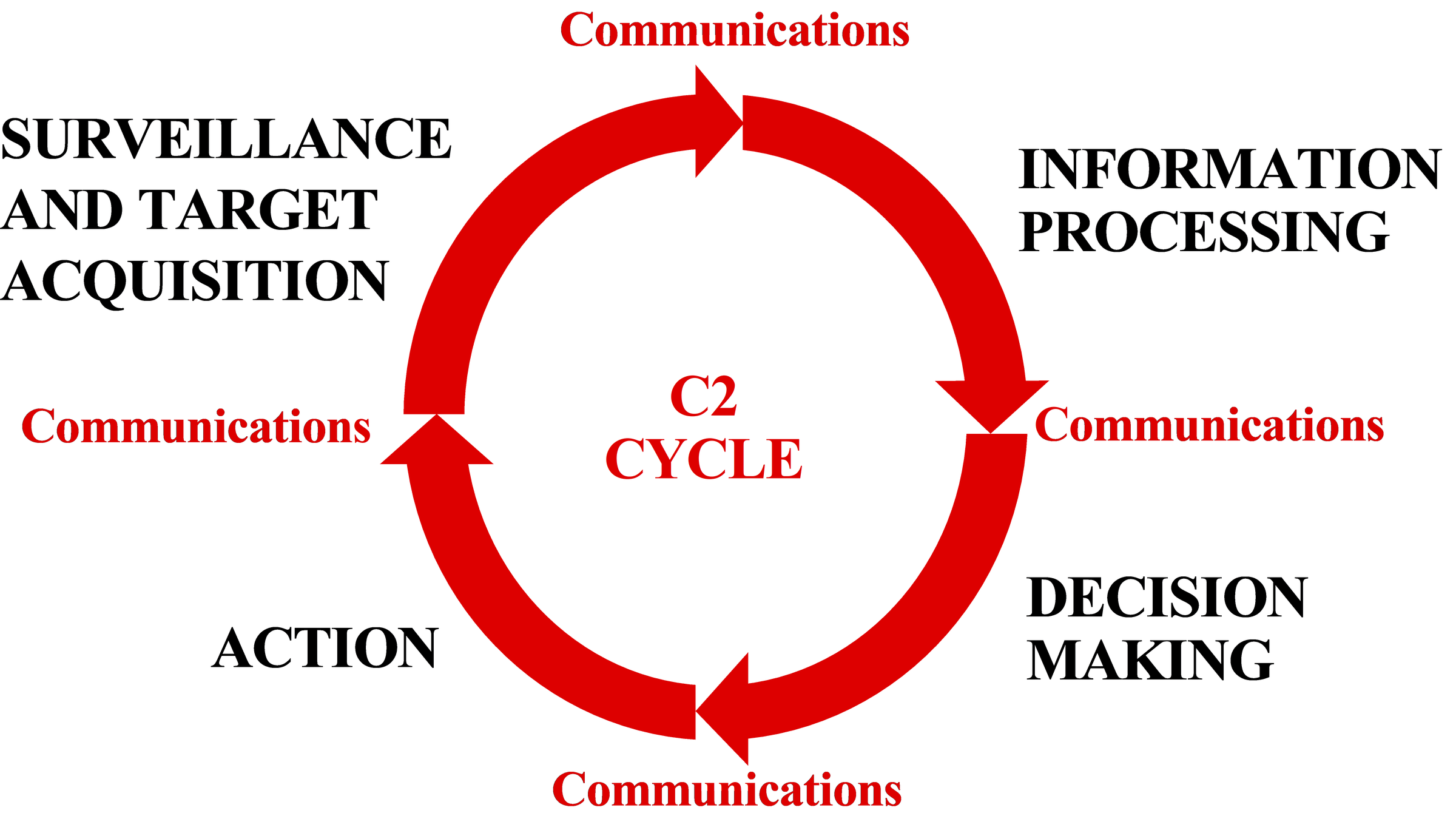
Information systems (or computers) exist in many locations on the battlefield and many have roles to play in the C2 Cycle. However, this paper concentrates on those systems provided to support the Information Processing and Decision Making half of the C2 Cycle.
The automated component of the command system provides the commander and staff with the means to support the C2 process across the range of military operations through the ability to complete the following:
- Data Understanding (processing and synthesis of raw data into descriptive information);
- Situation Analysis (analysing information to infer environmental descriptions);
- Planning (formulating courses of action); and
- Decision Making (selecting appropriate courses).
These areas are not mutually exclusive and often overlap due to the iterative nature of command and control.
Data Understanding
This phase involves the processing of input data to convert them into information. Inputs are often incomplete, incoherent, misleading, perishable or irrelevant. As the input problem becomes more severe, the analyst may lose the overall picture as he is consumed in handling detail, or is drawn into the enemy's deception plan because the deceptive inputs are both clear and coherent.[2] Processing is required to eliminate unwanted or corrupted data, and organise remaining data. Determining which data is relevant is situation dependent and is therefore difficult.[3]
Many AI development systems address the data understanding phase, including: analysis of intelligence messages; the extraction of target information from imagery; and processing radar, sonar and other signals. Systems in this phase represent all three AI research fields. Artificial sensing is critical if the command system is to interpret correctly the battlefield as presented by its remote sensors. From artificial understanding, natural language understanding is necessary to translate the vast amount of messages into information. Data processing and data relevance are the province of artificial behaviour and particularly expert systems.
Vision and natural language processing systems have not been successful despite showing considerable promise. They are still not capable of overcoming the major obstacles preventing them from extracting sufficient information from a remote image, or from understanding the natural language contained in a written message. Expert systems have, however, had the most success in this phase. The problem domains selected for research have been sufficiently narrow that successes can be claimed. For example, systems abound which deal with analysis of intelligence messages. Most, however, deal with limited environments such as maritime warfare where, on a single ship, a relatively small number of sensors produce data about a limited range of hostile threats. Very few successes have been achieved, for example, in the much more complex task of converting data into information in a divisional headquarters.
Situation Analysis
After the data are processed they must be combined with other information (synthesised) and then analysed. Situation analysis is the process of accurately building a model of the battlefield. It involves monitoring, situation assessment, hostile plan recognition, and the prediction of the status of a highly dynamic environment. Potential AI roles in this phase are to:
- construct and evaluate alternative situation scenarios,
- maintain a set of scenarios in response to changing information, and
- identify conflict between developed scenarios and any new information.
The AI research fields applying in this phase are artificial understanding and artificial behaviour. Natural language processing is applied to the collation of data represented in a natural way, such as that which has been extracted from a situation report. Situation analysis is the first phase of command and control requiring significant expert judgement to be brought to bear. It is therefore not surprising that most research effort in this phase has been in the application of expert systems.
Proposals for providing support using expert system technology have proved unable to meet the challenge, because the problem domain is so poorly bounded. The knowledge-based approach is only effective in domains where relevance relations between knowledge and data can be defined reliably in advance. This is not possible in battlefield situations, because data are subject to multiple sources of confusion and the situations to be analysed may be outside the knowledge base of the AI system.
Planning
Planning includes tactical planning, mission planning, route planning, resource management and scheduling. Possible courses are derived and their outcomes predicted. A significant portion of planning involves the generation and testing of constraints. There are some limitations of automated planners, but for problems involving the scheduling of action with no need to consider the actions of a competitive agent, these techniques appear quite appropriate. Tactical and mission planning are much more difficult due to the poorly bounded problem domain and the adversarial nature of the environment. Artificial behaviour systems and, in particular expert systems, dominate research in this phase.
Decision Making
In this phase, the advantages and disadvantages of each possible course are considered and the best course selected. Again, this is not a trivial task. There are very few current AI applications in this area. Those that do exist are based on expert systems and are limited to the provision of advice in highly specialised areas.
State-of-the-Art
Regardless of the tremendous potential for command and control applications, AI has failed to have a significant impact on current operations. Vision, natural language understanding, and neural networks are still immature technologies. Fielded systems operate in limited problem domains. Some successes have been achieved with expert systems although the range of problems to which heuristic solutions apply is much narrower than first assumed. Heuristics handle a small number of obvious cases but fail to work in general. It is now generally recognised that AI provides knowledge-based support to well-bounded problems but performs less impressively in situations with unpredictable characteristics preventing designers from identifying sets of responses. The process seems to be a gradual extension in the direction of AI, rather than a dramatic step. The current goal is to seek immediate AI applications to narrow but useful domains in what are termed ‘bite-size’ applications. Researchers still appear to be a long way from creating AI systems that measure up to the early ambitions of the field, with many even doubting current directions of research will lead to the desired standards.
There are also numerous constraints imposed by the requirement for real-time processing and the sheer size and complexity of the problem domain. To operate in military environments as effectively as a human expert, the machine must be able to contemplate the tactical picture as presented to it by many sensors, understand the terrain and weather, determine the morale of both enemy and own forces, access current intelligence data bases, determine relevant doctrine, identify possible enemy courses, identify a range of own courses open, select a best course and then proceed to direct and control the battle, whilst still contemplating the tactical picture, understanding the terrain and weather and so on. Such a process can only be accomplished successfully by a well-drilled commander and his staff. Replicating this process in a computer is far from current reality.
Operating Modes
Within each of the areas of command and control outlined above, there is a range of ways in which the human and the machine can interact within the system. It is quite feasible to build an AI-based system that operates autonomously. It is unlikely, however, that in any sphere of operations, particularly military ones, that the responsibility for the outcome of a critical venture would be handed over to a machine. In most cases a level of human involvement is demanded. The level of involvement will depend on the type of application and the ability of the machine to perform the task unsupervised. It is proposed that there are three modes in which an AI system can be used: advisory, supportive, and executive.
- Advisory. In this mode the AI system is simply available as a source of advice. The AI system can be separate (stand-alone) from the main command and control system, or it could be integrated (on-line). The advisory mode is the most desirable mode when integrating an AI sub-system into an existing conventional computer system.
- Supportive. Here the AI system performs some tasks up to a pre-determined level. The AI system may complete all allocated tasks autonomously or the operator may request specific tasks be referred for final approval. In another arrangement the AI system could be used to supervise the operator. That is the operator performs all tasks but the AI system duplicates, his effort advising where it disagrees and providing reasons. The supportive mode is not always an adequate solution in real-time problems because too much responsibility for timely action is placed on the user. It is convenient when AI technology is still relatively immature since the better-bounded problems can be allocated to the machine allowing the man to assume responsibility for the less bounded ones. As technology increases, the level of tasks accomplished by the machine will increase and the burden on the user will decrease.
- Executive. In this mode the AI system performs all processes and makes all decisions. The operator may ask the AI system to justify its decision and have the power of veto. The machine performs all functions, replacing the human in the process. Such systems are acceptable for many small problems such as signal processing because they do not encroach into the human decision-making domain. When the same techniques are applied to higher level domains where humans are involved, there are potentially serious problems of understanding, trust and responsibility for actions. Executive operation of AI systems on the battlefield will require mature systems from all three fields of AI research.
Summary
Table 1 summarises the above discussion. It identifies the AI research area(s) and the operating mode(s) that are applicable to each command and control application area. The current level of maturity of AI-based systems is also given for each application area.
Some trends can be noted. As the application area becomes less bounded, artificial sensing and understanding become less relevant and artificial behaviour becomes more applicable. Similarly, the applicable mode of operation becomes less autonomous as the problem domain becomes less bounded.
Conclusion
All of the three major research areas of AI (artificial sensing, artificial understanding and artificial behaviour) have great potential to be applied to battlefield command systems. They promise to provide essential assistance in each of the areas of data understanding, situation analysis, planning and decision making. When AI technologies mature, it is proposed that AI systems may be used in the advisory, supervisory or executive roles. Executive operation is applicable to well-bounded problems. However, as the problem domain becomes less bounded, the applicable mode of operation becomes less autonomous.
Despite tremendous potential for command and control applications, AI has failed to have an impact on current operations. Many technologies are still immature and fielded systems operate in limited problem domains. Yet, regardless of the considerable research and development required to solve problems with current AI systems, it is inevitable that future battlefield command systems will be based on this technology in order to meet the increasing functionality demanded by users. Conventional computer systems have proved very useful in automating many time-consuming tasks. They are extremely limited, however, in their ability to provide assistance in the intellectual planning and decision-making processes. AI-based systems appear to offer the only solution to the types of processing required by commanders on the modern battlefield.
References
[1] S. Andriole, Applications in Artificial Intelligence, Petrocelli Books, Inc, Princeton, NJ. p. 62, 1985.
[2] M.J. Coombs and R.T. Hartley, Design of a Software Environment for Tactical Situation Development, Report MCCS-88-144, Computing Research Laboratory, New Mexico State University, p. 3, 1988.
[3] J.P. Schwartz, et al., “A Framework for Task Cooperation Within Systems Containing Intelligent Components”, IEEE Transactions on Systems, Man and Cybernetics, Vol. SMC-16, No. 6, p. 792, November/December 1986.