
Volume 2, Number 1, March 1999
The Implications Of Deep Wading On The Design And Operation Of Armoured Vehicles
Abstract
This paper reviews the features of armoured vehicles that have been designed or adapted to wade through water up to five metres deep. The problems facing the designer are highlighted, including water exclusion, air supply, heat rejection, underwater navigation and mobility. The operational difficulties facing the crew are discussed, including the need for extensive vehicle preparation immediately prior to deep wading.
Introduction
Deep water has always presented a major obstacle for heavy armoured vehicles such as main battles tanks. Lighter vehicles, such as armoured personnel carriers (APC), can be designed with the ability to swim but the demand for increasing levels of heavy armour protection makes this option less viable for modern vehicles. This, together with the uncertain theatre of operation for future deployments, has resulted in renewed interest in vehicles with the capability to wade in water to a depth of up to 5m.
This paper comprises a brief description of the techniques which have been used hitherto to enable armoured vehicles to deep-wade, a critique of these techniques and suggestions on how they might be applied to modern armoured vehicles, including possible enhancements.
Fording and schnorkelling - background
Shallow fording
Shallow fording is the ability of a vehicle, with its wheels or tracks in contact with the ground, to negotiate water obstacles without prior preparation. In practice, some minor preparation by crews is usually necessary, for example the checking of access plates and their gaskets, and treatment of any doubtful ones with sealant. Allowance must be made for the pitch attitude of vehicles on entry and exit. Fording depths vary according to particular equipments; Def Stan 00-6/Issue 1 specifies several categories varying from 0.5m to 3.25m, dependent on the vehicle type:
- Typically, for turreted vehicles the shallow fording depth will normally be slightly less than the height of the hull.
- For vehicles of box-like configuration, for example APCs, the same consideration applies. Provided doors, firing ports and vision slits are properly sealed, the shallow fording depth achievable is higher than that for tanks and SP guns, which have relatively shallow hulls.
- For B vehicles, the fording depth without preparation is usually comparatively small, for example, 0.5m in the case of Landrover and 0.75m for medium mobility load carriers.
Deep fording
Deep fording is the ability of a vehicle, with its wheels or tracks in contact with the ground, to negotiate water obstacles greater in depth than those that it can shallow ford. This is achieved by prior application of special waterproofing kits which may need significant time and engineering support to fit. Deep fording for both A and B vehicles implies the capability to ford to a depth of at least 1.5m, and for fully enclosed armoured vehicles, to the top of the roof or turret. For vehicles of box-like configuration, there will be little difference between shallow fording and deep fording depths.
Schnorkelling
Schnorkelling, or schnorkel fording, is the ability of a vehicle, with its wheels or tracks in contact with the ground to negotiate water obstacles while completely immersed by using special schnorkel fording kits or built-in schnorkelling equipment.
The height of the schnorkel intake should be about 1.5m greater than the water depth to allow for sinkage on the bottom, waves and splash, and entry and exit angles. The schnorkel is required to provide air for the engine and crew, and a means of communication.
Schnorkelling - design considerations
Schnorkel design
Two basic approaches to schnorkel design have been employed: a tube or a tower.
Tube-type schnorkel
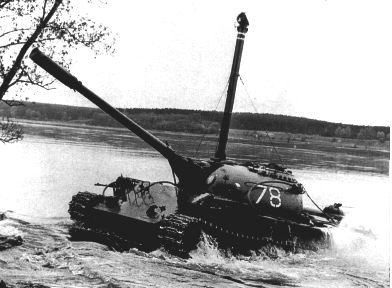
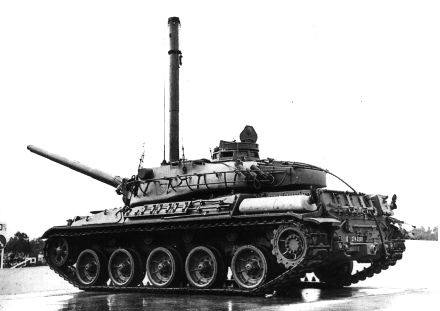
In some French and Russian practice, all hatches are sealed and a relatively narrow breather tube (diameter ~150mm) is fitted to a special aperture on the turret or roof (Figures 1 and 2). The tube can also be used as a rudimentary periscope for the commander, though the normal means of navigating across a river is via radio directions from a crossing commander on the bank. Stowage of the schnorkel tube when not in use is facilitated by splitting into several shorter lengths, which stack inside one another.
Tower-type schnorkel
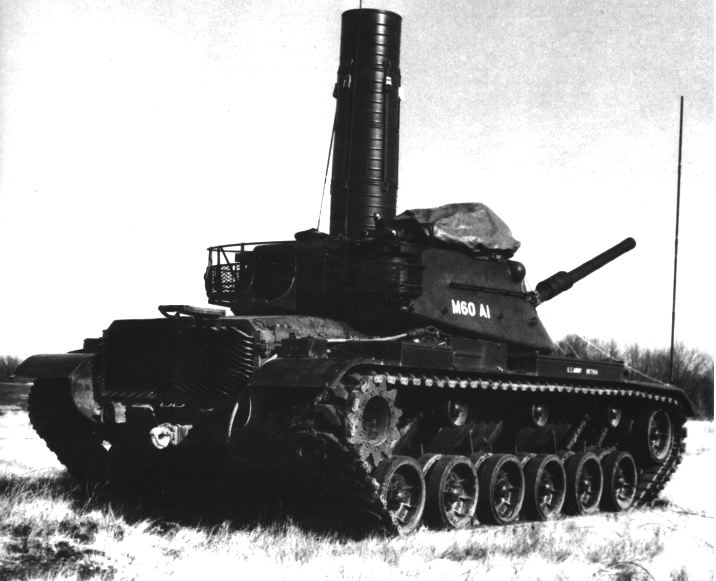
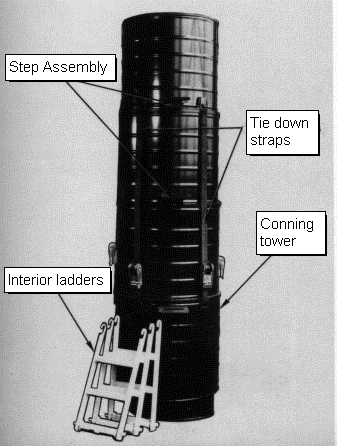
US and UK practice has generally been to fit a large schnorkel, usually to the commander's hatch. This is in effect a conning tower, at the top of which the commander can stand and look out (Figures 3 and 4). The use of a conning tower offers an important advantage in commanding and navigating the vehicle. This is particularly important for a vehicle that may operate in isolation.
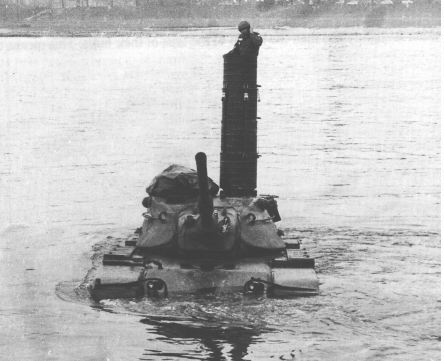
The tower serves as an emergency escape route for the crew should the vehicle become immobile or flooded while under water. In this system, radio communication while immersed is not essential, although still desirable. Stowage of the large diameter tower on the vehicle is difficult, even in sections, and presents a substantial logistic burden when separated from the vehicle. Cranage may be required to erect the tower. A typical tower is shown in Figure 5.
Engine induction air and exhaust
The engine induction air is usually provided via the same schnorkel tube (or tower) that supplies the crew compartment. It is advantageous to arrange for the engine to draw its induction air from the crew compartment, since this creates a continuous flow of fresh air for the crew through the schnorkel. The engine exhaust gases are discharged under water. To prevent water from entering the exhaust, even if the engine is stopped, a rubber fishtail, ball-float valve or spring-loaded flap-valve is used. Russian practice is to use the latter, which is bolted in position as part of the preparation process for a deep water crossing.
Flooded engine compartment
Past US practice, in vehicles such as M60 with air-cooled engines, was to allow water to flood the engine compartment when fording. The engine then effectively becomes water-cooled. The same approach could be adopted with a water-cooled engine, in which case the radiator would become water-cooled instead of air-cooled. This, at first sight, appears to be an attractive option since no measures are required to seal the engine bay covers and cooling air inlet
and efflux louvres, though the cooling fans must be slowed or disconnected prior to entering the water. However, during deep wading, the engine induction air, which is normally drawn from the engine bay, must be provided from the schnorkel (usually via the crew compartment). Re-routing the induction air ductwork would be a time-consuming and fiddly crew task, which, if not performed to perfection would result in irreparable damage to the engine if water were ingested.
Other obvious problems arise due to the need to waterproof electrical components and assemblies such as the engine management system, the transmission control system and the generator. Mechanical components, linkages and operating cables are also at risk from water ingress. Less obvious, though very important, are the engine crankcase, gearbox and final-drive breathers. During deep wading, these would best be vented to the engine air intake. Failure to do so would result in water ingress and failure of the engine and/or gearbox.
If an APU is fitted, this requires similar consideration.
Other problems associated with a flooded engine bay could result from thermal shock of very hot components, such as the exhaust manifold and turbo-charger. A cracked manifold could allow water into the engine with catastrophic results.
One major advantage of the flooded engine bay approach is that preparation can be undertaken in advance, well away from the anticipated river crossing, using whatever natural cover may be available.
Dry engine compartment
Usual UK and Russian practice on, for example, Chieftain and T-Series tanks, is to waterproof the engine compartment. Keeping the engine compartment dry requires much additional waterproofing kit to cover the large louvres over the engine bay. However, the absolute integrity of the seals on these covers is not paramount - modest leakage can be dealt with by bilge pumps. Russian tanks have the appropriate covers stowed adjacent to the louvres. After releasing the catches, the covers can be swung into position and fastened down.
If the radiator is also within the sealed engine compartment, as in Russian practice, then the duration of underwater operation is limited by the thermal capacity of the engine cooling system, whose temperature will rise continually while the waterproof covers are in place. If longer duration operation is required, one solution would be a separate engine-coolant-to-water external heat exchanger to dissipate the heat from the engine. An attractive alternative would be to mount the radiator in a separate compartment, so enabling the engine to remain dry whilst the radiator is flooded. Adequate openings should be provided under and above the radiator to allow the water to cool the matrix by natural convection. However, housing the radiator in a separate compartment will hinder the removal and replacement of the whole power pack as a single unit.
The engine induction air can continue to be drawn from the engine bay in the normal way, provided a simple access hatch is opened to communicate with the crew compartment which, of course, receives its air via the schnorkel. The air enclosed in the engine bay will heat up, due to the heat rejected from the surfaces of the engine block and exhaust manifold. Some of this heat will be conducted through the engine bay walls and dissipated to the surrounding water. However, the air drawn into the engine will still be hotter than normal, with a consequent reduction in power output and fuel efficiency, though only to an extent similar to that experienced when operating in high ambient temperatures in, for example, desert regions.
The risk of thermal shock-induced cracking of the exhaust manifold is lower in a dry engine bay, but any minor gas leaks would be exacerbated due to the increased back-pressure on the system when submerged. The crew would be in danger from leaking exhaust gases, since the crew compartment is open to the engine bay during schnorkelling.
If the radiator is housed inside the sealed engine bay, final preparations for schnorkelling can only be undertaken immediately prior to entering the water since, once the engine bay louvre covers are in place, little heat dissipation from the engine is possible. An externally mounted radiator would largely overcome this limitation, provided the cooling fans are left turned on, though the air enclosed in the engine bay could still get excessively hot.
It is unlikely that the engine could sustain high power without extra cooling of the engine bay. This could be provided by circulating the air in the engine compartment through an air-to-river-water heat exchanger.
Underwater mobility
Underwater mobility is another factor which might influence the choice of a dry or flooded engine bay. A vehicle with a flooded engine bay will be less buoyant than if the bay remains dry. This will result in a higher ground pressure and greater sinkage while submerged. This handicap would be most severe on a soft, muddy river bed; once the vehicle bellies on the mud, it would be in danger of becoming totally immobilised. Conversely, on a firm, stony river bed, a higher ground pressure might offer an advantage in terms of the traction available. A less buoyant vehicle would also be more stable in strong river currents. Weight distribution may also have an important effect on underwater mobility - a vehicle which is too buoyant at one end could be difficult to control.
Exiting from a river is often a very difficult manoeuvre. The extra weight of a flooded engine bay would tend to make it even more so, and the water discharged therefrom over the river bank may further hinder any following vehicles. A rocket-propelled grapple could be an invaluable aid to driving ashore.
Other considerations
Clearly, suitably designed seals would be required for access hatches, doors and temporary cover plates for the engine bay louvres and NBC system air intake. In addition, many other exterior components would require careful consideration at the design stage to ensure their suitability for submersion to depths of up to 5m in silty or sandy water. Major items include wheel bearings, trailing-arm bearings, suspension damper units, idlers, top rollers, track-tensioning gear, final-drive gearboxes and winches, all of which are fitted with seals which might need upgrading to avoid premature failure due to the ingress of particulate-laden water. Minor items prone to damage include hinges, latches, locks, lights, horns, cable glands, sights and sensors.
A vehicle designed for schnorkelling would have a substantial extra inventory including engine louvre cover plates, NBC inlet cover plates, schnorkel tube or tower, exhaust gas one-way valve, fixing tools, a gyro compass for underwater use, life jackets, face masks or respirators, bilge pump, and so on. If there is a requirement for NBC protection while prepared for schnorkelling, further special consideration would be required.
Alternative approaches
The prospect of schnorkelling is universally feared by armoured vehicle crew members. An alternative approach could be to drive the vehicle under water by remote control, the crew crossing the water obstacle in an inflatable boat. This could be feasible at modest cost, particularly for a next generation "drive-by-wire" vehicle.
For medium-weight vehicles, the possibility of equipping the vehicle with buoyancy aids to enable it to swim might be considered preferable to schnorkelling.
Conclusions
- Even for a well-trained crew, schnorkelling in any vehicle is fraught with difficulties, both operational and psychological. On reconnaisance missions, the crew face the additional problem of operating remote from other vehicles, with no assistance available. Therefore, before committing to a vehicle designed for schnorkelling, it is worthwhile considering further the possibility of equipping the vehicle with buoyancy aids to enable swimming as an alternative means of negotiating water obstacles.
- If schnorkelling is to be adopted for a modern vehicle, a configuration utilising a dry engine compartment with a flooded radiator compartment offers some advantages. Although preparation time is longer than with a flooded engine bay, the reliability of the vehicle both during and after the crossing is likely to be better, and the risks to the vehicle and crew are lower. However, such a configuration does not lend itself to the concept of the quickly removable power-pack.
- A tower-type schnorkel is preferable operationally, particularly for a vehicle operating solo, but presents more problems logistically.
- Many vehicle components and systems would require special attention to their detailed design in order to function reliably during and after immersion in deep water.
Appendix
Soviet experience
It is evident from information culled from Soviet sources that tube schnorkelling is a potentially hazardous activity and can be extremely traumatic for the crew, especially if things start to go wrong. The author’s impression is that the whole operation is at the margins of both the vehicle's and crew's capabilities and requires punctilious adherence to demanding and comprehensive procedures during preparation and wading.
Crew tasks during preparation are numerous and include such things as:
- checking exhaust manifolds, bellows and pipes for cracks;
- lubricating trailing arm bushes to impede the ingress of water;
- removal of numerous external fittings such as sights and searchlights;
- raising the engine coolant boiling point by increasing the system blow-off pressure;
- checking the vehicle for straight-running when no steer is demanded;
- fitting and checking a direction gyro for the driver to mitigate disorientation under water;
- fitting and checking the integrity of numerous external seals and gaskets, and applying sealing compound if necessary;
- fitting, and verifying the correct operation by a trial immersion, of spring-loaded flap valves on the engine exhaust stacks;
- checking the integrity of the entire crew compartment waterproofing either by a trial immersion and monitoring the rate of water ingress or by sealing the schnorkel inlet and monitoring the rate of depression of the crew compartment air pressure while running the engine at a known speed; and
- fitting and checking the operation of an electric bilge pump.
Russian tanks generally wade in groups following a lead vehicle in line astern. The complete line is controlled by a crossing commander on shore who passes simple commands by radio to the drivers of all vehicles in the line. These commands are intended to maintain line and avoid collisions between moving and immobilised vehicles. There is no return communication from the vehicle crew to the crossing commander.
There is a specific training manual for water crossing procedures which includes detailed reconnaissance of suitable crossing sites and site preparation. Because of the poor engine cooling provision, crossings exceeding 300m must be started with a virtually cold engine. Notwithstanding this, the engine coolant temperature may rise to 115°C during a crossing. Standard procedure includes stopping for several minutes at two or more stages of immersion after entering the water to check for leakage before proceeding with a full crossing.
In addition to life jackets, other safety equipment provided for crews include gas masks which are deployed if exhaust fumes enter the crew compartment. No auxiliary air supply is provided to assist escape in the event of the vehicle flooding. Crew training includes escaping from flooded vehicles.
Following completion of a crossing, comprehensive de-preparation procedures are necessary before continuing the mission.
It can be concluded that executing a water crossing using the Russian technique (or indeed any schnorkelling technique) is a very difficult and time-consuming operation that would severely disrupt the normal pace of an advance (or retreat).