
Volume 1, Number 2, July 1998
Defence Applications of System Dynamics Models
Abstract
System dynamics (SD) modelling has been successfully applied in many commercial scenarios. This brief paper reports on recent successful applications of SD in strategic planning and management of defence weapon systems and in particular combat radios. The application of SD has generated shared understanding and allowed tailored logistics to be provided more cost effectively. Case studies illustrate the application of SD in defence.
Introduction
Governments around the world are keen to reduce the cost of being prepared for military action. This year has highlighted how rapidly the strategic defence environment can change when influenced by economic ‘meltdown’. The key to managing defence capability is the determination of preparedness. A need has been recognised in the Australian defence environment for weapon system management that:
- minimises the risk of under or over procurement of defence assets;
- maximises the value obtained from existing defence assets; and
- balances logistic support requirements.
If the number of assets is under procured, or lacks the appropriate level of logistic support, the assets may fail to provide the capability or deterrent required thereby being of little or no defence value. If assets are over procured, or have greater than anticipated logistical cost then financial resources are trapped or excessively consumed. This paper illustrates how practical applications of system dynamics (SD) can be used to better manage defence capability.
Objective
In this paper we consider a weapon system to be any collection of like assets which are managed as a fleet to provide some form of military capability. Within an environment of tight fiscal policy the effective utilisation of the military assets is critical to maintaining a credible defence posture. The measure of success of a SD model [1] is the maintenance of a defined capability effectively utilising the assets at various levels of effort within a force structure that is ready and able to perform military operations. This is not a static situation, but is dynamic requiring continual adjustment to maintain optimum asset utilisation. This gives rise to the concept of weapon system preparedness.
System dynamics, being concerned with the causality within complex systems, is suited to providing better control in very turbulent strategic environments.
History
During the late 1980s, logistics within the Australian defence environment started to apply commercial planning practice to its business. Strategic planning was applied to military asset management and asset support. Best-practice concepts like Program Management and Budgeting (PMB), organisational empowerment, devolution and outsourcing were adopted. Emphasis was placed on integrated logistics support and life cycle costing. However, a pre-occupation with the inputs and processes detracted from organisational understanding of the levers that controlled outputs such as fielded defence capability.
The challenge of the late 1990s was to adapt the classic strategic thinking processes to the new dynamic business environment of defence. To understand the fundamental dynamics of defence asset management was to provide insight into the controls needed to respond rapidly to changing defence capability demands.
System dynamics
The management of defence capability was recognised to be a process of gaining control of weapon systems and particularly defence assets. The effective utility of the weapon system is its current capability in light of acquisition cost, logistic cost and potential life expectancy. Additionally, in rapidly changing defence environments more frequent capability upgrades are needed to keep the assets at the leading edge of effectiveness.
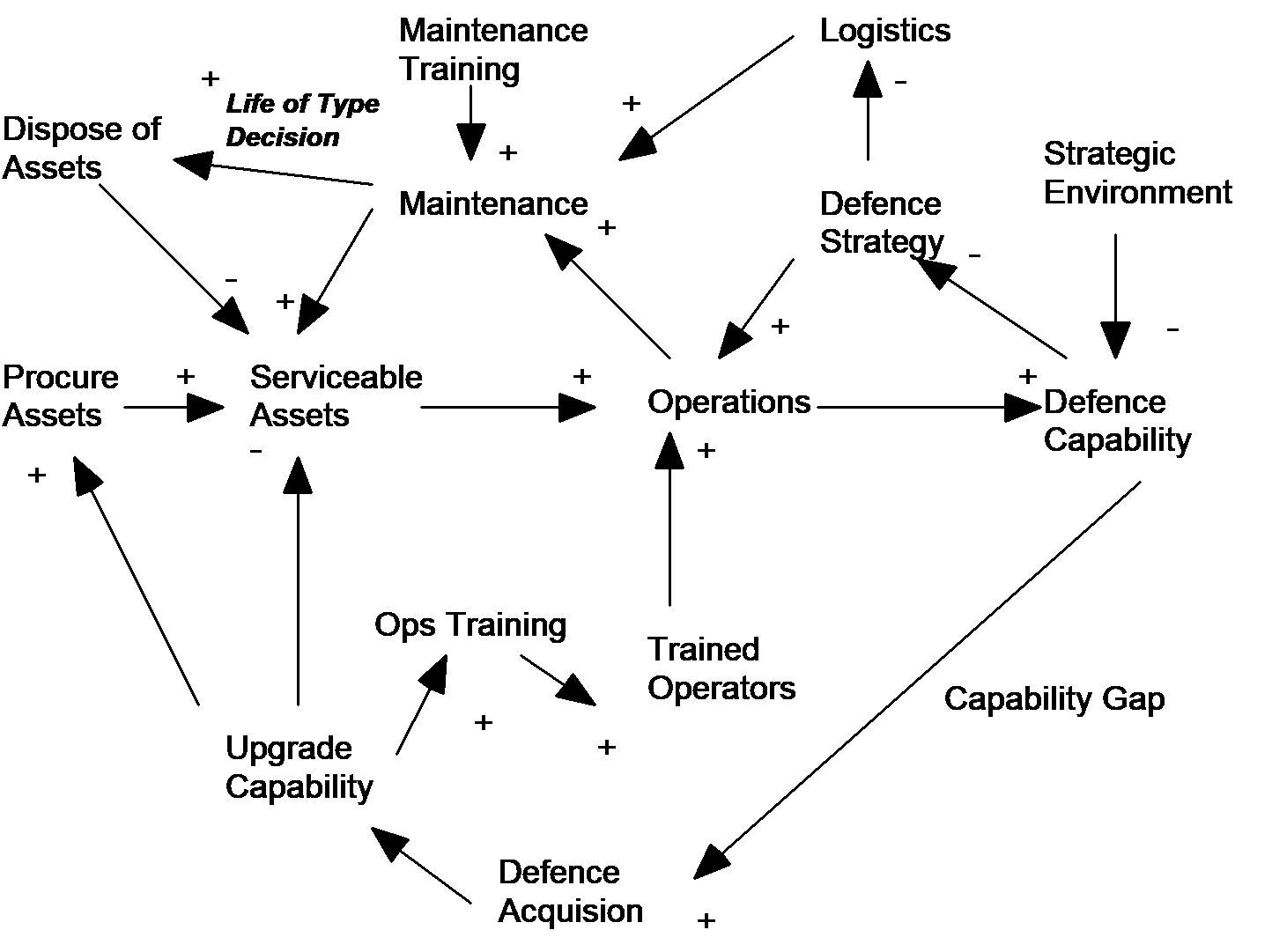
The causality diagram of Figure 1 can be used to illustrate the inter-dependencies within a fleet of military assets. If an asset is under-procured or lacks adequate logistics support, it will fail to provide the required capability through operational availability. Conversely if the assets are over-procured but not utilised, then defence resources are tied up without effective benefit. If Australia is to maintain its defence capability then ongoing weapon system upgrades will be required throughout the asset life cycle. Flexibility is required within the system dynamics to adjust, in a responsive manner, to changes in operational effort, capability or logistics support.
Early applications
A survey carried out by Support Command Australia in November 1997 confirmed that fleet management practice had deteriorated as a result of devolution of responsibility and increasing fleet management complexity. Weapon systems like the F-111 fleet and the Blackhawk / Chinook fleet displayed reducing availability, increasing logistic cost and increasing need for major capability upgrades.
In 1994 a small project was launched to generate a more responsive fleet management tool for both strategic and tactical management of the F-111 aircraft. Initially, a very simplistic SD model was developed in the ithink application environment. This SD model, entitled STRAT2020, characterised the interaction of aircraft operations, deeper maintenance, logistics support and capability upgrades. Using this strategic model, insight and adjustment to maintenance policy and operations were achieved reversing the declining availability trend.
In 1995 a longer-term project was launched to develop a more tactical SD based tool that could accurately predict individual aircraft activity ahead by 10 years. This tool, entitled FLEET DOCTOR was a hybrid tool utilising a database engine, an SD model and a project planning application. This product has been refined to assist not only in managing operational availability but also in automatically scheduling major capability upgrade programs.
Following these favourable results, a strategic model was developed for the Blackhawk / Chinook fleet to manage better the rapid operational usage in support of humanitarian food distribution in Papua New Guinea. This model again looked to optimising the capability of the Blackhawk fleet within constrained resource limits.
VHF radio model
In 1997, during a three-day workshop with project and logistic support staff, a model of the VHF army radio assets was developed. The objective was to illustrate the dynamic effects of various procurement and logistic support options available to the project director of Project Wagtail. The simulation controlled a fleet of 5,000 new field radios allowing a phased introduction and achieving a non-linear operational availability and usage rate. The model included:
- operation of some radios in the field;
- unit level maintenance and forward supply;
- brigade level maintenance and re-supply;
- regional logistics support;
- centralised deeper maintenance; and
- logistic supply chain delay.
The dynamic simulation was used to develop strategic plans for radio introduction at the project office and was transferred to the logistic command fleet manager to aid in ongoing fleet control.
Dynamics
The dynamics of complex systems involving fleets of assets that exhibit causality and inertia can no longer be intuitively managed. To illustrate this point, a gaming environment has been developed called AIRPOWER 2100. This board game establishes a simplified F-111 system architecture in which players are required to generate a time-varying level of aircraft on line, and rate of effort. The game has been played by operational, logistics, maintenance and strategic planning staff to illustrate the complex dynamics that can result in weapon system management [2].
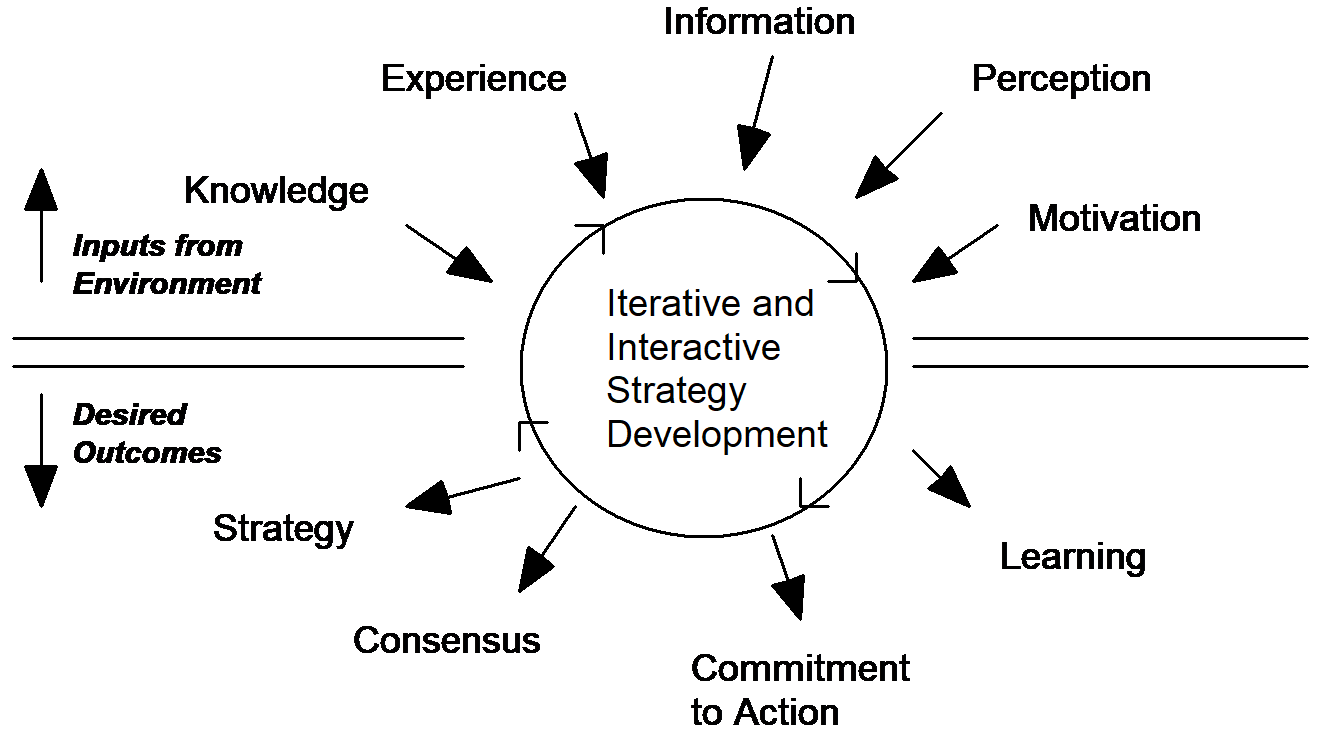
The game play has highlighted that many military managers rarely comprehend the complexity in controlling, let alone optimising, complex fleets of military assets. The SD models discussed in this paper have been developed by applying a methodology similar to that shown in Figure 2 [3].
Conclusions
The success of SD applications to defence has been built on the recognition that you need more than just a model. At a strategic level, the modelling facilitates organisational learning and the development of mental models. This supports the provision of strategic guidance and doctrine leading to consensus and commitment. At the tactical level it cultivates recognition of feedback and decision support within fleet control. The gaming environment enables players to experience long term system dynamics in an accelerated timeframe.
The SD models described in this paper have proved to be a significant tool in optimising defence capability through better asset management. The defence environment is littered with examples of expensive weapon systems that have failed to achieve the desired outcomes. This often occurs due to a lack of fundamental understanding of the dynamics of defence assets. System dynamics, if applied appropriately, can achieve real tangible benefits within defence.
References
[1] J. Forrester, Industrial Dynamics, Productivity Press, Portland Oregon, 1961.
[2] J. Kearney et al, "Fleet Doctor to Airpower 2100", International System Dynamics Conference, Turkey, 1997.
[3] A. McLucas, "Integrating Soft and Hard Systems Analysis", To be published, UNSW, Canberra.