
Volume 1, Number 2, July 1998
Towards Establishing the Information Requirement in the Battlegroup
Abstract
This paper attempts from first principles to establish some of the information flows and processes within the battlegroup. As a start point, it takes the current iteration of British Military Doctrine with its manoeuverist approach to warfighting and the consequent need for Mission Command. Using a Soft Systems approach to the analysis, a Root Definition of the battlegroup is derived which serves as the basis for discussion. It treats the battlegroup as a system, sitting within a wider system and itself made up of a number of similar and easily defined sub-systems. The flows between these can be related to the Areas of Interest, Operation and Influence and show that knowing the Origin, Location and Time of the information can be used to identify its relevance to a particular system.
Introduction
The origins of this paper lie in contemplation of two issues; the first, a comment from a UK defence manufacturer that they could supply a battlefield mission system and fit it to a tank but the difficulty was in finding out what the tank crew wanted to know. The second was the relationship, if any, between the overt espousing of a manoeuvrist doctrine by many countries and the explosion in the capabilities of information systems (IS), or, rather like Guderian having been signals officer, was this merely a fortunate coincidence? To answer the former, some understanding of the latter seemed essential and the starting point of this work, in the margins of normal duties. This paper is a summary of progress to date; much remains to be done, but I hope that others may find it a useful approach.
Manoeuvre theory and mission command
The intention of this paper is to attempt to determine, from first principles, the information requirement in the battlegroup, thereby providing a conceptual basis for considering the technical solutions. In order to set the problem in context, it is necessary to consider the implications of adopting a manoeuvrist doctrine and Mission Command. Manoeuvre warfare is a warfighting philosophy that seeks to defeat the enemy by shattering his moral and physical cohesion; his ability to fight as an effective, co-ordinated whole, rather than destroying him through incremental attrition [1]. To do this successfully requires us to get inside his decision making cycle so that he becomes reactive rather than proactive and collapses into chaos. Chaos is a condition of which we should not be afraid as long as our decision making cycle or OODA loop (or Boyd cycle after Colonel John Boyd, USAF) remains intact and we can operate at a higher tempo, or in the words of Guderian, “Don’t work hard, work fast”. Manoeuvre warfare requires us to be proactive and able to exploit the enemy’s weaknesses faster than he can respond. From this, for example, comes the concept of ‘recce pull’, where reconnaissance forces, having found a gap, ‘pull’ the main forces in after them. This inevitably means that decisions start being made at a lower level and flow upwards where superior commanders act to support them. If chaos is not to descend, then some framework is required which allows the junior commander to act with initiative to exploit opportunities as they present themselves. Thus we turn to Mission Command where orders specify desired outcomes (outputs) to be achieved with given resources (inputs) without rigidly specifying how this is to be done (the process). The junior commander needs to know, therefore, what it is his superiors, usually two levels up, wish to achieve so that he can direct his resources to that end. Mission Command means decentralisation if high tempo, or speed, is to be achieved. But to bring about the commander’s intent, action needs to be focused by the commander designating where his main effort is to be made, and this may change as the battle develops and other opportunities expose themselves. In designating his main effort, he is indicating to his subordinates where he is focusing his combat power at that time. For his subordinates to respond to keep the main effort focused requires sound planning for operations, a flexible framework within which to operate, and a high degree of situational awareness, if the commander at every level is to be able to ‘navigate, formulate his plans, make decisions, synchronise his assets and co-ordinate with his flanks’[2].
Impact of technology
The trend of technology, and particularly information systems (IS), has been to drive against the quintessential manoeuvre warfare described above, as it leads to the ability for detailed control at higher levels. The higher commander is now able to access not only his subordinates, but the levels below them and, if he so chooses, can issue orders directly to the lowest level, especially if he has access to intelligence which is relevant to that commander, since he who owns the intelligence becomes the decision maker. In general terms, the more complex the information, the higher and more centralised command becomes, and it is easy to envisage a stage where subordinate commanders are more akin to staff officers than commanders in their own right. If we are to retain a true manoeuvre warfare doctrine, it is important that command is retained at the appropriate low levels and whatever IS is used supports this. If the commander is to command effectively, and this is especially true within the battlegroup, he must be able to make quick decisions that are as accurate as possible. IS is there to support him by presenting information that is relevant in a simple, easily assimilated way. If information is not relevant, chaos ensues and temp is minimal. ‘Digitisation of the Battlefield is the application of information technology to acquire, exchange and employ timely, digital data information through the battlespace, tailored to the needs of each decider (commander, shooter and supporter) allowing each to maintain a clear and accurate vision of his battlespace necessary to support both planning and execution’. This definition, given by the US Army’s TRADOC [3], provides a clear picture of the desired end state and, rightly, emphasises that the information must be timely, and tailored to the user. The problem of ‘untailored’ information, or information overload, is well illustrated by the action of the General Officer Commanding 1 (UK) Armoured Division during Operation DESERT STORM in dumping several hours worth of intelligence data that he had not the time nor the means to handle. In Exercise WARRIOR FOCUS, held at Fort Polk, Louisiana, as part of the US Digitisation programme, Commander 2nd Brigade, 10th Mountain Division (Light Infantry) was overwhelmed by 30,000 messages in one day (1,250 per hour) against a projected baseline of 500-700 messages per day (25 per hour). Therefore, management of information is crucial if the user, whatever his function and whatever his level, is not to be inhibited by information that is irrelevant or by a lack of that which is; either of which circumstance will erode his capacity for making decisions.
Requirements for a battlefield IS system
The principles of Mission Command are: Unity of Effort, Decentralisation, Trust, Mutual Understanding, and Timely and Effective Decision Making [4]. These emphasise two crucial points for IT systems: the first, that the more fluid the nature of operations the lower the decision level should be set, and second, he who always waits for the latest available or ‘complete’ information, is unlikely to act decisively or in good time; in essence, the requirement for speed. Regardless of the technical ability to communicate with every level within a span of command, studies show that a ratio of more than four or five points of command to one headquarters is the maximum that a commander can manage effectively [5], and experience indicates that the commander risks becoming overloaded, with a debilitating effect on decision making, if more than three are active at any one time. Far from concentrating command, therefore, the commander may have to delegate either according to the operational framework existing at the time or by function [3].
From these considerations, we can outline some general requirements for a Battlefield IS System:
- It must allow the commander to act quickly and decisively by presenting information that is relevant and timely.
- The information must be relevant to the level of command.
- To be relevant to a commander, the information must be pertinent to his operational framework, while providing a high degree of situational awareness so that he may respond quickly to his own and his superior needs.
- While technology may allow it to be much greater, a commander’s span of command is limited to not more than five points of command, more probably three, and he may need to delegate.
Soft systems approach
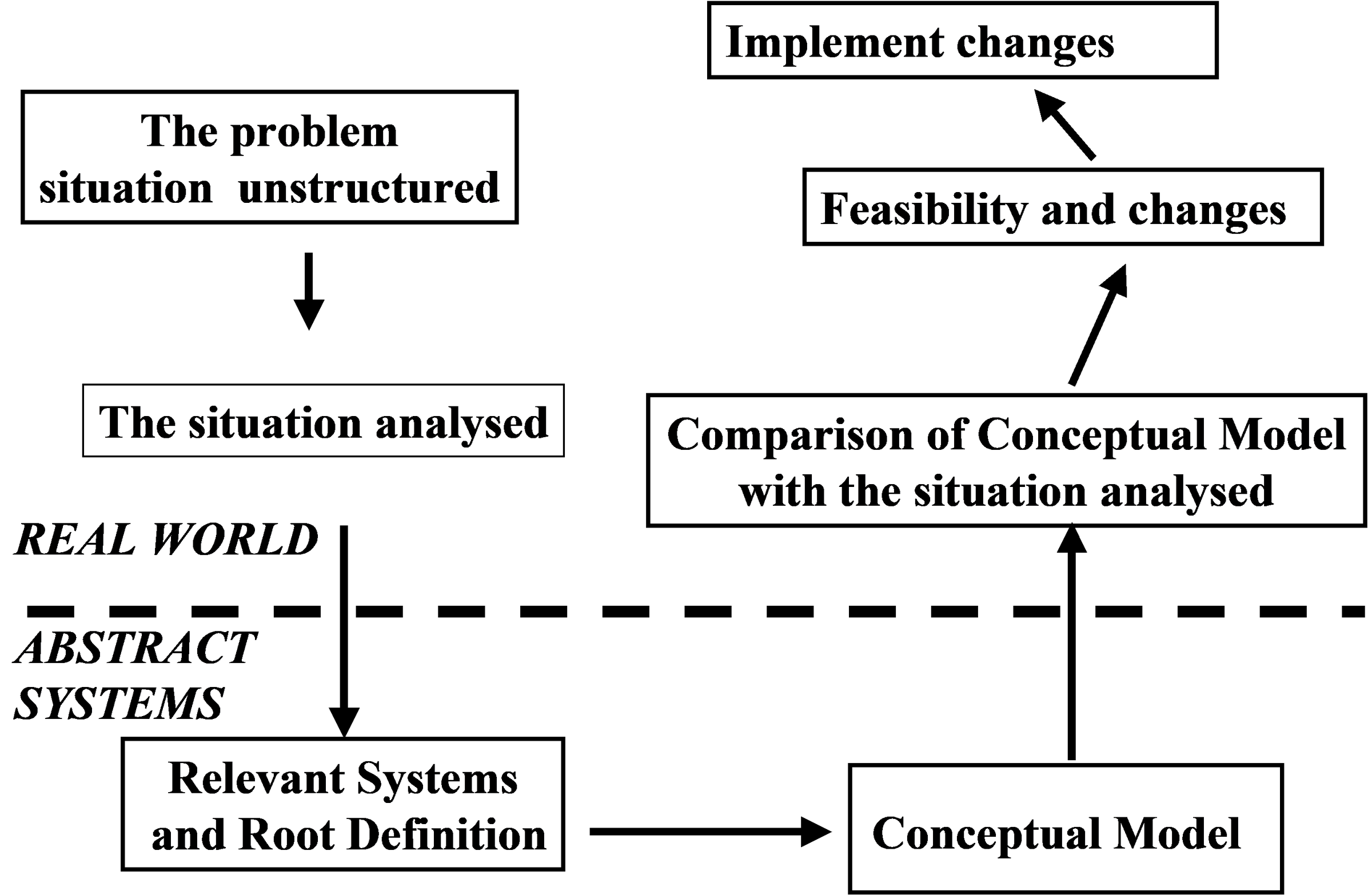
We can now adopt a Soft Systems approach to establish information systems requirements, using Checkland’s methodology [6] shown diagrammatically in Figure 1. The generalities given above are needed at battleground level as much as any other and in considering them, we have essentially achieved the first two stages. This is to understand that the primary task of information in the battlegroup is to allow the commander to act quickly and decisively, and that we need to resolve the conflict between the technology which can place all information in the common domain and so drive the decision making level up, and the requirements of manoeuvre warfare to push the level of command to the lowest practicable, creating a commander’s need for information that is focused at his level. To progress, we must consider the battlegroup as a system and the temporal and spatial relationships of its parts.
At its most basic, a battlegroup is a grouping of tanks and infantry based on an infantry battalion or armoured (tank) regiment, which can be supported by other assets; artillery, engineer and aviation being the most common. The grouping is flexible and its organisation depends upon the task and resources allocated to it by a higher formation, such as a brigade or division. These higher formations form the wider system which influences the battlegroup, as does the enemy (Figure 2). The system, itself, is composed of sub-systems, components and elements that take combat power down to troop and section level (Figure 3).
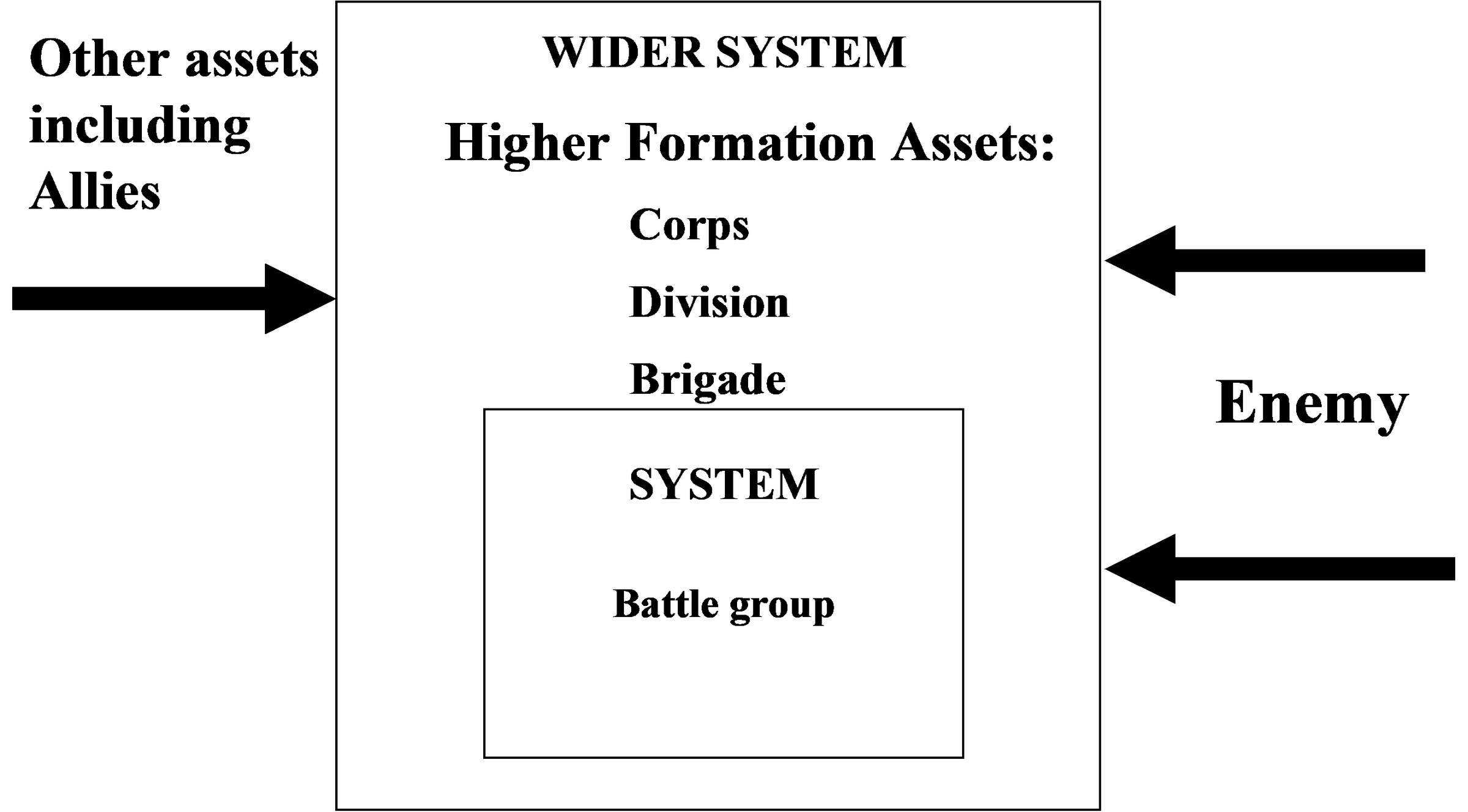
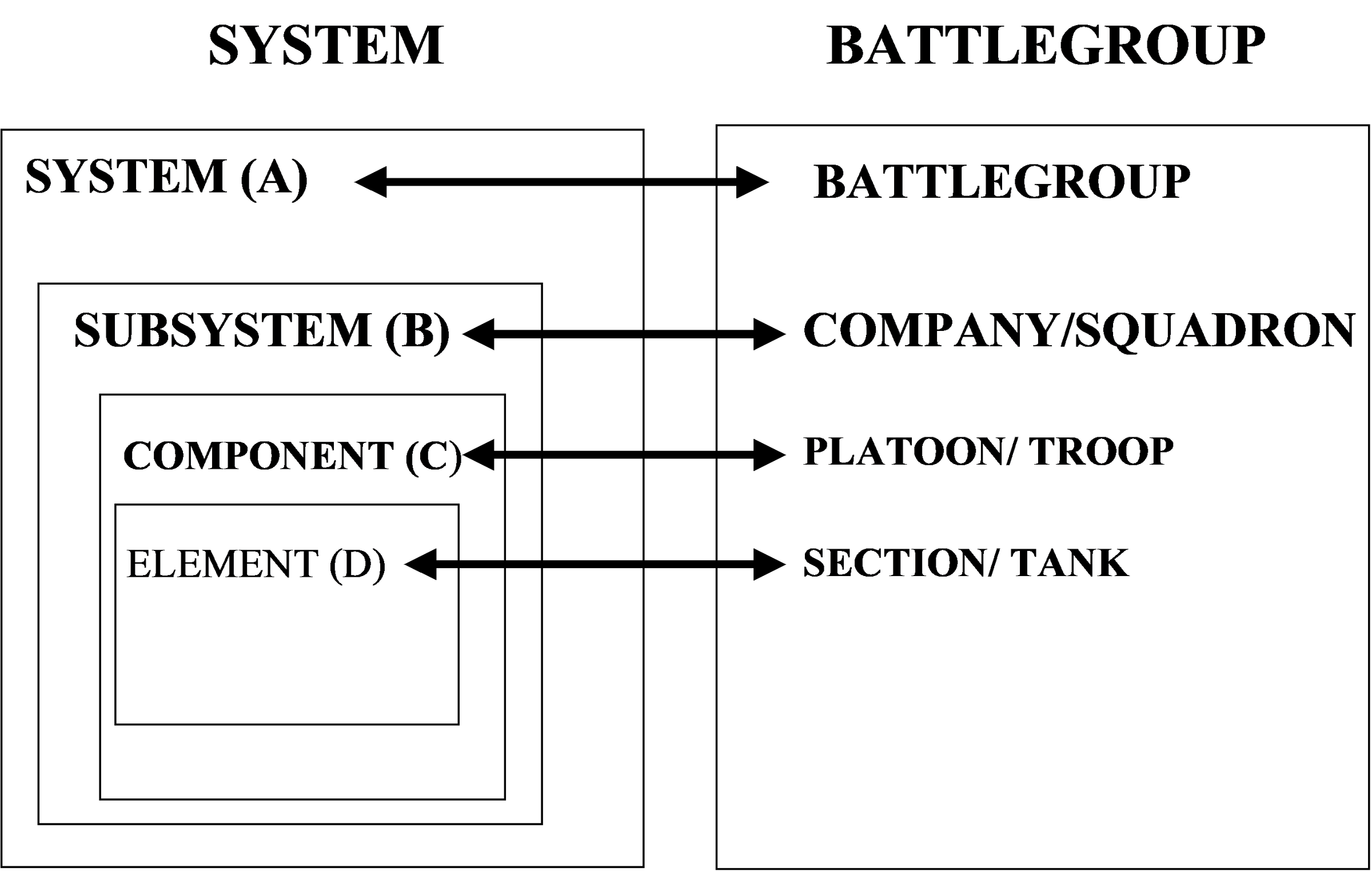
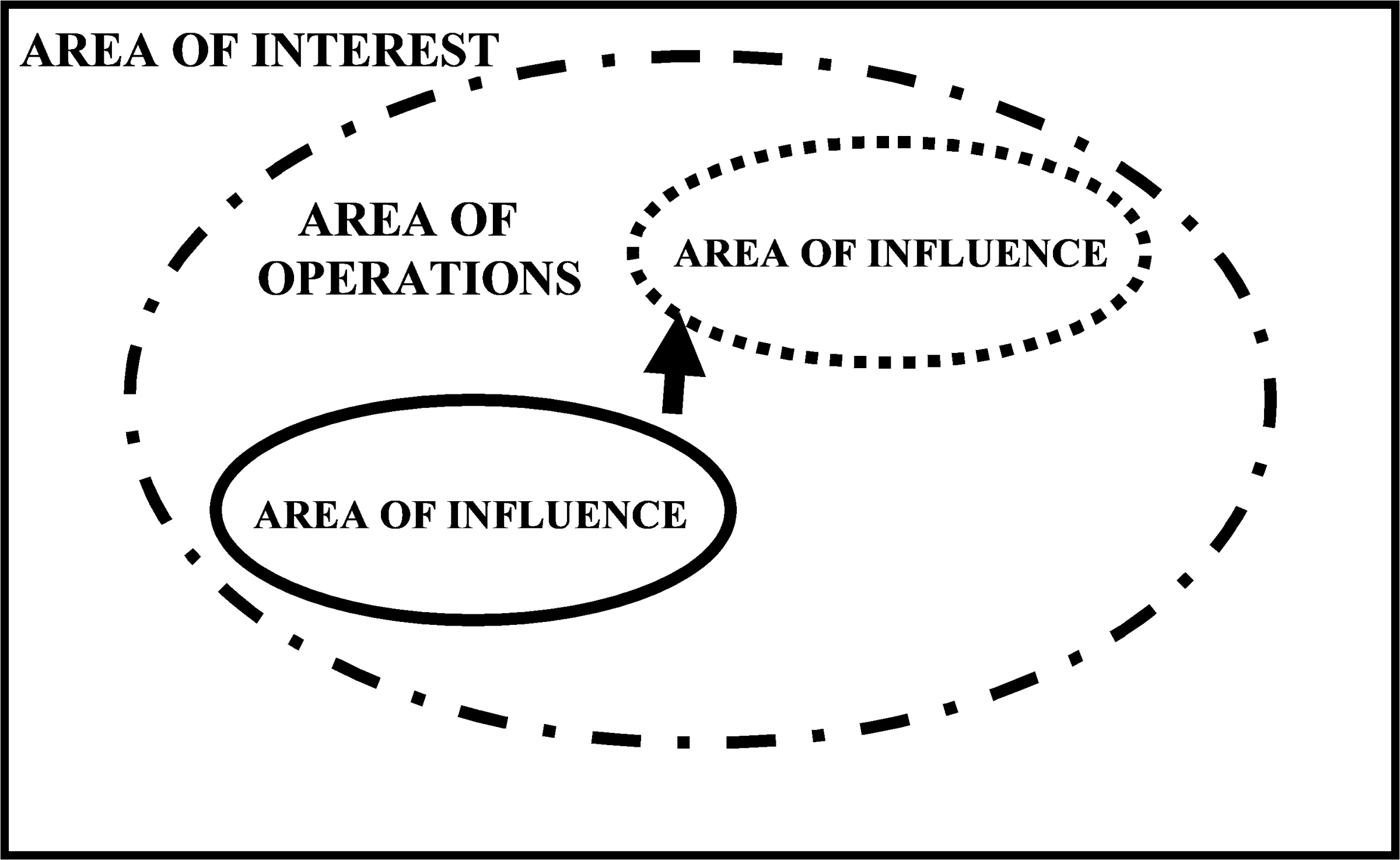
The battlegroup is a convenient level at which to base the system as it is concerned with the immediate contact battle and has areas of operations, influence (battlespace) and interest which can be defined in time and space. As a result, we can expect the information requirement of the battlegroup to have reasonably well defined boundaries. This view highlights several factors: firstly, the sub-systems, components and elements are embedded, that is, they exist entirely within the system. This means that if there is alteration to the system at any level, it will have a consequence throughout the system and cannot be isolated. Thus if the nature, quality or quantity of information is changed at one level, it is going to change the nature, quality or quantity of information throughout the system. For example, the generation of a Contact Report by a reconnaissance commander reporting at Battlegroup level will generate information throughout the system as it adjusts to deal with the threat. Secondly, this view reflects the structure and organisation of the battlegroup and allows the effects of changes to be gauged. In particular, it shows that in addition to any synergistic effects, the system will have emergent properties. For example, the synergistic effect of combining tanks with infantry is that the infantry can protect the tanks in close country and the tanks can protect the infantry in open country. The emergent property of a battlegroup that contains both tanks and infantry is it is more flexible (less constrained) in its employment than one that does not. Finally, the embedded nature of the battlegroup reinforces the notion that the need for information at the system level is not the same as that needed at lower levels and that information must be relevant to the level of the system to which it is applied, a condition described as ‘Relevancy’.
While Figure 3 stresses the vertical relationships in the system, it also indicates the horizontal relationships, in that a battlegroup does not comprise only one company or squadron but several, and likewise at the other levels. This is important when considering space and hence time. A battlegroup will have an Area of Operations within which it will have an Area of Influence and about which it will have an Area of Interest, as shown in Figure 4. These concepts can be taken down through the levels in the system, such that a section or tank will have its own areas of influence, operations and interest. Since these can be defined, they set a boundary to the information requirement in time and space. As the levels are embedded in the system, the areas relevant to the section, for example, are all contained within those relevant to the battlegroup and section’s area of influence, operations and interest may all be within the battlegroup’s area of influence. Thus, knowing the origin of the information, the location of the origin and the time at which it originated, provides a useful indicator to its relevancy. This is particularly important in the horizontal relationships where similar levels can occupy adjacent areas of operation, since one area of operation is another’s area of interest, and relevant information must move rapidly laterally.
We can describe a battlegroup as a system, based on doctrine, for generating combat power. While accurate enough for most purposes it is still too general and needs to take into account the issues discussed thus far to become a Root Definition (RD). One such RD might be that a battlegroup is a doctrinally based, theatre-owned, brigade-directed organisation of men, equipment and information whose purpose, through the command and control of the assets at its disposal, is the generation and application of combat power to diminish the effects of the enemy to the extent that he cannot participate in combat or fulfil his intentions. This is sufficient for our purposes at this iteration, since it fulfils Checkland’s requirements for an RD, in that the customers are the enemy; the actors are the men, equipment and information; the transformation process is the turning of these inputs into combat power (output) through the command and control function; the world view is that given by doctrine; and the owners are the higher formations.
From this RD we can develop a first resolution conceptual model that is shown in Figure 5. This shows a battlegroup as a function based fighting system which can be identified at each of the levels shown in Figure 3, giving us a reasonable correlation between the model, RD and the Real World.
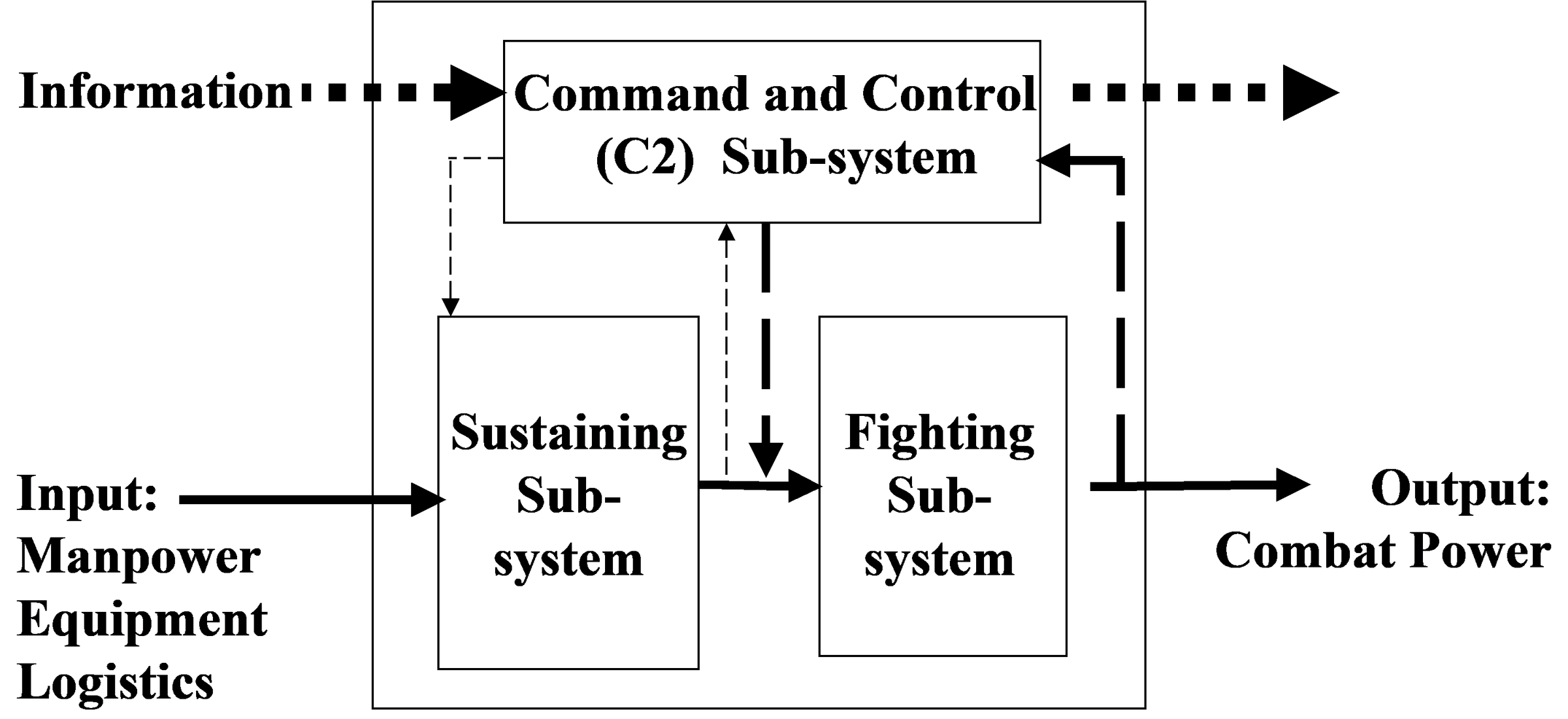
At company/squadron level, for example, the C2 function is performed by Company Headquarters and the Sustaining function by the Company Quartermaster Sergeant (CQMS). The Fighting function is carried out by the platoons under command, each of which shows the same structure. At section level, the C2 and Sustaining functions are performed by one man, the section commander, who also fights as part of his section.
The model is a process model that uses resources to produce combat power. For this to happen the transforming process needs a set of rules against which the output can be measured and the input controlled. The C2 Sub-system contains these rules in the form of Standard Operating Procedures (SOPs), which regulate the routine functioning of the system to generate combat power. In order to apply combat power, additional instructions are needed and these are provided by the higher system, as shown in the diagram, in the form of orders. The diagram also shows the feedback loop required to control the system, regulating either the system input to the sustaining sub-system or directly to the Fighting sub-system. What the diagram does not show is that the C2 and Sustaining Sub-system are linked to perhaps three or four fighting sub-systems, all generating combat power and requiring regulation. This suggests that most of the information generated in the system needs to stay there and is of little value elsewhere, and the higher system is not concerned with the needs of the individual sub-systems but only their aggregate as represented by the system. This is important in defining the requirement since, if nothing else, it emphasises the fact that not everybody needs to know everything throughout the battlegroup system. It would be unlikely that the battlegroup commander would want or need to know the location of every section or tank under his command, except in exceptional circumstances. If he should, then there is a need to question the way in which the battlegroup is organised and structured and, in particular, the role of the junior commanders, as we have discussed earlier. The battlegroup commander is more likely to be concerned with the sub-system level, that is the companies, squadrons and battlegroup assets such as indirect fire controllers and reconnaissance.
As stated earlier, to be relevant to a commander, the information must be pertinent to his operational framework, while providing a high degree of situational awareness so that he may respond quickly to his own and his superior needs. This need for situational awareness can be developed further by considering the availability and survivability of the system, both emergent properties, since if it is neither available or survivable, it is unlikely to be successful as given in the RD. For example, to survive, the commander needs to know the enemy’s intent and distribution in his areas of influence, operations and interest. From this he will derive not only his priorities for action but for information, since a force moving through his area of interest into his area of operations may require him to adjust his own dispositions. To maintain the availability of his forces, commander will need information such as terrain data, and the status of his forces in terms of combat supplies; fuel, water, rations and ammunition. Information for his operational requirement will include his commander’s intent, his mission and his constraints. By applying these ideas through our now three dimensional model, since the battlegroup includes the different levels of embedded systems, we can start to build higher resolution models of the information required at leach level that meets our requirement for it to be relevant and timely to that commander.
One example of such a model is to consider the requirement for fuel. If the vehicles run out of fuel, the system ceases to be available or survivable, therefore monitoring fuel consumption, as with ammunition, water and casualties in both men and equipment, is important though not critical until assets need to be switched from generating combat power to ensuring survivability. This is a problem that the Sustaining sub-system must manage but it needs to ensure that it has the resources in the right place at the right time and that can only be done if the information is forthcoming from the Fighting Sub-systems it is supporting. There are several ways in which it can obtain this information: it can ask for the information by voice; it can rely on receiving the information as an urgent need, or routinely by SOP. If a suitable embedded IS is in the vehicles, it could monitor each vehicle at every level and deal with each on an individual basis. What it needs to monitor is the rate at which the Fighting Sub-systems are approaching a critical point. The critical point might be that at which the sub-system has enough fuel left for four hours of operations, and this sets the boundary that turns the information from being routine to being a priority. If the sub-system is the company/squadron level, then the information from the sections and platoon level needs to be aggregated in order to be relevant. This can be done at the various levels by interrogating the levels below, doing the necessary aggregation and passing them up when requested to do so. The IS can be designed to do this automatically from vehicle to battlegroup with the emphasis being on ‘pulling’ information from the top in a structured way rather than ‘pushing’ it upwards regularly or even continuously.
It is possible to do similar modelling for the navigational and Surveillance and Target Acquisition (STA) information. Using a system such as the US EPLRS, it is possible for the battlegroup commander to know accurately the position of every vehicle in his battlegroup and see it displayed for him. His need for all this information all the time is questionable in terms of relevancy: again he is far more likely to need the aggregate at sub-system or company/squadron level, except in exceptional circumstances. But that is only to take into account the information pertinent to his area of influence and it needs to be augmented by what is happening in his area of operations and his area of interest. This is going to call for information from higher formation and from adjacent battlegroups to be presented to him. His IS needs to do this but without overloading him with irrelevant detail. The key to this appears to be an EPLRS system that is combined with information as to the organisation of the brigade, or wider system, so that the battlegroup commander has displayed before him information relevant to his areas of influence, operations and interest based upon the time, location and identity of the originator.
Conclusions
In summary, the work done so far allows the following assertions:
- For effective mission command in manoeuvre warfighting, decision making needs to be done at the lowest level of command practicable and with a command span of no more than five command points.
- To provide information that is relevant to commanders throughout the battlegroup, the management of the IS needs to reflect the command structure.
- Since a commander at any one level needs information on his areas of interest and operations as well as influence, the information from the horizontal levels is as important as the vertical, saving time and accuracy.
- Information is more likely to be relevant if pulled from above than pushed from below.
- The information requirement at a given level hinges on what the commander needs to conduct operations and maintain situation awareness. This is linked to his need for information pertinent to his survivability and availability, which are emergent properties of the battlegroup system.
- Relevancy and priority can be determined to a large extent from knowing the location and originator of a message and the time of origin when placed in context with the formation task organisation.
Further work is needed to complete the high resolution models through the development of Data Flow Diagrams using the techniques described by Yourdon [7], before completing the Soft Systems analysis and arriving at some specifications.
This paper does not reflect official policy and the views expressed are those of the author.
References
[1] (British) Army Doctrine Publication Volume 1 (ADP-1), Operations, June 1994.
[2] W. Lind, in Manoeuvre Warfare, an Anthology, R. Hooker (ed), Presido Press, Novato CA, 1993.
[3] TRAC brief to DLW, 24 April 1996.
[4] (British) Army Doctrine Publication Volume 2 (ADP-2), Command, April 1995.
[5] M. Orr et al, in ADP-2.
[6] P. Checkland, Systems Thinking Systems Practice, John Wiley and Sons, New York, 1978.
[7] E. Yourden, Modern Structured Analysis, Prentice-Hall, International, Englewood, New Jersey, 1983.