
Volume 1, Number 2, July 1998
Electric Drive Technology for Tracked Vehicles
Abstract
The drive system in tracked vehicles has to accomplish tasks which go far beyond the usual requirement of wheeled vehicles. Besides forward and backward propulsion and other tasks, it also assumes the safety-related functions of braking and steering. New studies investigating electrical transmission systems were started a few years ago [1]. One result of this work was the development of the RENK Electro-Mechanical Transmission (EMT). This transmission belongs to the category of electric drives and offers specific advantages. Because of its few mechanical parts the EMT provides significant reductions in the power requirements of the electric motors and corresponding power electronics compared with 'purely' electric sprocket drive systems. This paper describes the basic ideas and the technology of the electro-mechanical transmission RENK EMT for future tracked vehicles.
Introduction
Today, fully automatic powershift transmissions with reversing gear, infinitely variable steering drive and integrated brake system have reached a high level of development in function as well as in power density and reliability [2]. So is there really a need to introduce electric drive systems in new tracked vehicles?
Table 1 lists the main advantages of electric drives compared with conventional powershift transmissions. Whether the mentioned advantages lead to a good relation between costs and benefits of electric drive depends on the tasks and variety of missions the vehicle is considered for.
| Advantages |
|---|
| Suitable for high power density diesel engines; infinitely variable torque and speed transformation; suitable for high power generation; intelligent vehicle energy management; increased flexibility in integration of drive components; higher potential for automation and drive by wire; regenerative electric braking; potential for stealth operation; integration into an all-electric combat vehicle. |
In designing the layout of an electrically driven vehicle, a decision has to be made whether the electric motors, necessary mechanical gear sets and brakes are positioned largely outside or inside of the vehicle hull [3,4,5]. Studies have shown that with the electric motor technology available in the foreseeable future, no medium or heavy weight vehicle fittedwith in-hub motors could match the standards of the existing final drive systems. So the layout with electric motors positioned inside the hull seems - at least in mid-term - to be the best solution. This paper discusses the electro-mechanical transmission (EMT), which is an interesting alternative to those purely electric sprocket drives at two or maybe four corners of the vehicle.
The Electro-Mechanical Transmission RENK EMT
RENK is working on an EMT 600 for 600 kW and an EMT 1100 for 1100 kW input power. Because of the high torque and power density permanent magnet motors are used in today’s EMT design. But in principle it is also possible to install induction motors or any other type of motor. The specific advantages of EMT mentioned in this paper remain true with all types of electric motors.
Figure Main groups of the electro-mechanical drive system RENK EMT
The technology of the electric components will be not described here, but can be found in the literature [6,7]. The electro-mechanical transmission will be presented in this paper on its adaptation to a 55 ton vehicle as a RENK EMT 1100 for 1100kW input power. Figure 1 shows the main components of the EMT drive system:
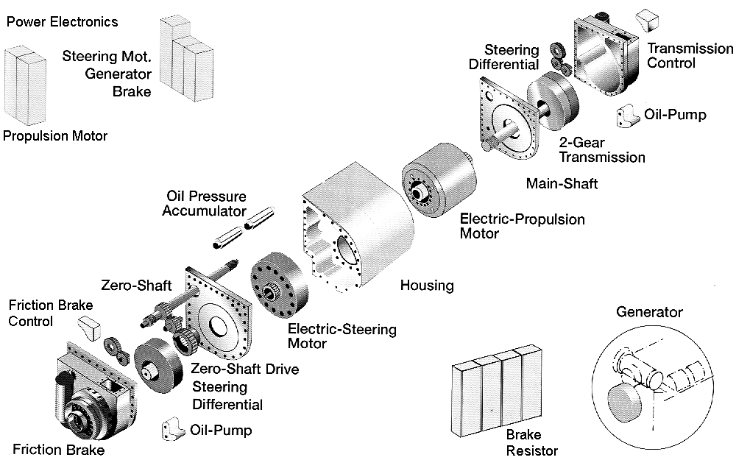
- Propulsion drive with electric propulsion motor, mechanical two-gear transmission and main-shaft.
- Steering drive with electric steering motor, zero-shaft drive, zero-shaft and steering differentials.
- Braking system with brake resistors and mechanical friction brakes.
- Hydraulic system with friction brake control, transmission control, pumps and pressure accumulators.
- Electric generator directly coupled to the prime mover. No mechanical power input into the EMT.
- Power and control electronics for propulsion and steering motor, brake control and generator.
Propulsion Drive
The electric propulsion motor drives a powershift two-speed transmission. It is a simple planetary gear set offering a significant reduction in torque demand on the electric propulsion motor and thus its size. At a ratio of 3.3 in the lowdrive range, the maximum torque to be installed is reduced against the purely electric drive by the same factor. At identical maximum output speeds of the electric motors, the corner power is correspondingly reduced and with it the size of the related power electronics. The corner power of an electric motor refers to the product of maximum torque and maximum speed. (N.B. The required power electronic unit of a permanent magnet motor is slightly bigger than that of an induction motor.)
Figure 2 shows an ideal traction diagram for a 55 ton track-laying vehicle with ideal tractive power hyperbola of 1100kW.
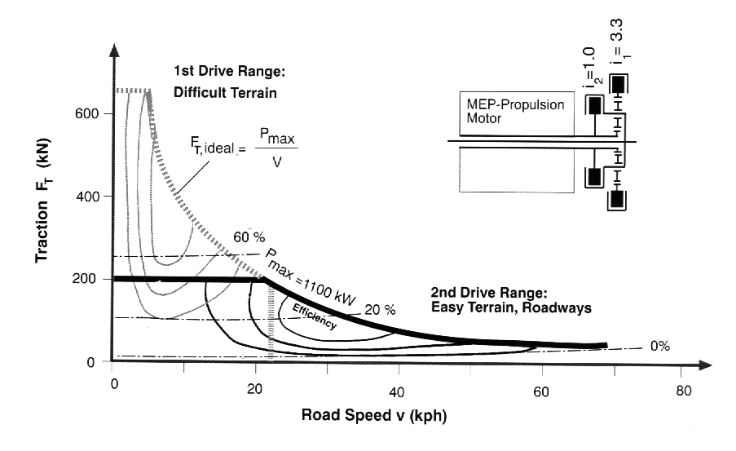
Figure Traction diagram for a 55 ton vehicle with EMT 1100
According to the ratios defined for the two-gear transmission and the final drive, the maximum traction is about 1.2 x GVW (660kN) and the maximum speed is 70kph. The first drive range is for use in difficult terrain, the second directly transmitted drive range is designed for use in easy terrain and on roadways. The vehicle can start up in the second drive range on easy terrain with gradients up to about 30%. In normal vehicle operation shifting does not occur between the two drive ranges. However, it is possible to start in the first drive range as well. During the gear shift, while the vehicle is moving, the speed of the electric propulsion motor is adjusted.
By means of the two-speed transmission, the optimum efficiency of the electric motor is available in both drive ranges. Because of this, even in difficult terrain at low speeds and high torques, good drive efficiency is achieved.
Steering drive
If a tracked vehicle drives through a curve, the track links must necessarily go through a sliding motion normal to the track's lengthways direction. In order to overcome the friction force thus created perpendicular to the track, a turning torque is required, which is created by decelerating the track on the inside of the curve and accelerating the track on the outside of the curve. The power needed for this on the outer track can be quite high.
Figure 3 shows power readings for outer and inner track of a 55 ton vehicle slaloming on concrete. The maximum readings on the outer track reaches up to 1900kW. In order to make such propulsion power possible with a prime mover of 1100kW, a regenerative steering principle is necessary. It enables the power to flow from the slow to the fast track.
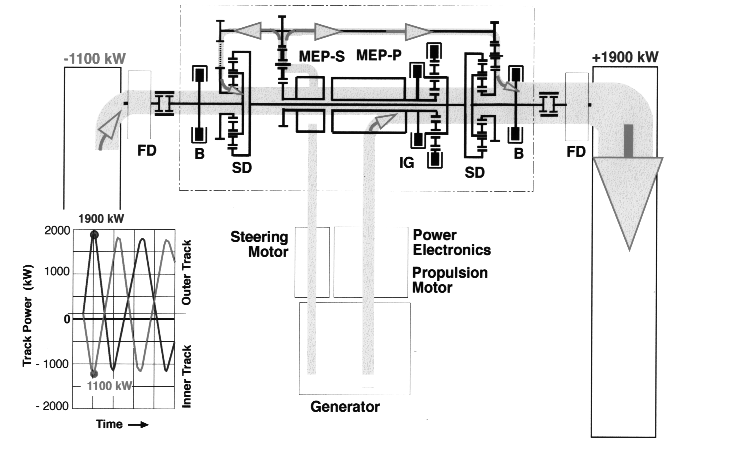
Figure Power required to steer a 55 ton tracked vehicle in slalom motion
The EMT-drive has a separate electric steering motor, which drives via a zero-shaft ZS two summing steering differentials SD. Inside the SD the steering speed is super-imposed to the propulsion speed. Figure 3 shows the regenerative power flow from inner to outer track. Only the missing differential power is provided by the prime mover. The rating of the electric steering motor is determined by the time required for pivoting on the spot. The electric steering motor, which is designed for a corner power of 700kW, is significantly smaller than the electric propulsion motor. The well-proven technology of zero-shaft steering has been adapted to the electric drive. Besides regenerative steering, it offers high steering precision, quick reaction and good driving attributes when driving straight ahead.
In driving through a curve with a purely electric drive, the braking inner-curve propulsion motor acts as a generator and produces electric energy, which is taken to the propulsion motor of the faster outer track via the electric power system. In the example with the 55 ton vehicle, the electric motors must be in a position to supply up to 1900kW per track side. This corresponds to about 170% of the nominal capacity of the prime mover. The power electronics for each track side must be designed accordingly.
Braking system
The combination braking system (service and parking brake) of the RENK EMT-drive is integrated into the drive block. Basically the system consists of brake resistors of the electrical service brake, two mechanical friction brakes built onto the transmission outputs, the hydraulic pressure generating, storing and regulation device, the dual-circuit brake cylinders and the spring accumulators for parking the vehicle.
When the brake is engaged the electric propulsion motor is working as a generator producing electrical energy. The brake resistors remove the surplus energy to a cooling fluid. In case of a failure of the electric service brake, full braking is available from the mechanical brakes. In this way a redundant system is created. The friction brakes assume the function of an emergency steering mechanism when a failure of the electric steering drive occurs.
Comparison between RENK EMT system and purely electric sprocket drive
Figure 4 shows the principal factors of a purely electric two-sprocket drive for a 55-ton vehicle.
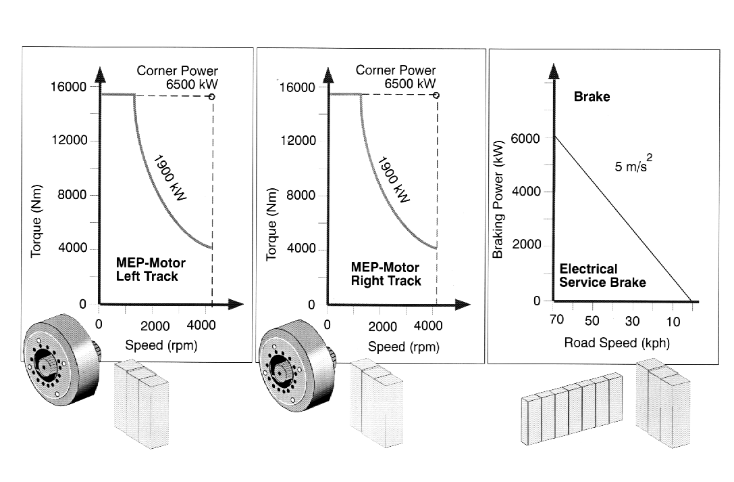
Figure Design of a purely electric 2-sprocket drive (GVW: 55 tons, prime mover: 1100 kW)
To achieve the required start-up traction and maximum speed, an electric motor with a corner power of about 6500kW must be installed for each track, (total 13,000kW). With this design, the electric motors are able to provide the 1900 kW needed for regenerative steering and to supply the required braking power for full brake application. The size of the power electronics is proportional to the corner power.
In Figure 5 the design of the basic RENK EMT components is shown. With the simple two-speed mechanical transmission, the installation of an electric propulsion motor with a corner power of about 4000kW suffices.
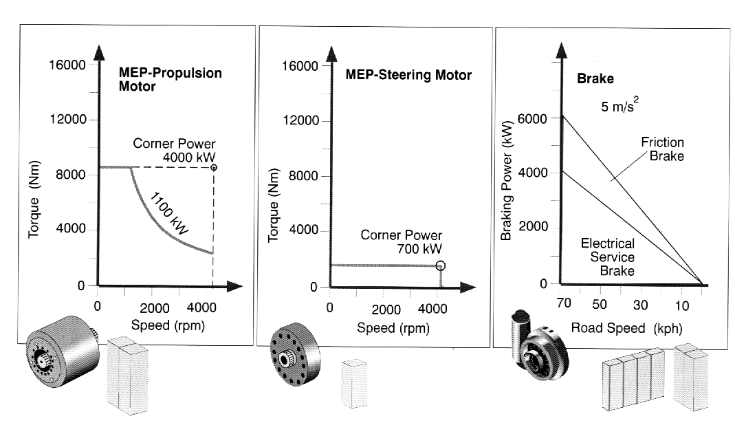
On the basis of the mechanical regenerative zero-shaft steering, an electric steering motor with a corner power of about 700kW is sufficient. (Total: 4700kW).
Figure Design of the EMT 1100 (GVW: 55 tons, prime mover: 1100 kW)
By adding the few mechanical parts of EMT, it is possible to use an electric corner power, which is 2.8 times less than the one needed for a purely electric drive. Because of the reduced torque and corner power requirements, the EMT-drive is able to reduce the volume and weight to that of a five-gear powershift transmission of the latest design. However, in the foreseeable future the cost inevitably will be higher. (Generator, power electronics, brake resistors, cable sets and so on are taken into account). A design investigation indicates thatthe EMT installation saves space, weight and costs in comparison to the purely electric 2-sprocket drive. In future, volume and cost of the electric components might decrease, but the EMT will also profit from this.
Vehicle Integration
The EMT is suitable for front and rear drive. The compact EMT-drive block with its integrated brake hydraulics and extremely short cable and piping runs, offers the vehicle designer distinct advantages. For example, the space between the sprocket wheels can be optimally used, Figure 6.
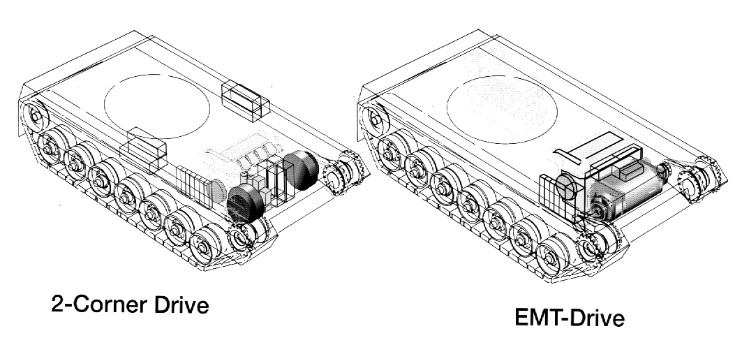
The prime mover can be integrated with the EMT-drive system to form a power pack, or it can be located on some other convenient place in the vehicle. Because there is no mechanical power input into the EMT, multi-engine concepts are possible.
Figure Vehicle integration, 55 ton vehicle with an electric 2-sprocket drive and EMT 1100
Safety and Licensing Aspects
With a purely electric drive, the safety-related systems of propulsion, steering and braking are inter-connected. Ultimately the electric motor on each track side assumes all three functions.
| Additional advantages |
|---|
| Smaller, lighter, more economical by means of synergies of mechanics and electrics; quick power pack replacement and less servicing expense; short pipe and cable runs; good packaging; good efficiency at low speed/high torque requirements; stabilised drive straight-forward; mechanically regenerative steering; safety and traffic licensing aspects. |
The EMT-drive has its own independent system for each of these three safety-related functions. For normal vehicle operation, there is a separate propulsion motor, a separate steering motor and a high performance braking system. The friction brake assumes the function of an emergency steering and braking device. Steering with the brakes can compensate for a failure in the electric steering system. The vehicle remains mobile. In this way the EMT-drive is more suitable in respect to system safety and the required licensing for roadway traffic.
Conclusion
The electro-mechanical transmission, RENK EMT, has the sameadvantages as all electric drives. The simple two-speed transmission and the zero-shaft steering principle offer significant reductions in the requirements of the electric motors and related power electronics compared with a purely electric sprocket drive. Since the EMT connects the two sprockets, this arrangement could be criticised as providing less flexibility. However, as illustrated in Table 2, the EMT offers many additional advantages when compared with purely electric drive systems for tracked vehicles.
By appropriate combination of mechanical components and electric drive technology, synergistic effects are achieved. For a tracked vehicle with an EMT drive system, the advantages of proven mechanical drive technology are combined with those of forward-looking electric drive technology.
References
[1] R. Reppert,Mechanisch-elektrisches Getriebe für Kettenfahrzeuge, [Mechanical-Electric Transmission for Track-Laying Vehicles], Military Technology Symposium on Electric Power Systems and New Electric Drives, BAkWVT, Mannheim, 1988.
[2] RENK, Transmission Technology for Military Vehicles, P 538/1.3.95, 3,0 e, 1998.
[3] S. Struwe, Leistungsverhalten bei Kettenfahrzeugen mit angetriebenen Laufrollen, [Performance of Track-Laying Vehicles with Powered Track Rollers], 1995.
[4] G. Khalil, and A. Loss, Electric Drive is at the Heart of an All-Electric Combat Vehicle, 1st International Conference on All-Electric Combat Vehicles, Haifa, 1995.
[5] G. Juhl, All Electric Combat Vehicle, 3rd European Armoured Fighting Vehicle Symposium, Shrivenham, 1998.
[6] M. Heeg, Advanced Electric Drive Technology for All-Electric Combat Vehicles, 2nd International Conference on All-Electric Combat Vehicles, Dearborn, 1997.
[7] P. Mongeau, High Performance Permanent Magnet Motors/Generators, 2nd International Conference on All-Electric Combat Vehicles, Dearborn, 1997.
Dr. Harald Naunheimer is the Manager Product Research, Vehicle Transmission Division, RENK Aktiengesellschaft, Gögginger Straße 73, D-86159 Augsburg, Germany. RENK is a division of the MAN corporate group and is a manufacturer of transmissions for military wheeled and tracked vehicles. Dr. Naunheimer is the author of a technical book on vehicle transmissions "Fahrzeuggetriebe". He can be contacted on veh@renk.de.