
Volume 1, Number 1, March 1998
The Role of Surveillance and Target Acquisition in Guided Weapons
Abstract
Surveillance and target acquisition (STA) form one of the five key sub-systems that combine to make up a guided weapon (GW). This paper addresses the role of STA in GW systems. It identifies the key principles that can be used to select an STA sub-system to suit a particular application. A classification of types of STA is then proposed and finally, some of the GW-STA interface problems are discussed, including the issue of keeping the human somewhere in the STA-GW decision loop.
Introduction
Normally, when we think of a guided weapon (GW) we think of the missile or torpedo that delivers the warhead to the target. However, that is only a small, albeit important, part of the complete GW system, the key sub-systems of which are shown in Figure 1.
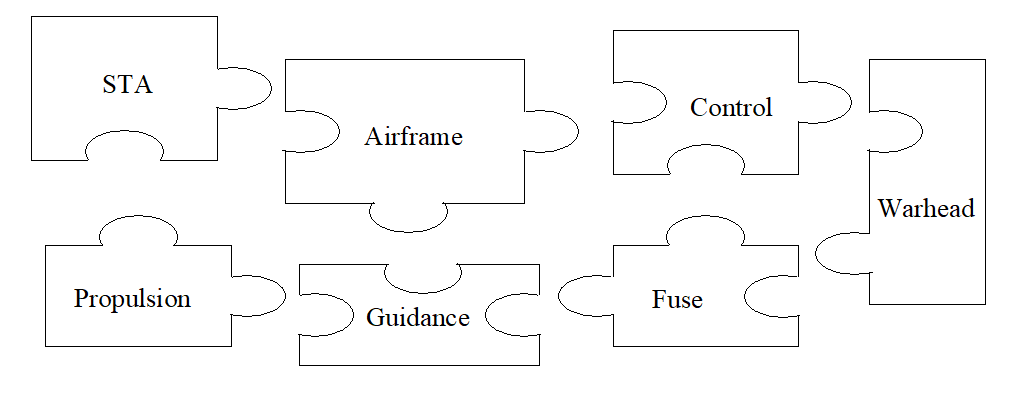
A typical GW target engagement sequence would be as follows. The surveillance and target acquisition (STA) sub-system detects, recognises, identifies and locates the target (the DRIL process). This information is passed to a guidance sub-system that directs the missile to the target. The propulsion sub-system moves the airframe sub-system forward while the control sub-system takes the guidance commands and turns them into direction corrections. When the missile reaches the target the fusing sub-system initiates the warhead. This is of course a very simplified statement of events, and it is not unusual for a number of events to occur concurrently. The STA sub-system could, for example, also be used as the target and missile tracking sensor in the guidance sub-system. However, it is clear that the missile engagement sequence cannot start without some means of detecting and locating the target in the first place. This is therefore the role of STA in GW.
Principles
GW systems operate in widely differing environments; they can, for example, be air-launched, ground-launched, or sea or sub-sea-launched. They can be short range (a few hundred metres like the French Eryx antitank system) to long range (such as the Tomahawk cruise missile with a range in the order of a 1000 km). It is not therefore possible to conceive of a single type of STA sub-system that will cover all applications. What we can do is identify some principles that will help guide the selection of an STA sub-system for a particular GW application. There are perhaps three main principles: doctrinal consistency, temporal consistency and integration consistency.
Doctrinal consistency
Guided weapons do not operate in isolation on the battlefield, but form part of the commander’s complete array of weapon systems. It is important that all these systems are complementary and neither unnecessarily duplicate each other, nor interfere with each other’s effective operation. At the same time all the weapon systems must support current military doctrine. Understandably then, any GW STA sub-system must follow the same doctrinal framework. This means for example, that if doctrine at a certain phase of war, demands that electronic systems do not radiate electromagnetic energy, then active STA systems such as active radar cannot be used. It also means that if doctrine demands that a target be identified with a particular degree of confidence before a missile is released to engage it, then the STA sub-system must be able to achieve this level of confidence in its identification at the desired ranges.
Temporal consistency
The STA sub-system is generally responsible for the DRIL process for the whole weapon system. The DRIL process is itself a sub-process of the larger decision process which makes the decision to fire the weapon. This decision process can be described by the observe, orientate, decide and analyse cycle, or OODA loop. This describes all types of decision but it will only be looked at here in its GW context. The full GW OODA process is shown in Figure 2.
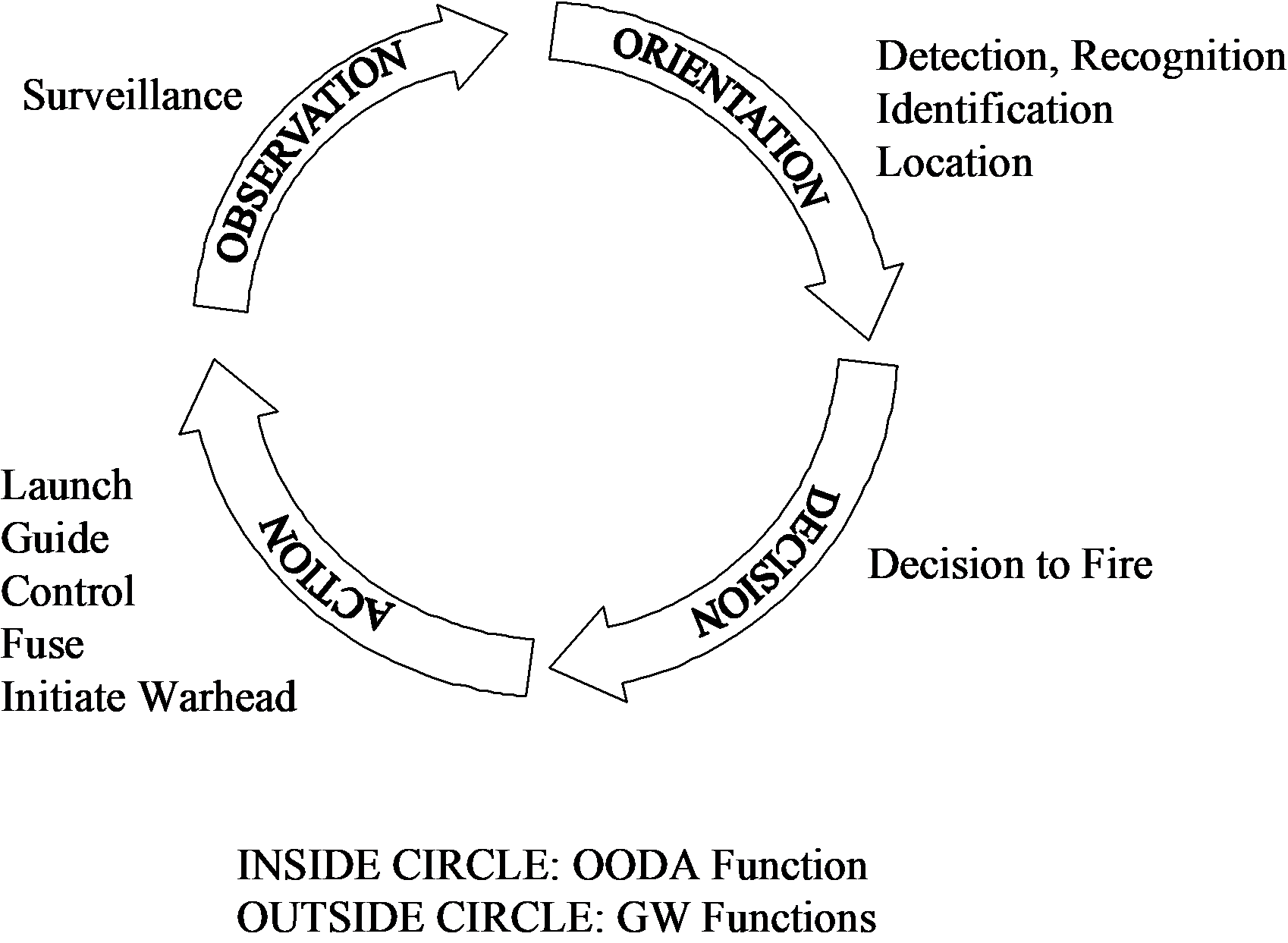
In GW terms the OODA loop runs as follows. The STA subsystem observes the scene of interest. When a target appears it detects, recognises, identifies and locates it; this is the orientate part of the loop. The decision is then made to fire the weapon. The STA sub-system can then be used to observe the missile as it flies to the target (indeed, the STA sub-system may form an integral part of the guidance sub-system, in which case it has to track the missile flight). After the missile has hit (or missed) the target the STA can observe to assess target damage; this is the analyse part of the loop. Throughout the whole OODA loop the STA sub-system must produce data that is consistent with the speed with which the weapon system is designed to operate. For example, the STA sub-system of a low-level air defence missile system will need to detect rapidly moving targets that uncover quickly and are rapidly out of range. The STA sub-system will have to produce detail quickly if the missile system is to have a chance to engage the target. At the other extreme, cruise missiles targeted against static high-value targets, such as power stations, do not require a STA sub-system capable of real-time, rapid detection of targets.
Integration consistency
The STA sub-system must fit in with the other sub-systems of the GW system. For example, it must have the resolution to detect targets at sufficient range to allow for the rest of the GW system to react in time to launch the missile and intercept the target at the planned doctrinal engagement ranges. Similarly, it must locate targets accurately and then pass this information on to the guidance sub-system with sufficient accuracy to allow the guidance sub-system to guide the missile to the target so that the warhead can operate effectively. It must also fit into the constraints placed on it by the rest of the system, such as weight, power budget, time into and out of action etc.
Types of GW STA
It has already been identified that not all GW STA sub-systems have the same characteristics, or have exactly the same role in each GW system. Therefore it is useful to classify such STA sub-systems into categories, namely third party, integrated, mixed, augmented and dual-role STA. As will be seen a STA sub-system can fit into more than one category.
Third-party STA
If the STA sub-system is not located geographically with the rest of the system then it can be considered as a third party source. For example, the targeting data for a cruise missile attack may well come from satellite imagery, or from airborne synthetic aperture radar. Such STA sub-systems may be entirely dedicated to a particular missile system, as in the case of an air-defence radar which locates targets and then passes the detail on to one of its dedicated missile launchers. Alternatively, the STA may be non-dedicated, as with STA satellites that produce targeting information which can be used by a number of attack systems, such as manned aircraft, missile systems and artillery. The key area with third-party STA is the handing over of target information from the STA sub-system to the relevant parts of the remainder of the GW system; this problem area is considered in more depth later.
Integrated STA
An integrated STA subsystem is collocated with the remainder of the GW system and is dedicated to producing target information for that particular system. This has the particular advantage over third-party STA in that the target information is immediately available to the remainder of the GW system, in a form that is tailored to the needs of the system. It is likely, though, to be a more expensive option than third-party STA as each GW system has to have its own dedicated STA sub-system.
Mixed STA
Mixed STA, as the name implies, is a mixture of third-party and integrated STA. An air-defence system, such as the Shorts Starsteak fits into this category. The IR Air Defence Alerting Device, detects an incoming target and this information is passed onto the appropriate missile launcher (the third-party STA). The operator of the designated launcher then recognises, identifies and locates the target before firing the missile (the integrated STA).
Augmented STA
The STA process can be assisted by other non-STA systems. For example, after detection of an air target, recognition can be aided by the use of an Identify Friend or Foe (IFF) system. Similarly, there are a number of planned combat identification systems that will assist in the identification of land vehicles.
Dual-role STA
Dual-role is the final category of STA sub-system. In this the STA sub-system is used in the first instance to DRIL the target. Once this process is complete the sensors of the STA sub-system are then used in the guidance sub-system to help in the guidance of the missile to the target. A good example of this is the target acquisition radar of the Rapier air-defence system. Here the radar locates the target prior to launch, but is then used to track both the target and the missile after launch. The guidance computer uses the two tracks that result to calculate and pass guidance commands to the missile so that it intercepts the target.
STA – GW system interface
There is little point in the STA sub-system following the DRIL process and producing high quality target data if the rest of the GW system is unable to use the information, or the information is in some way corrupted in being passed to the GW system. The target data is normally passed over (or handed down to) the guidance sub-system. It is important therefore that the interface between the two sub-systems is correctly designed. Two critical areas need to be addressed at this interface. First, the STA and guidance sub-systems need to be collimated so that what the STA is looking at what is passed on to the guidance sub-system so that the guidance sub-system looks in the same direction and finds the same target. This is less of a problem if the sensors for the two sub-systems are the same (that is, the STA sub-system also forms part of the guidance subsystem). However, the problem is more severe if two different sensor sets are being used, and especially if they are working in different frequency bands. The French Blaser air defence system, for example, uses a radar STA sub-system, but an IR seeking missile. The second key area is that of the timing of the handover of the target data from the STA to the guidance sub-system. Again, if the STA is also a part of the guidance sub-system then the problem is less critical. However, if the STA is separate then the target must be handed down in sufficient time to allow the guidance sub-system to acquire the target itself and then launch the missile to intercept the target.
Determining suitable STA for a particular GW system
In choosing a suitable STA sub-system for a GW there are a number of criteria which need to be addressed. The following list is by no means exhaustive but can be used as a guide.
Doctrine and Rules of Engagement. Doctrine will determine whether an active or passive STA sub-system can be used. Similarly, the rules of engagement under which the GW system is likely to be operating may have an influence. If, for example, it is thought that in a particular UN peace-keeping operation the high profile presence of GW would jeopardise the mission, then passive STA would be appropriate.
Target Characteristics. The nature of the type of target that the GW system is designed to defeat will have a significant influence on the type of STA that is selected for a given GW system. Target speed, manoeuvrability, size, electromagnetic characteristics and electronic protection measures will all determine what type of STA sub-system is best suited to a particular application. The situation is more problematic if the GW system is designed to engage two or more significantly different targets, such as in the case of the Canadian ADATS which is designed to engage both armoured vehicles and aircraft. Unless two separate STA sub-systems are employed in the same GW system, the choice of the best single STA sub-system in such dual or multi-role applications will always be a compromise.
Engagement Range and Envelope. Generally, the further from the launch point that the GW system is required to engage the target, the more capable the STA sub-system must be. Short-range line-of-sight GW applications require only comparatively simple direct view STA; this could be radar, IR or visual. Over-the-horizon applications can be more difficult, and normally require some type of third party STA.
Guidance Sub-system Characteristics. If the STA and guidance sub-systems are separate, requiring the hand down of target information from the STA to the guidance sub-system then the two sub-systems must at least be compatible. This normally means that the STA and guidance use similar sensors. It would be of little value if the STA could detect and track a target if the guidance sensors were not capable of doing the same. The reverse also holds true as it is pointless having a guidance sub-system which is capable of seeing the target if the STA is unable to actually detect the target in the first place and alert the guidance sub-system as to the presence of a target.
Electronic Warfare. The STA sub-system must be capable of operating in the appropriate electronic environment. If the enemy is able to hide the target signature in the frequency band used by the STA then the STA, and hence the GW system is easily rendered ineffective. In selecting the frequency band used by the STA the GW system designer needs to consider what electronic protection measures the enemy is likely to employ.
Degree of Automation. If the decision part of the GW OODA loop is not too time critical then the information produced by the STA sub-system can be analysed in slow time, with possible intervention by the human operator of the system. However, if the GW system must react quickly, (as in many ballistic missile defence scenarios), or there is a need to automate the OODA process (because, for example, the environment is unsuitable for human input, as in space applications) then the STA sub-system must produce its information in a format that can be processed easily by the GW processor responsible for launching the missile. This will determine the type of STA that is used, as it must produce a suitable output that is capable of automated processing. Imaging techniques in the visual, IR and, to a lesser degree, the radar frequency bands offer this capability.
Future trends
In the future the STA sub-system designer faces a dilemma. On the one hand, the quality of STA sensors is improving rapidly and is beginning to allow the ability to image a scene, from which the target can be detected, recognised, identified and located automatically. This is making possible a totally automated GW engagement system. On the other hand, with the end of the Cold War, and with armies becoming increasingly involved in operations other than war where collateral damage is unacceptable (as in the Gulf War), the usefulness of a totally automated GW supported by an automated STA process is in doubt. Rules of engagement are unlikely in the foreseeable future to allow totally automated target engagement without the human involved in the OODA loop in some way. The GW STA designer is therefore able to design increasingly capable autonomous systems, but the user is increasingly unable to use such systems in the situations that he is likely to find himself in in the future. Future GW STA sub-systems are likely therefore to have to continue to recognise that the human must be kept in the loop in order to ensure that the GW system is engaging the right target.