
Volume 1, Number 1, March 1998
A Hybrid Civilian/Military Payload to Support Battlefield Communications
Abstract
One of the most challenging issues facing the Australian Department of Defence is provision of high data rate links to tactical platforms to support future generation command and control, surveillance, intelligence, logistics and administrative networks. Recently, a window of opportunity arose to place a military payload onboard a civilian spacecraft bus. This paper provides an overview of the proposed military payload and some of its potential applications.
Introduction
The thrust in military communications is towards C3I dominance through fusion of sensor, reconnaissance and intelligence information, and delivery of this information to the battlespace through command, control and communications (C3) systems as depicted in Figure 1.
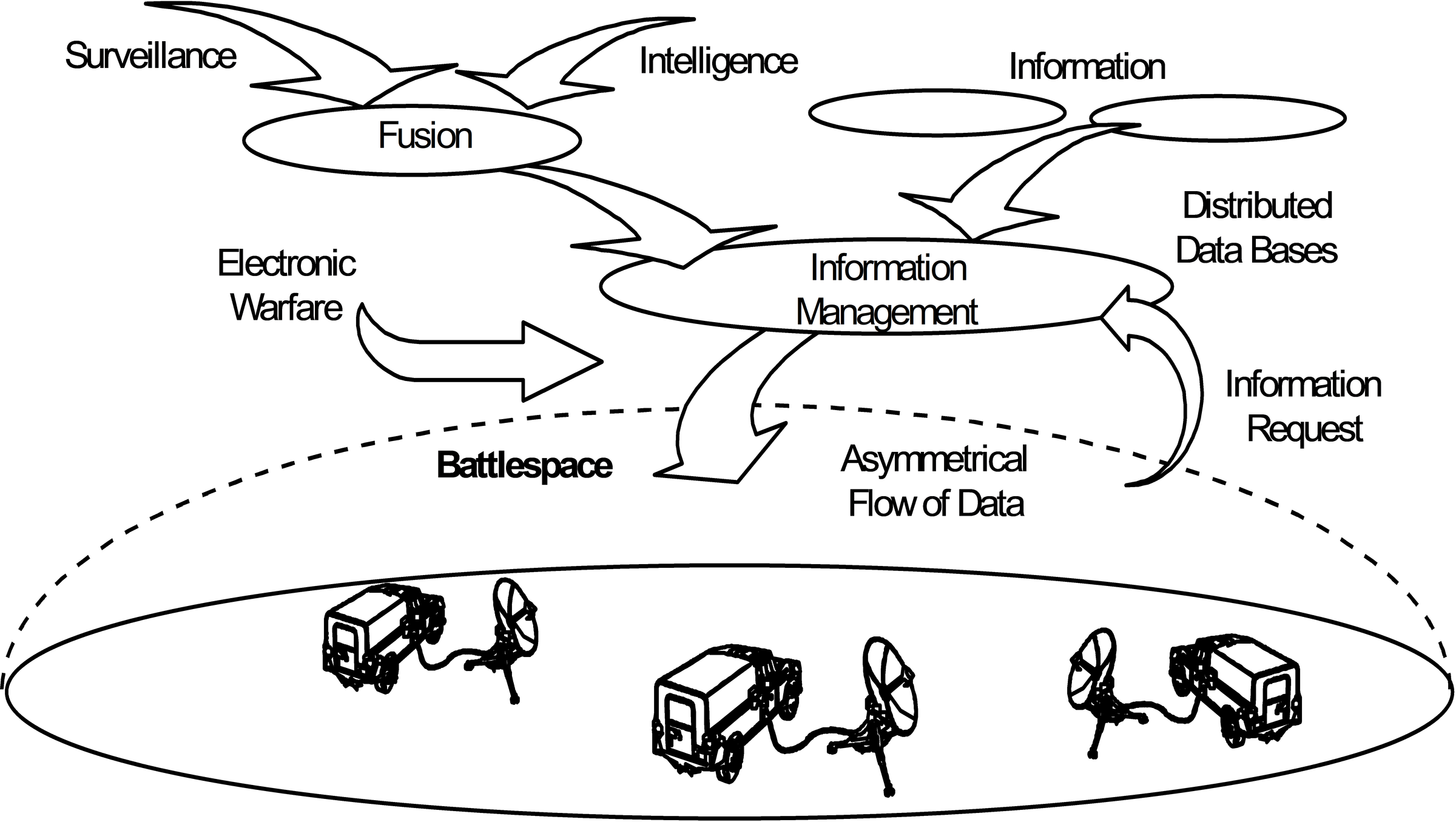
Computing hardware and software have progressed at such a rapid pace that they have resulted in advanced command and control systems which have outstripped our ability to deliver this information to the battlespace. Recently, a window of opportunity arose to place a military payload onboard a civilian spacecraft bus capable of supporting data rates commensurate with future generation command and control systems. This paper provides an overview of the military payload and some of its potential applications.
Hybrid civilian/defence spacecraft
It was originally proposed that the Australian Department of Defence would not acquire a military space segment before 2006. A window of opportunity has arisen to place a military communications package onboard the replacement for the civilian OPTUS A3 spacecraft which is due to be retired from service in 2001. The current schedule for the replacement hybrid civilian/military spacecraft, designated OPTUS C1/D (D for Defence), is for launch in late 2000 to provide an operational capability in early 2001.
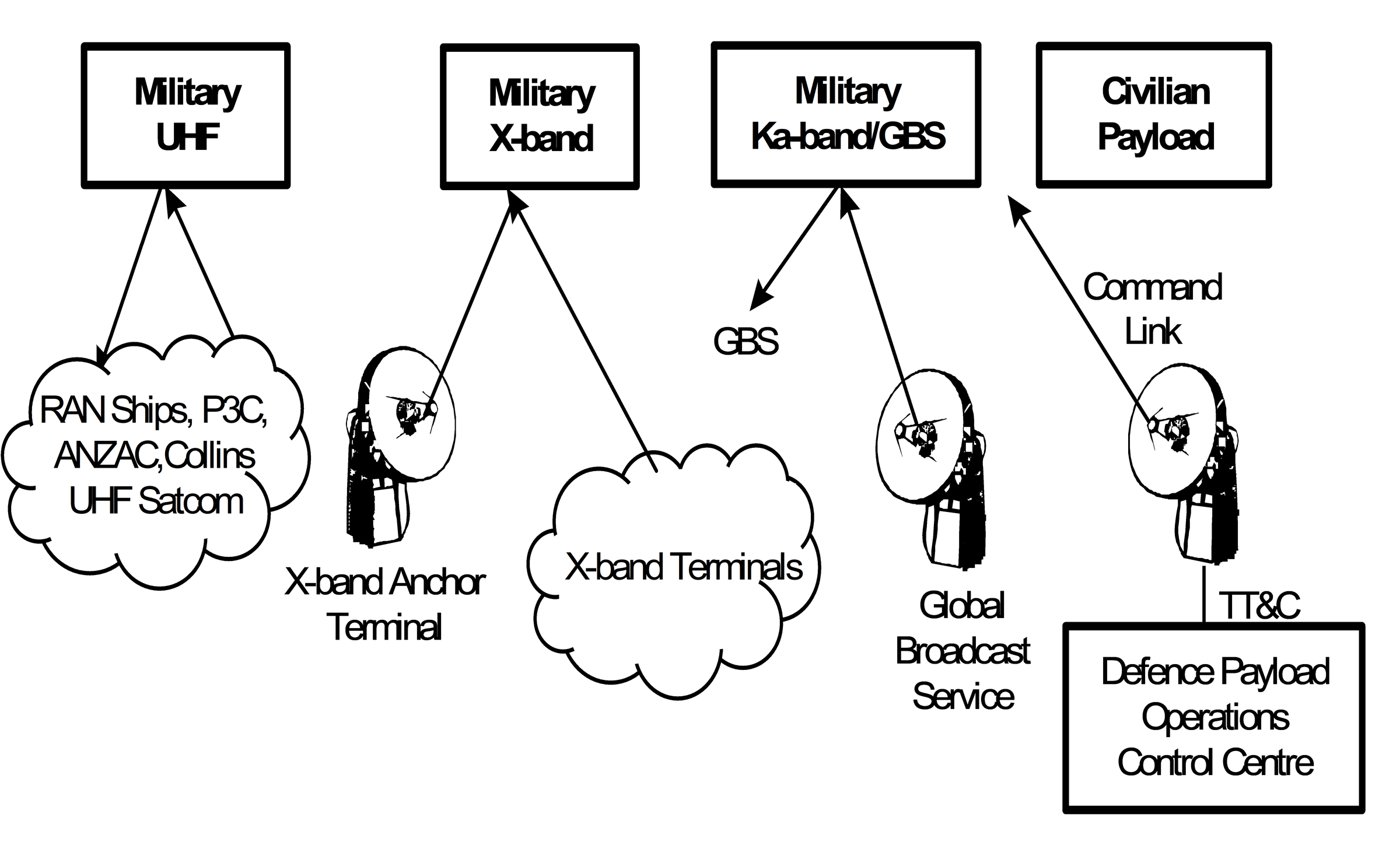
Optus Communications sought Registration of Interest (RFI) in the OPTUS C1/D hybrid civilian/military spacecraft from a number of overseas spacecraft manufacturers. Defence expressed interest in four separate packages, UHF (220-400 MHz), X-band (8/7 GHz), Global Broadcast (30/20 GHz), and US MILSTAR compatible EHF (44/20 GHz). Initial responses were that the EHF package could escalate the cost of the Defence payload and substantially increase the technical risk. For this reason, the concept of an EHF payload was not pursued during the second RFI issued in July 1997. A schematic diagram of the proposed OPTUS C1/D spacecraft communications payload is shown in Figure 2. A contract to build and launch the hybrid spacecraft will be sought by mid 1998.
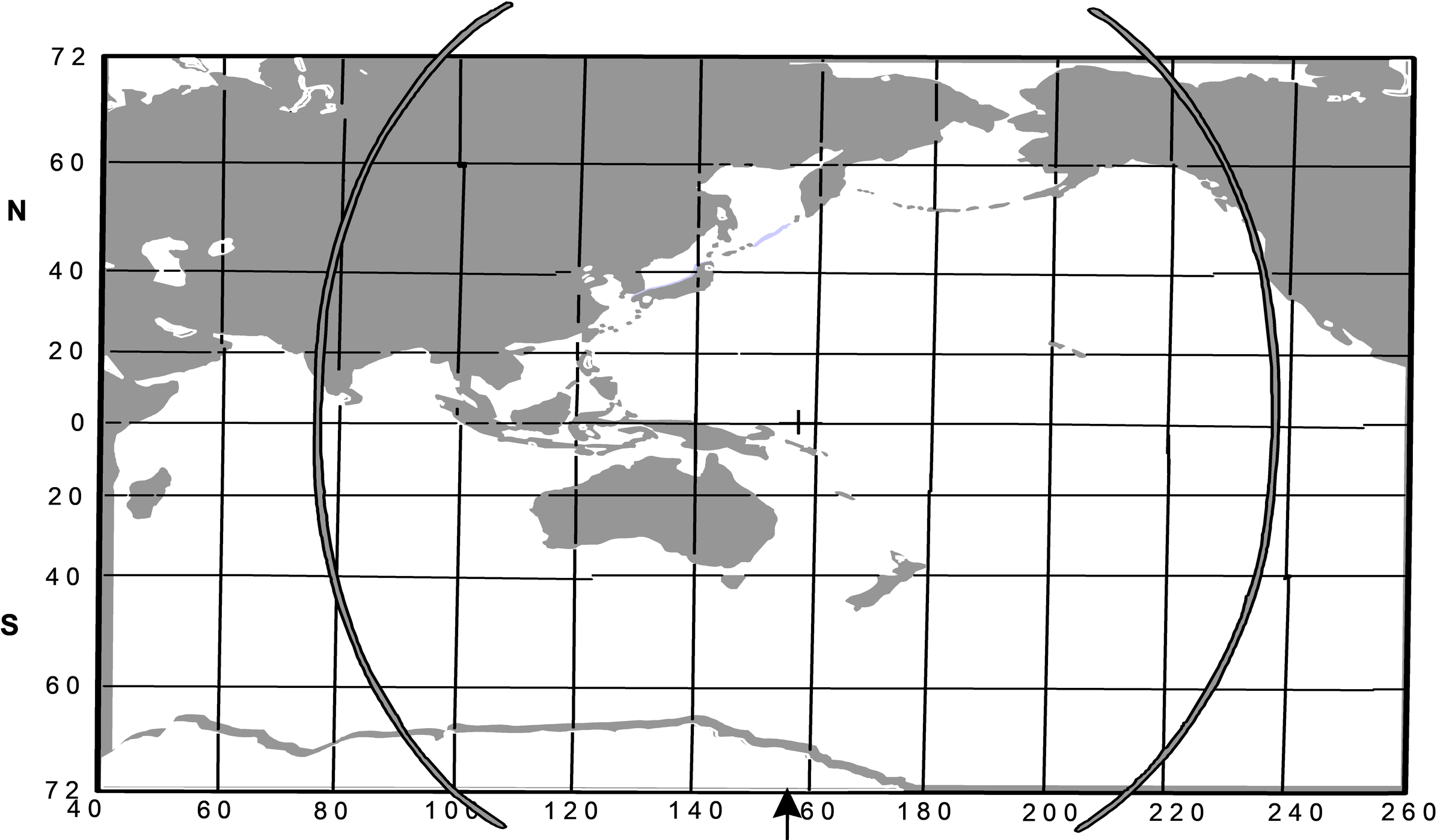
It is intended that OPTUS C1/D will be stationed at 156°East. Earth coverage from this orbital location is shown in Figure 3.
UHF payload
UHF (220-400 MHz) is the only frequency band in which the Australian Defence Force (ADF) has a significant investment in military earth terminals, for example, 25 kHz Demand Assigned Multiple Access (DAMA) terminals are fitted to most Navy ships and 5/25 kHz DAMA terminals are being fitted to Air Force P3C Long Range Maritime Patrol Aircraft. Additionally, it is proposed that ANZAC ships, Collins class submarines and ANZAC helicopters will be fitted with UHF satcom. Because of limitations on the size of UHF spacecraft antenna, earth coverage only is possible as shown in Figure 3. UHF also offers the potential of small, line-of-sight/satcom transceivers capable of supporting secure voice and data at 2400 bps to deployed Army elements.
X-band payload
The X-band (8/7GHz) payload will incorporate an earth coverage beam as shown in Figure 3, primarily to support Naval platforms. While earth coverage has some significant benefits, it will not support high data rates to small tactical terminals. For example, a single earth coverage, 50 W X-band transponder will support typically only one full-duplex 2 Mbps link between two Army earth terminals with 2.4 m diameter antennas, i.e., a total capacity of 4 Mbps. The way of supporting higher data rates to smaller terminals is to concentrate the satellite power over smaller regional areas via spot beam technology. The penalty is that the number of areas that can be supported simultaneously is limited by the area of the spot and number of beams. Two X-band spot beams are proposed for OPTUS C1/D as depicted in Figure 4, one fixed beam covering continental Australia and one beam approximately 2000 km in diameter which is steerable within the global coverage area.
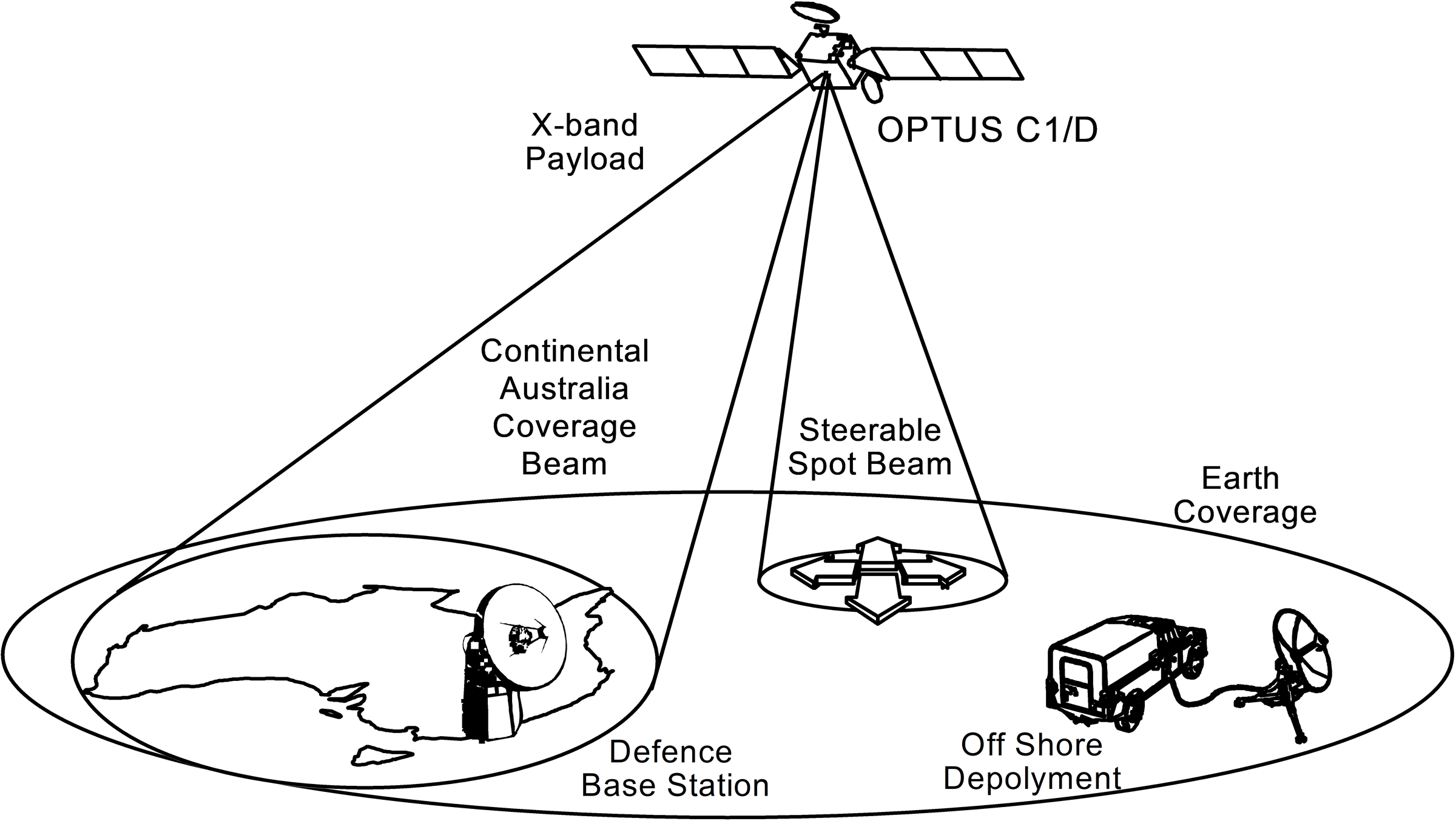
Figure 5 shows the typical maximum data rate versus spot beamwidth in degrees, the corresponding spacecraft antenna diameter in metres and coverage diameter on the surface of the earth in kilometres for a 50 W X-band transponder.
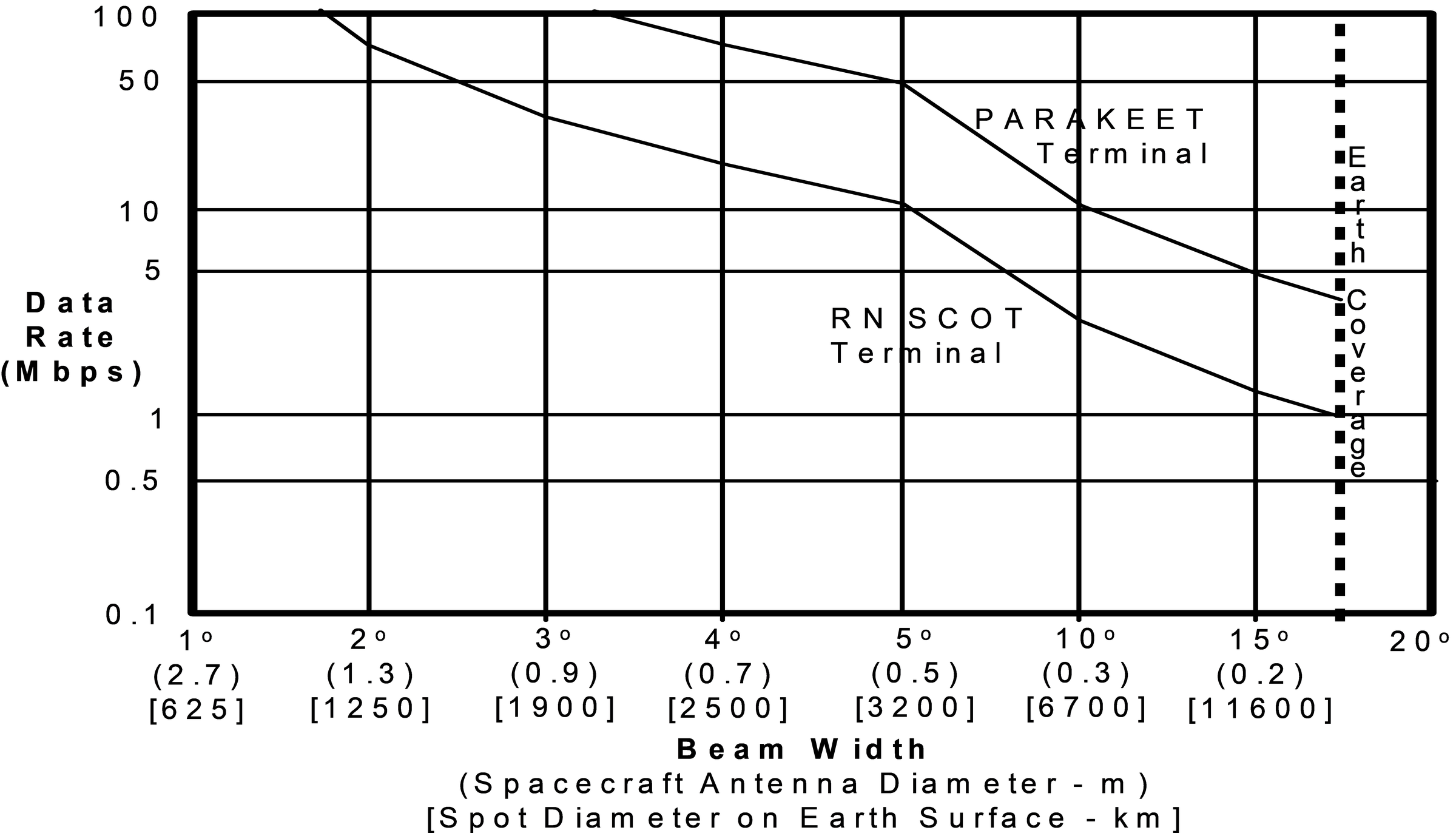
It can be seen that the maximum data rate increases significantly as the spot diameter is reduced, however, the size of the antenna onboard the spacecraft increases proportionally. For example, a 1° spot beam [625 km diameter on the earth’s surface] requires a 2.7 m diameter steerable antenna onboard the spacecraft. The continental Australia beam can support a total capacity of approximately 60 Mbps to a 2.4 m earth terminal while the 2000 km steerable spot beam can support typically 100 Mbps.
Global broadcast payload
Generally, the traffic into a military platform is asymmetric with the data rate into the platform much greater than the data rate out of the platform as depicted in Figure 6 (unless it is a reconnaissance platform requiring transmission of imagery or other high data rate services). Global Broadcast relies on high-power, steerable spot beam technology on the spacecraft and for this reason, the term “Global” is misleading. Global Broadcast does not provide global coverage, the spot beams are steerable within the global coverage area.
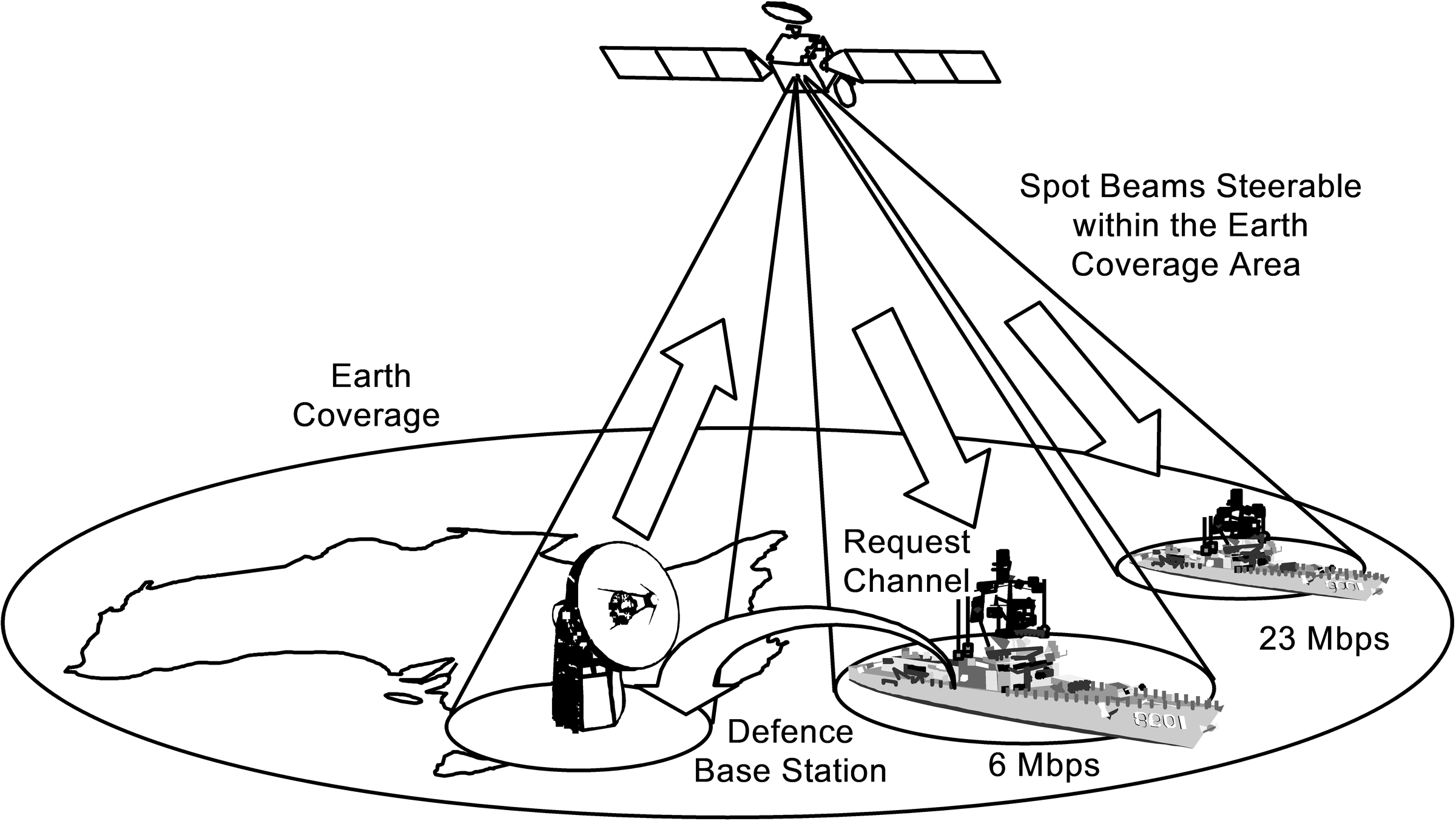
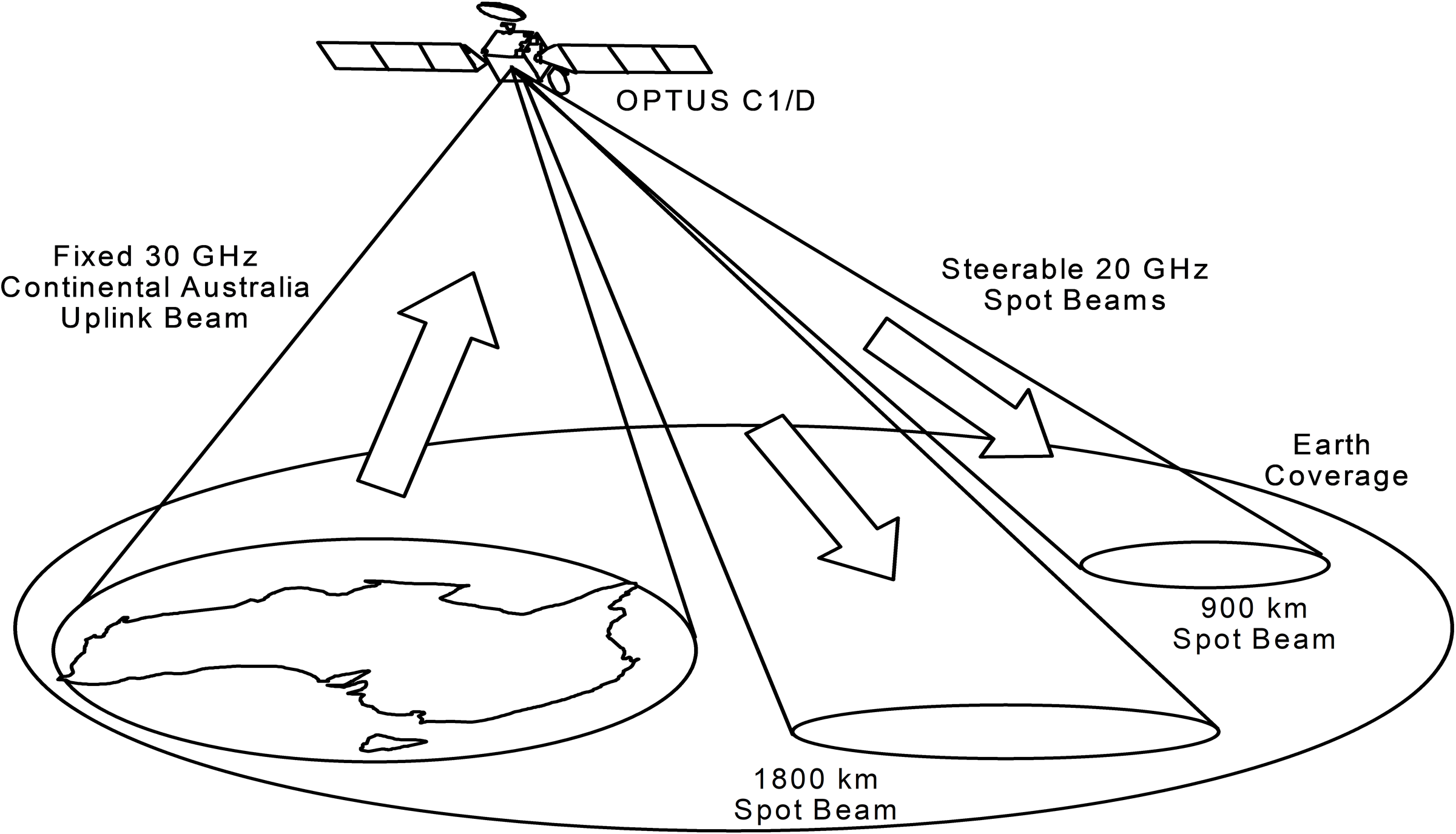
One proposed Global Broadcast payload for OPTUS C1/D is shown in Figure 7. It consists of a continental Australia 30 GHz uplink beam with a continental Australia 20 GHz downlink beam and two steerable 20 GHz downlink spot beams, one 900 km in diameter and the other 1800 km in diameter. Broadcast data rates to a terminal with a 0.6 m diameter antenna are typically 23 Mbps in the 900 km spot beam, 6 Mbps in the 1800 km spot beam and 1 Mbps in the continental Australia beam. Significantly higher data rates could be supported to larger terminals.
Ka-band payload
Increased demand for capacity and orbital crowding is forcing the civilian sector to move to higher frequency bands such as Ka-band (30/20 GHz). Ka-band has the potential to support high data rates to tactical mobile military terminals such as ships, submarines, aircraft through the use of spot beam technology. It is therefore possible to gain the benefits of moving to Ka-band and contain costs by exploiting civilian technology. It should be noted that antenna beamwidth is inversely proportional to frequency and a 30 GHz antenna onboard the spacecraft is approximately one quarter the diameter of an X-band antenna to achieve the same coverage area on the surface of the earth.
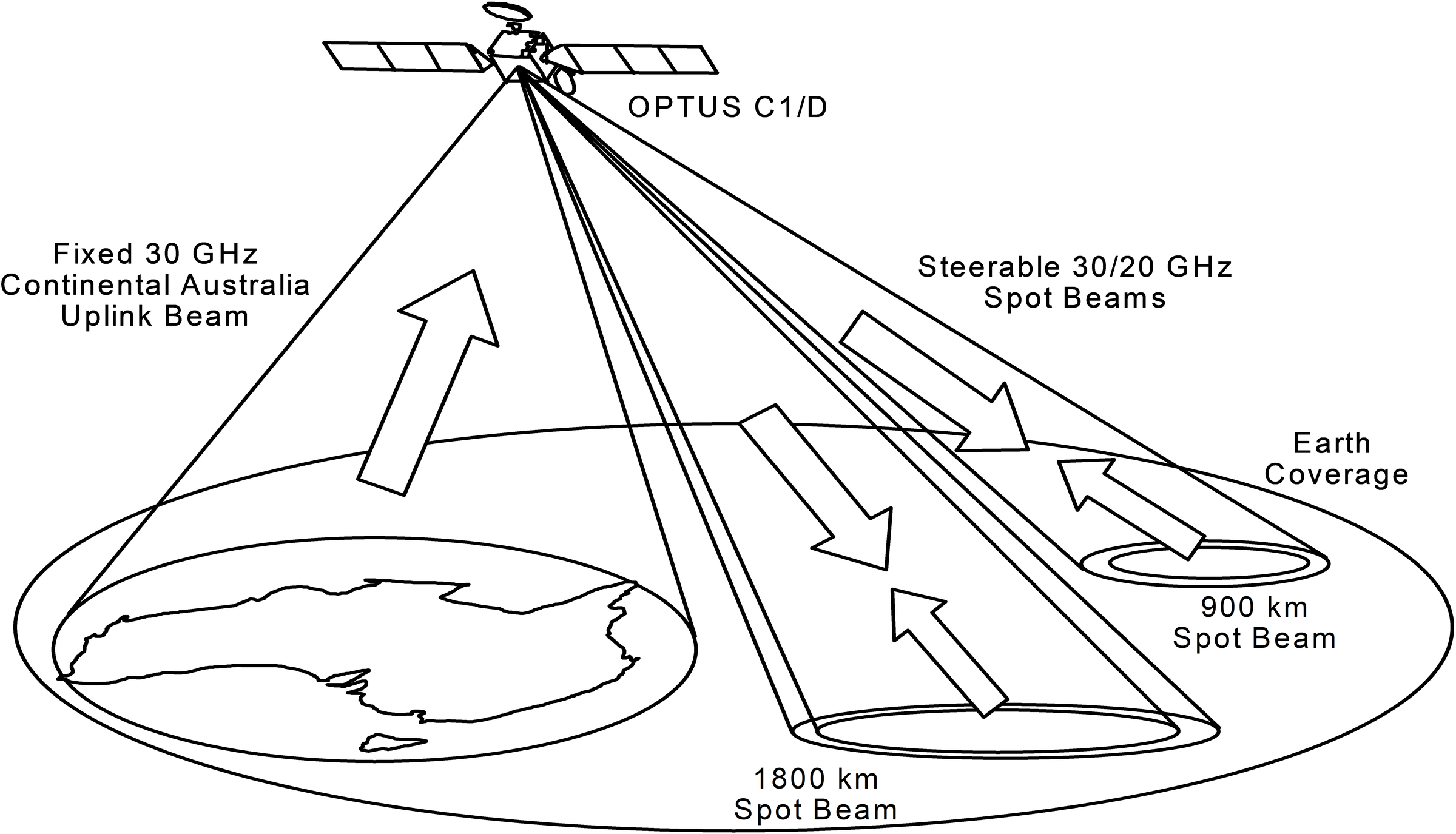
An innovative approach with OPTUS C1/D is to utilise the Global Broadcast antennas onboard the spacecraft to provide a simultaneous 30 GHz receive capability as shown in Figure 8. The downlink frequency band is similar to the Global Broadcast Service, hence, it may be possible to fit ADF platforms with 30/20 GHz antennas that are capable of supporting high data rate, full-duplex links as well as receiving Global Broadcast.
Potential military applications
Broadcasting of multiple television channels via satellite or Direct to Home (DTH) services has been available in the civilian sector for many years, yet, it is only recently that the military has embraced the concept by what has become known as the Global Broadcast System. In its strictest sense, Global Broadcast is a one way transmission. A variant is to incorporate a “reach back” or request channel to control dissemination of information on the broadcast. One innovative feature incorporated on the OPTUS C1/D payload is Ka-band uplink spot beams concentric with the GBS downlink beams capable of supporting high data rates.
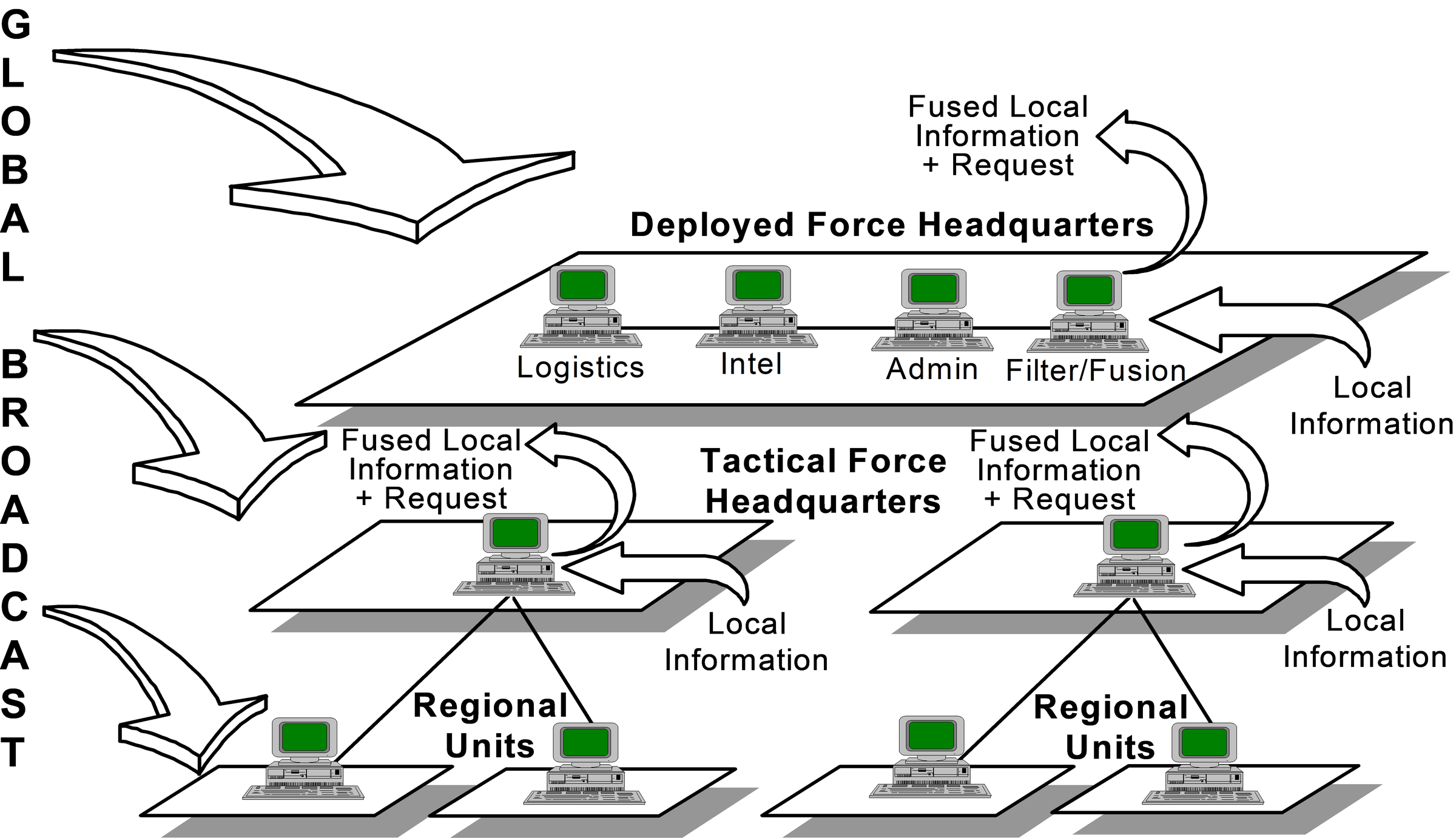
Figure 9 shows a possible multi-level GBS architecture designed to capitalise on the unique features of the OPTUS C1/D GBS/Ka-band payload. At the highest level such as a Deployed Headquarters, a large number of users may receive information via the broadcast using Web-based technology. The example shows a number of users performing different functions, e.g., logistics, intelligence, administration, etc., with information received via the broadcast in response to requests by way of the “reach back” channel. Information considered relevant to the Tactical Force Headquarters (TFHQ) may be filtered at the Deployed Headquarters and fused with local information/knowledge and transmitted back to the GBS server where it may be broadcast to the Tactical Force Headquarters. Information delivered to the TFHQ also may be filtered, fused with local information and returned to the GBS server for broadcast to regional units. Although a considerable amount of research is necessary to implement the Information Management system, this tiered GBS approach provides significant advantages over the conventional GBS system.
Conclusions
A window of opportunity has arisen for the Australian Department of Defence to incorporate a military communications payload onboard a civilian spacecraft bus designated OPTUS C1/D. Four payloads are being considered, UHF, X-band, Global Broadcast and Ka-band. UHF will support a significant number of tactical mobile terminals already fitted to military platforms and under procurement. X-band will support relatively high data rates to a number of major naval platforms and transportable earth terminals. GBS will provide asymmetric data flow and provide challenges on it optimal use, particularly in areas such as information management. Increasing demand for frequency spectrum and crowding of the geostationary orbit is forcing both the civilian and military sectors to higher frequency bands. Implementation of a Ka-band payload with spot beam technology has the potential to support high data rates to mobile platforms.
The extremely tight timescale for contracting, building and launching the spacecraft is testing the new Defence approval and acquisition procedures implemented under the recent Defence Reform Program (DRP).
It is not intended that the military payload on the OPTUS C1/D spacecraft will satisfy all ADF satcom requirements but serve as an interim capability. It will also provide the ADF with valuable expertise and a migration path to a full military satellite communications capability.