
Volume 1, Number 1, March 1998
Penetration Performance of Segmented Rods - Comparison with Continuous Rods at High Velocity
Abstract
A study was conducted to compare the high velocity penetration performance of segmented-rod projectiles of various spacer and segment lengths with that of continuous rod projectiles of the same mass and diameter. A high-pressure pre-burned propellant gun was built for this study. Analytical models by Tate and Charters were used to predict the penetration performance predicted. Computer simulations using the AUTODYN 2D package were run to study the penetration process. It was predicted that at velocities around 1800 ms-1 and above, the performance of the steel-segmented rods was much superior to continuous rods. In trials, a 5-segment rod, with spacing of l/d=2.25, fired at 1800 ms-1, achieved a penetration performance 44% higher than continuous rods of similar mass and diameter fired at similar velocities. Simulation of segmented projectiles with 10 segments, compared to continuous rod of similar mass and diameter, impacting at 3000 ms-1, produces an increase of 59% penetration.
Introduction
Although segmented rods appear to give little advantage over continuous rods at low velocities, above 1.5kms-1 the predicted penetration begins to be impressive. At 5kms-1, penetration of a device with 15 segments is expected to be twice as effective as the same length of continuous rod, and with increasing velocity the advantage of the segmented device continues to grow [1]. Tests of segmented rods penetrating spaced armour showed that the armour is defeated by the front segment (or segments) punching a hole in the front plate allowing the remaining segmented rod through, intact, to attack the main armour [2]. The potential benefits of segmented rods over equivalent continuous rods are based on the advantage of multiple impacts by well aligned and well separated rod segments [3].
Penetration by segmented rods at high velocity
Continuous rod penetration prediction using tate's model.
Tate [4] considered two cases of penetration. For the case of a hard penetrator against a soft target, the penetration process passes through two stages: at sufficiently high impact velocity, both the penetrator and target first flow hydrodynamically; later, after the penetrator has decelerated, it ceases to flow and penetrates as a rigid body. In the second case of a soft penetrator impacting a hard target, both penetrator and target initially behave hydrodynamically; then after the penetrator has decelerated to below a critical velocity, the initial stage of pure hydrodynamic behaviour is absent.
Tate takes into account the dynamic strength of the rod material, Yp, and the target material strength at high strain rate, Rt, to predict penetration performance. Dynamic strength of the rod and target are obtained from the following formula:
(1)
where σyp is the yield strength of the rod, σyt is the yield strength of the target, and Et is the Young Modulus of the target. The study conducted assumes that Rt>Yp and the densities, ρ, of both the target and the rod are the same.In this simplified case, the penetration of the rod, p in relation to length of penetrator, l, is:
(2)
(vp is the impact velocity and v the instantaneous velocity)
Segmented Rod Penetration Prediction Using Charters’ Model.
In describing the penetration process of a continuous rod in the hydrodynamic regime, Charters [5] assumes that the rod penetrates the target in two successive stages: a fluid dynamic phase, followed by a residual phase.
The fluid dynamic stage consumes the length of the rod, except for a residual length equal to the diameter of the rod. The rod penetrates the target as though it were a fluid jet impinging on a large body of fluid [6]. Since the rod is used up at the same rate that the interface penetrates the target (in case of target and penetrator of the same density), the depth of penetration of the fluid dynamic phase always equals the length of the rod involved, (l-d), regardless of the velocity.
The residual phase is assumed to be generated by the last one-diameter length of the rod, a length chosen because the analysis assumes a hemispherical crater shape.
The cratering resistance parameter, S, is given by:
(3)
where d is the diameter of rod and p is penetration. S is determined from experimental values.
The total penetration, p, of the continuous rod is the sum of its fluid dynamic and residual phases.
(4)
Where pf is the penetration in fluid dynamic phase and pr is the penetration in residual phase.
Moreover, Charters assumed that each segment:
- penetrates the target as a continuous rod; and
- increases the total penetration by an amount equal to the penetration of the segment in question impacting the virgin surface of the target.
These assumptions imply that the penetration of each segment is independent of the penetration of all other segments. In other words each segment strikes the bottom of the crater one after another, increasing the penetration by an amount equal to the penetration generated if the segment had struck the surface of the target by itself.
The total penetration is thus equal to the sum of the individual contributions. The penetration of each segment is assumed to be the penetration of its equivalent continuous rod. This theory neglects the effects of two potentially important parameters: the spacing between segments and any material between segments required by a practical projectile design. According to Charters the penetration of a segmented rod is:
(5)
Where lt is the number of segments (n) x length of each segment.
This equation indicates that the penetration increases linearly with the number of segments.
Computer prediction of high velocity impact
To compare the penetration performance between segmented and continuous rods at high velocity, AUTODYN Version 2.7 has been used. Throughout the simulation, a Lagrange processing was used on all sub-grids. The materials used in the simulation were Steel 4340 for the rod and Steel 1006 (mild steel) for the target. The properties of the two materials were derived from the Johnson Cook Model readily available in the package. The computational grid was laid out to cover the rod-target configuration with the penetrator’s centre line coinciding with the axis of symmetry. In every case the impact was normal, thus permitting the problem to be considered as being perfectly axisymmetric. The projectile diameter was fixed at 6 mm and the summated length of the rod was 30 mm in all cases. The following simulations were carried out:
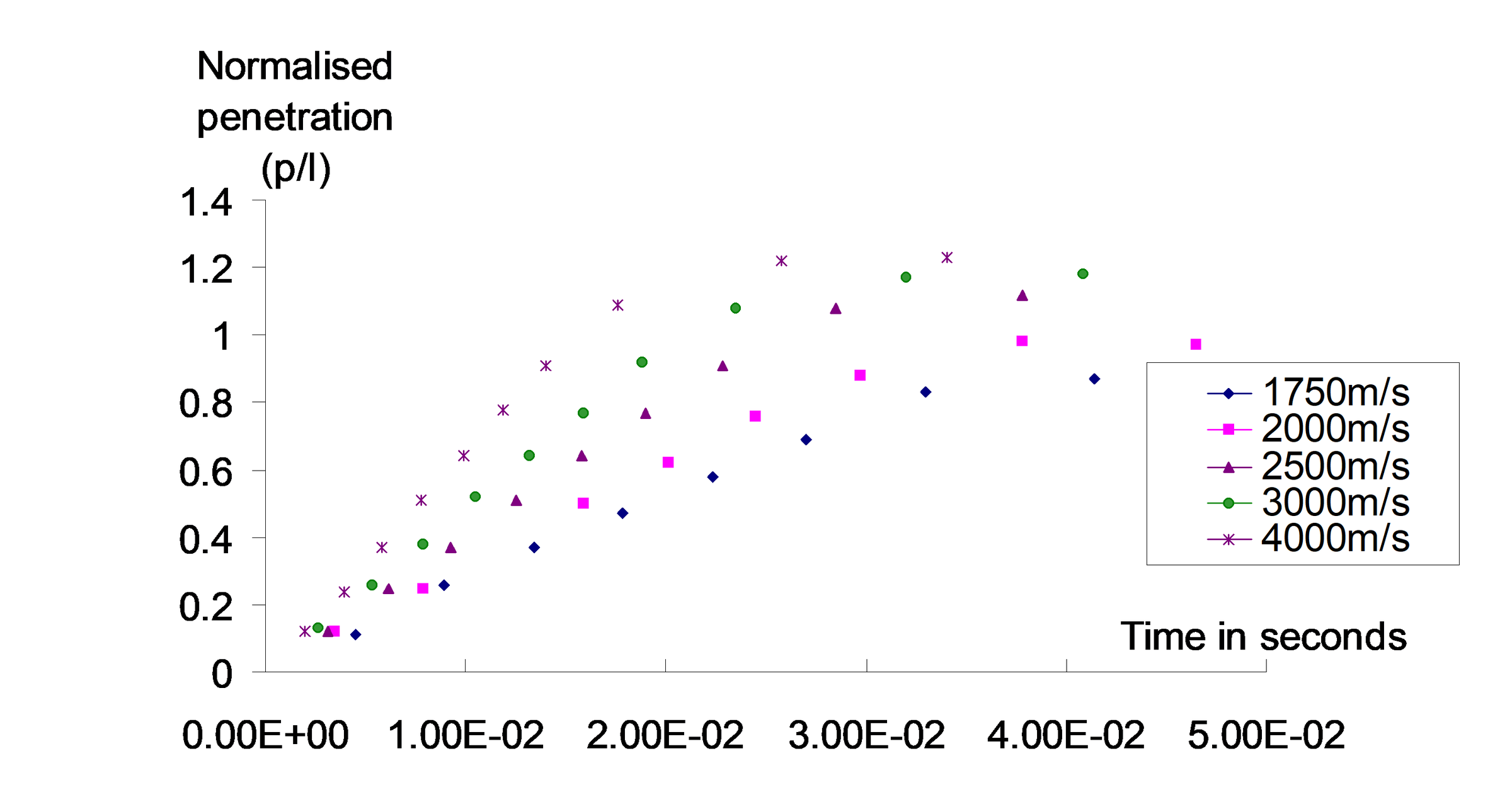
a. Continuous Rod Impact at Various Velocities. The simulations were carried out to investigate the effect of penetration performance of a continuous rod for impact velocities varying from 1750 ms-1 to 4000 ms-1. The result of the simulations is shown in Figure 1.
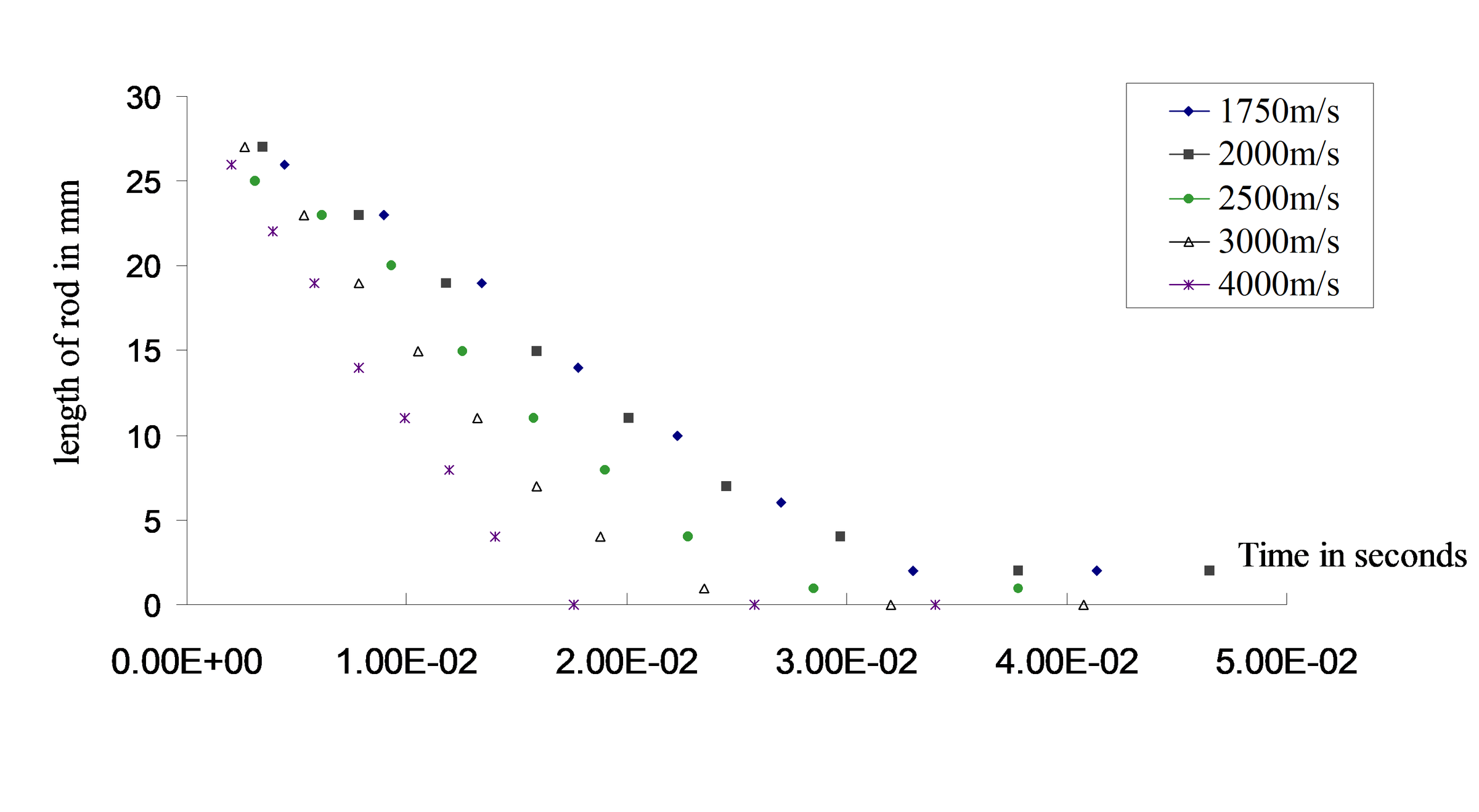
The erosion of the rod is shown in Figure 2.
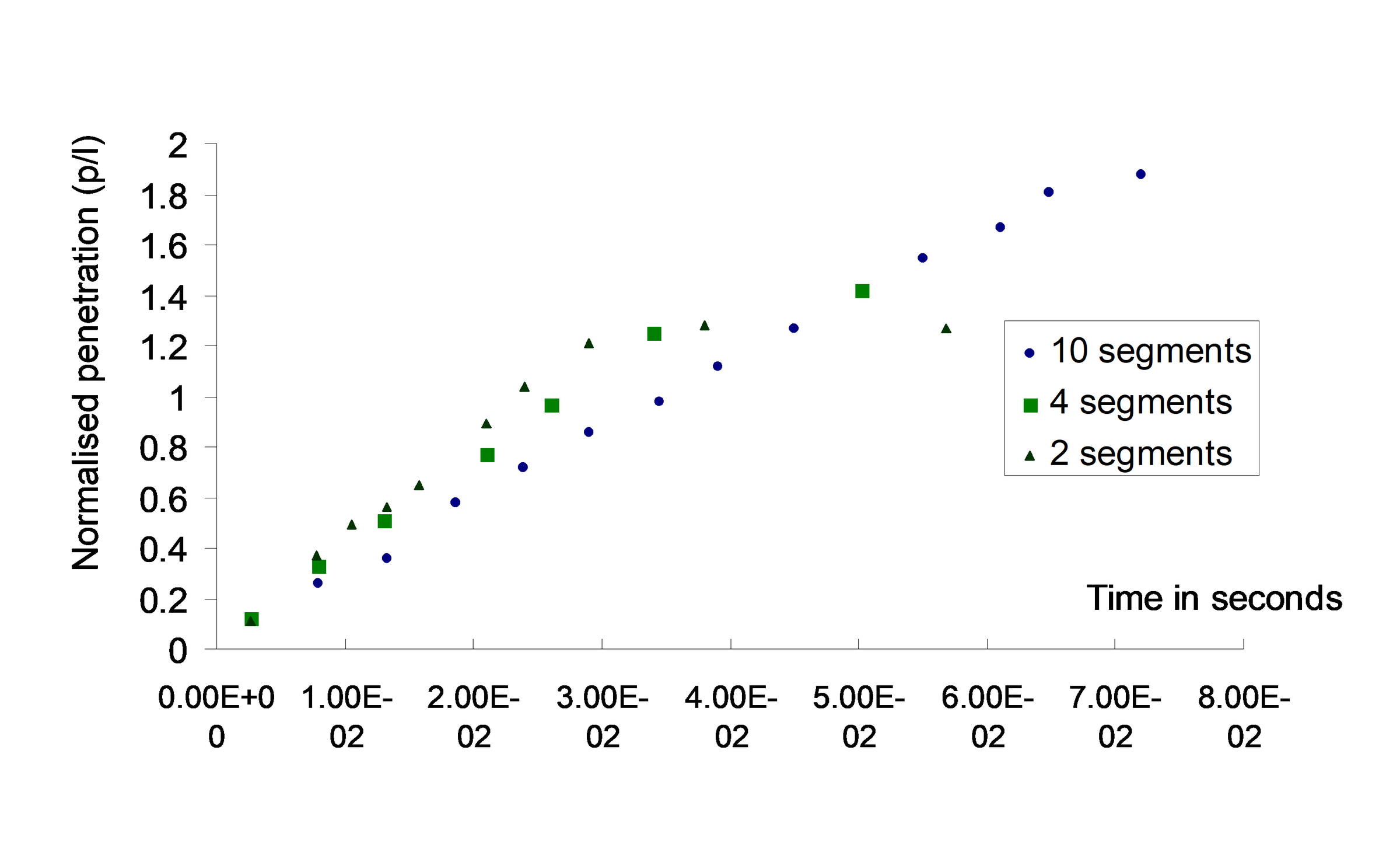
b. Segmented Rod Impact for Rods of Various Numbers of Segments, Spaced Evenly. Three simulations were conducted involving segmented rods spaced 2d apart with the same summated length as the continuous rod. The impact velocity for all rods was 3000 ms-1. The penetration performance of the rods is shown in Figure 3.
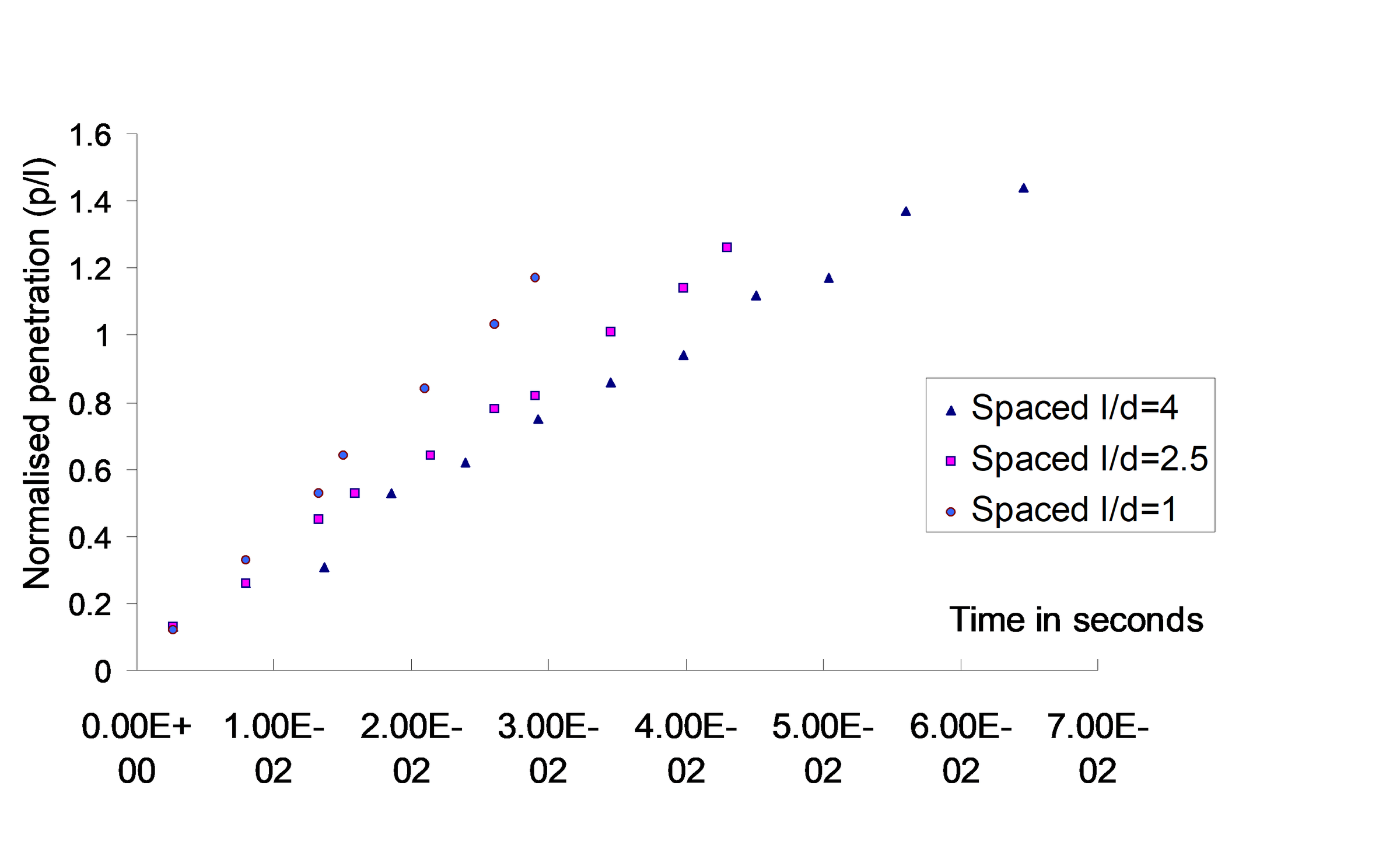
c. Segmented Rod with the Same Number of Segments but with Different Spacer Length. Three simulations were conducted to investigate the penetration performance of segmented rod projectiles with penetrator length l/d=1, for spacer lengths d, 2.5d and 4d. The number of segments was fixed at 5. The projectile impact velocity for all rods was 3000 ms-1. The results of the simulations are shown in Figure 4.
Experimental results and theoretical prediction
Experimental results
Three series of firings were conducted to compare the penetration performance of continuous rods with that of segmented rods of varying spacer length and segment numbers. The firings were conducted at Cranfield Ordnance Test and Evaluation Centre Lavington using a high-pressure gun.
Experiment 1. This experiment investigated the penetration performance of continuous rods when fired at high velocity. Four firing were conducted using projectiles of similar mass. Propellant mass was varied to obtain a variation in velocity. From the four firings, only three shots produced penetration crater with reasonable axial symmetry; the distorted crater shape due to the fourth shot indicated poor coaxiality of the projectile segments at impact. Results of the experiments are given in Table 1.
Experiment 2: This test investigated the effect of spacer length on penetration performance of segmented rods. The penetrators were made of five 6mm diameter segmented rods. The spacing between segments was varied for each firing. The mass of propellant was held constant to maintain similar velocities of around 1900 ms-1. The results of the experiments are presented in Table 2.
Experiment 3. The aim of this experiment was to investigate the effect of varying the number of segments of similar summated penetrator length fired at similar velocity. Four projectiles having equal spacer length of l/d=2, with various length of penetrator varying from l/d=0.25 to l/d=2.5 were fired at similar velocity. The results of this programme are presented in Table 3.
| Shot number | Projectile mass | Observed velocity | Normalised Penetration |
|---|---|---|---|
| 1 | 13.07 g | 1374 ms-1 | 0.57 |
| 2 | 12.7 g | 1690 ms-1 | 0.83 |
| 3 | 12.78 g | 1800 ms-1 | 0.97 |
| 4 | 12.09 g | 1959 ms-1 | projectile tumbling |
| Shot | Spacer length | Projectile mass | Observed velocity | Normalised penetration |
|---|---|---|---|---|
| 1 | 2.25d | 20.19 g | 1804 ms-1 | 1.4 |
| 2 | 2d | 19.5 g | 1233 ms-1 | tumbling |
| 3 | 1.5d | 18.5 g | 1906 ms-1 | 1.33 |
| 4 | 1d | 16.5 g | 2000 ms-1 | 0.87 |
| 5 | 0.5d | 16.5 g | 725 ms-1 | tumbling |
| Shot | Projectile mass | No of segments | Observed velocity | Normalised penetration |
|---|---|---|---|---|
| 1 | 27.1 g | 12x2.5mm | 1740 ms-1 | 0.96 |
| 2 | 23.6 g | 8x3.75mm | recording failure | tumbling |
| 3 | 22 g | 4 x 7.5mm | 600 ms-1 | tumbling |
| 4 | 19.8 g | 2 x 15mm | 888 ms-1 | tumbling |
Theoretical predictions - continuous rod impact
Theoretical models by Tate [4] and Charters [5] were used to calculate the penetration depth of a continuous rod. Figure 5 compares the penetration depth predicted using these two models with the result of simulation stated earlier in the paper, and with the achieved limited experimental firing results.
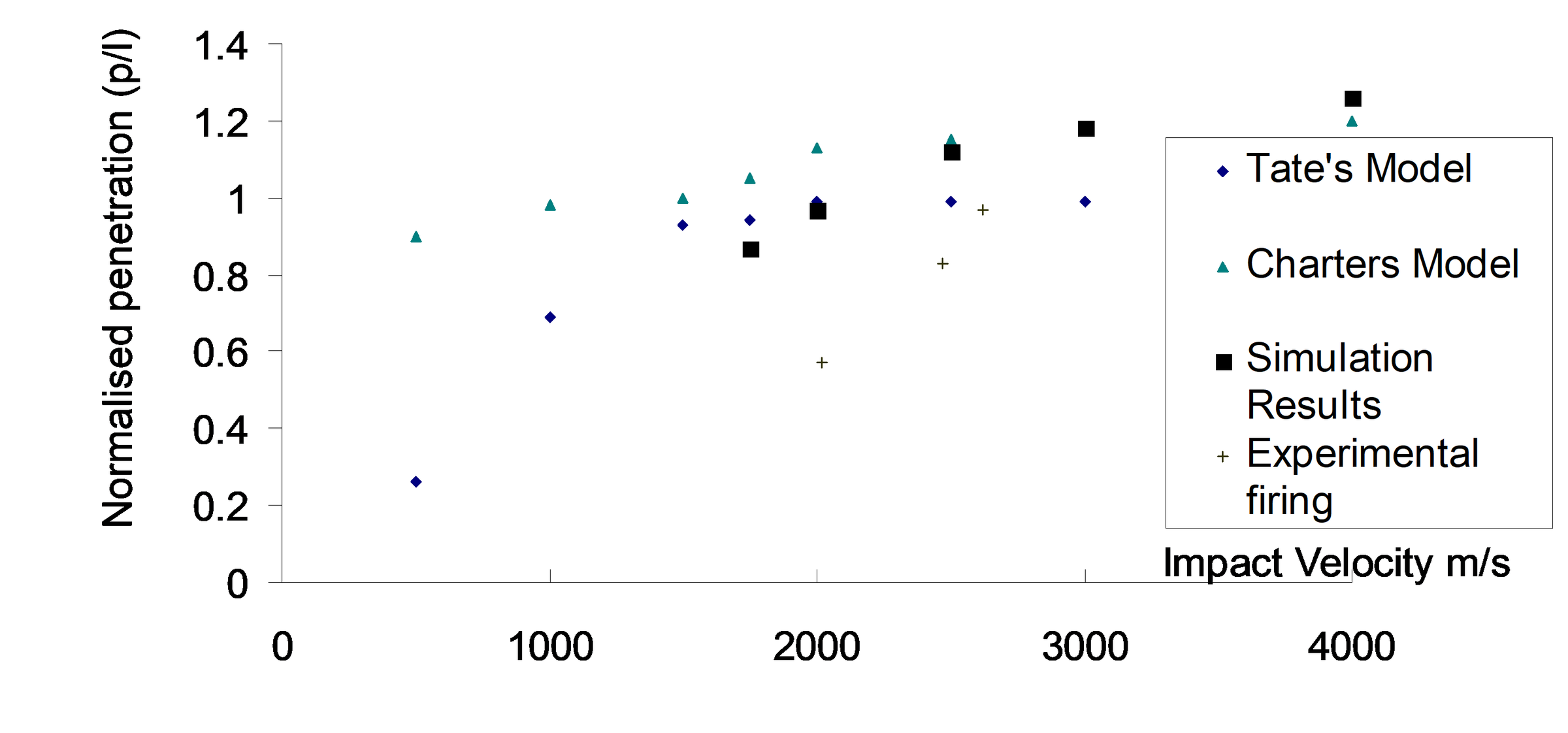
Tate’s Model takes into consideration two parameters Rt, the pressure within the target at which the material begins to flow hydrodynamically and Yp, the pressure at which the rod material begins to flow hydrodynamically. The value of Rt is 3.82 GPa and Yp is 1.648 GPa taken from his experiment for Steel 4340 and Steel 1006.
Theoretical Prediction of Segmented-rod Penetration Using Charters’ Model
Penetration prediction for rods of the same total length but varying number of segments are presented together with result of simulation (Figure 6). These are based on the Charters’ model (Equation 5). The cratering resistance stress of penetrator rod, in the calculation is using the value used by Charters [5] where, S=1x10⁹ Jm-3.
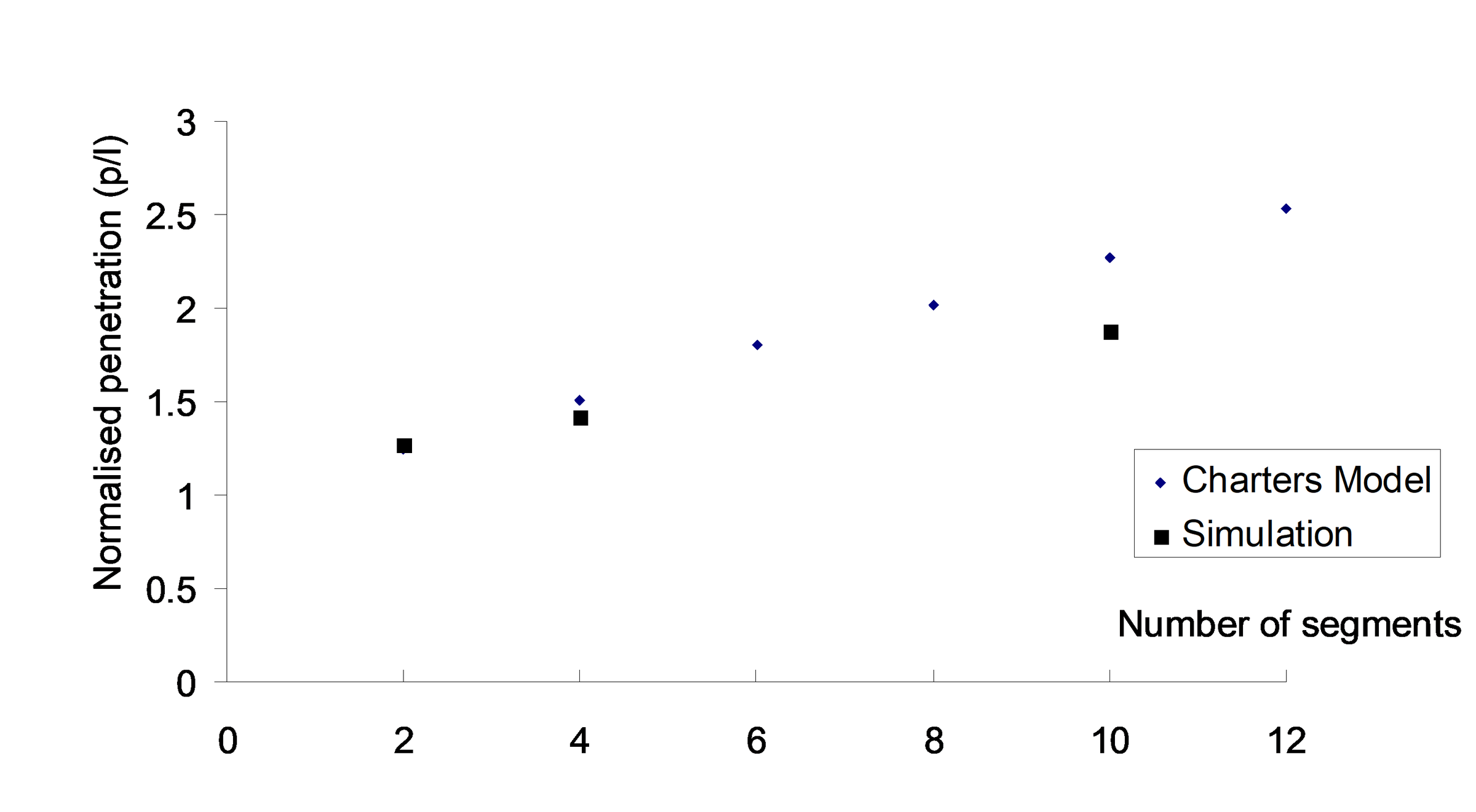
Predictions based on the Tate model produce lower values than those based on computer simulation. Tate also limits the penetration at high velocity to ideal jet penetration (p/l=1) for material of similar density. At high velocity Charters’ model produces similar result as the computer simulation.
Discussion
Continuous Rod Impact. The simulation results presented in Figure 1 show that the penetration of similar mass, length and diameter penetrators increases with impact velocity. At high velocity, in this case at 2000 ms-1 and above, for Steel 4340 penetrator against Steel 1006 target, the penetration achieved exceeds that predicted by the first order hydrodynamic model.
Simulations for an impact velocity of 2000 ms-1 show a relaxation of penetration at the end of the penetration process. At 3.7x10⁻² seconds the normalised penetration (p/l) is 0.98, but as the simulation progresses it reduces to 0.97.
At impact velocity of below 2500 ms-1, unconsumed residual rods were observed at the end of the penetration process (Figure 2). This was in agreement with the explanation by Tate [4] that as velocity falls below a critical value, the rod suffers no further erosion, and will penetrate as a rigid body.
In all cases for impact velocities of 1750 ms-1 and above, it was observed that the penetration process continuous, even after the rods has all been consumed or have stopped eroding.
Experimental firings of continuous rod impact have achieved three satisfactory results. Figure 5 compares the result of continuous rod penetration using theoretical prediction, computer simulation and experimental firing. Charters’ model places emphasis on the cratering resistance stress of the target material, giving a high penetration even at the low impact velocity of 500 ms-1. As the velocity of impact increases the model provides penetration higher than jet penetration. Tate’s Model gives more sensible result at lower velocities. At higher velocities, Tate tends towards the classical jet penetration. Computer simulation seems to compromise between Tate’s and Charters’ models. At lower velocities, it gives the results similar to Tate’s Model and at higher velocities it gives results similar to Charters’ model.
From the experimental result, it seems that the hydrodynamic regime for Steel 4340 steel rod impacting Steel 1006 (mild steel) occurs at velocities around 1700 ms-1, which agrees with computer simulation and Tate’s model. However, Charters’ model gives a much lower velocity at which hydrodynamic regime of penetration starts.
Impact of Segmented Rods Spaced at Various l/d
Both computer simulation and experimental results shows that increase in spacer length between segments will improve penetrations (see Figure 7). It was observed during simulation involving 4d and 2.25d spacing, that penetrator segments are totally consumed before the next penetrator arrives to penetrate the bottom of the crater. Simulation involving rod with spacing of1d shows a small portion of each segment has not eroded before the next penetrator arrives for further penetration; this has significantly reduced the total penetration.
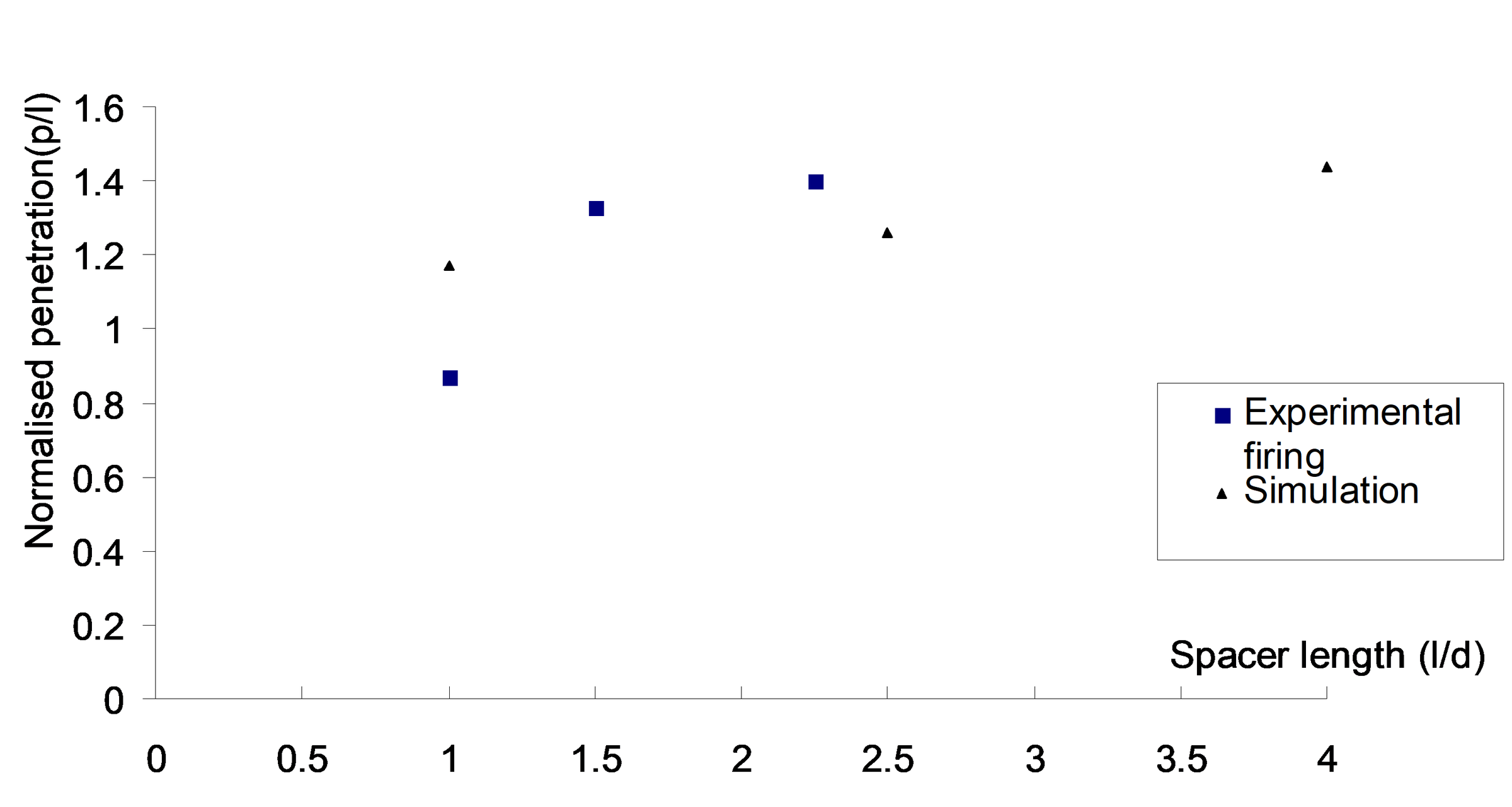
The limited experimental results show similar modes of penetration performance to those predicted. Spacing of 1.5d and above, result in better penetration than idealised jet penetration. For a spacing of 2.25d, the penetration performance is 40% more than penetration calculated using idealised jet penetration equation. For a segmented rod with spacings of 1d, the penetration performance is only 0.87 normalised penetration. A residual rod of 2 mm length segment was recovered from the bottom of the crater. This indicates that for smaller spacings, the time between impact of segments was too short, so that oncoming segments impacted the rear of the penetrating segment.
The crater holes produced by penetration of longer spacings segmented projectiles shows more significant crater rings, distinguishing penetrations of each segment. This is clearly shown by crater holes produced by rods of spacings of 2.25d and 1.5d. However, in the case of the crater hole from segmented rod with spacing of 1d, there is no clear distinction of penetration made by different segments. Hence, reducing the spacing between segments will finally lead to penetration behaviour equating to continuous rod.
Impact Of Segmented Rod With Various Segment Numbers
Comparison of the performance of penetration of segmented rod by varying segment number can only be made between the computer simulation results and penetration prediction using Charters’ model (see Figure 6). Both predictions show that penetration performance increases with segment number. Computer simulation shows an increase of 12% penetration for every additional segment number, whereas penetration prediction using Charters’ model leads to average 7.7% increase in penetration.
Comparison of Penetration Performance Between Continuous-rod and Segmented-rod from Experimental Firings
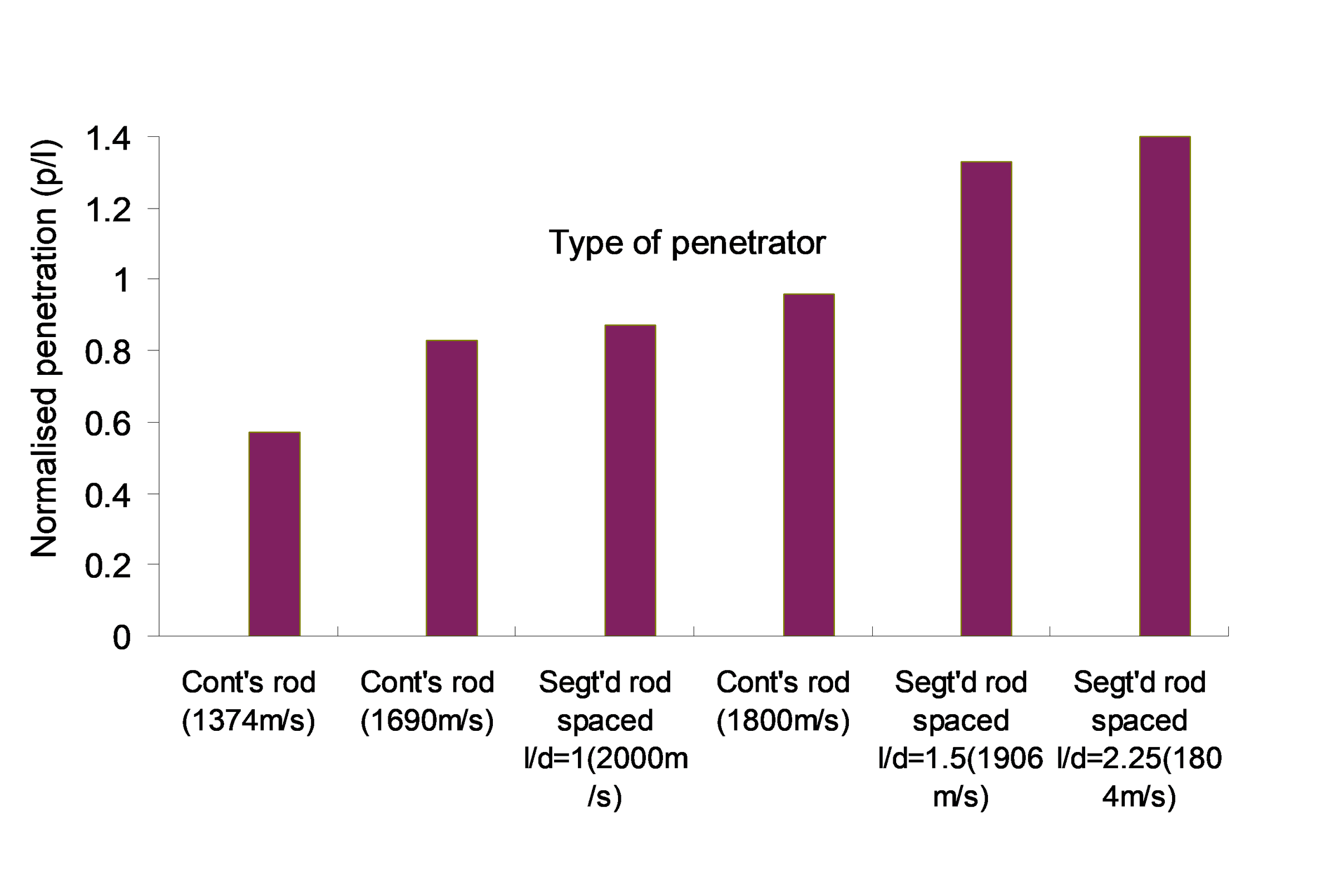
Figure 8 summarises the different of penetration performance between continuous rod and segmented rod. In general, the segmented rod offers improved penetration but relies on good alignment at impact.
Conclusions
Penetration performance of continuous rod at velocities lower than 2000 ms-1 from the experimental firings, though limited in numbers, correlate well with computer simulations and calculations using Tate’s model. At velocities higher than 2000 ms-1, computer simulation and prediction using Charters’ model provide matching results. The prediction using Tate’s model shows unchanging penetration at velocities higher than 2500ms-1. It seems that at low velocities, Tate’s model is more effective, whilst at high velocities, Charters’ model is more suitable.
Penetration of Steel 4340 into mild steel target is already in the hydrodynamic regime at velocities as low as 1700 ms-1. Segmented rod already shows superior penetration to equivalent mass and diameter continuous rod.
Efficiency of segmented rod shows strong dependence on spacing between segments. The penetration increases with spacing length. Experimental firing shows that penetration performance of segmented rod with spacing of l/d=2.25 can improve up to 44% more than continuous rod of the same mass, diameter and velocity.
Both theoretical modelling and computer simulation predict that, for rounds of same mass and diameter, penetration will improve with segment number. It has not been possible to confirm this experimentally due to problems of round alignment on impact.
References
[1] F. Fair, “Hypervelocity Then and Now”, International Journal of Impact Engineering, Vol 5, pp. 1-11, 1987.
[2] A. Charters, T. Menna and A. Piekutowski, “Penetration Dynamics of Rods From Direct Ballistic Tests of Advanced Armour Components at 2-3km/s”, General Research Corporation, Santa Barbara, California and University of Dayton Research Institute, 1990.
[3] J. Zukas, “Numerical Simulation of Semi-Infinite Target Penetration by Continuous Rods”, Ballistic Research Laboratory, Aberdeen Proving Ground, Maryland, 1990.
[4] A. Tate, “A Theory for Deceleration of Long Rods After Impact”, Mechanical Physics of Solids, Vol. 15, p. 387.
[5] A. Charters, “Penetration of Armour by Continuous Rod and Segmented Rods At High Velocities - Theory and Experiments”, General Research Corporation, April 1986.
[6] G. Birkhoff, D. McDougall, E. Pugh, and G. Taylor, “Explosive with Lined Cavities”, Journal of Applied Physics, Vol. 19, No. 6, p. 563, 1948.