
E.4 BINARY NUMBERS AS CHARACTERS
Beyond representing numbers, binary patterns can also encode symbols and characters. The second type of pattern we often wish to represent is the range of characters used in everyday communication. The most common early system for mapping binary patterns to alphanumeric characters is the American Standard Code for Information Interchange (ASCII). ASCII uses seven of the eight bits in a byte to define patterns for 128 different characters, including letters, numerals, punctuation marks, and control symbols.
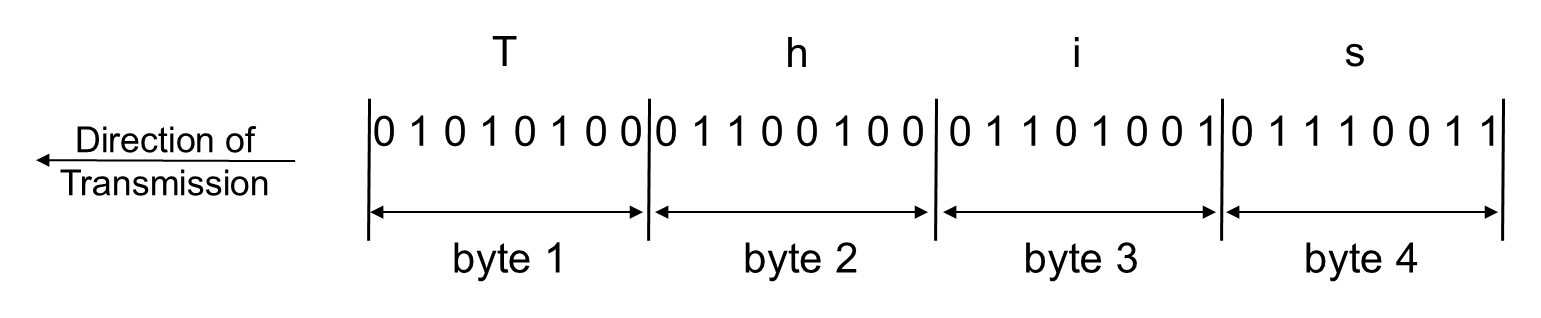
Figure E.1 shows the standard ASCII seven-bit code, while Figure E.2 illustrates how text characters are represented in binary form.
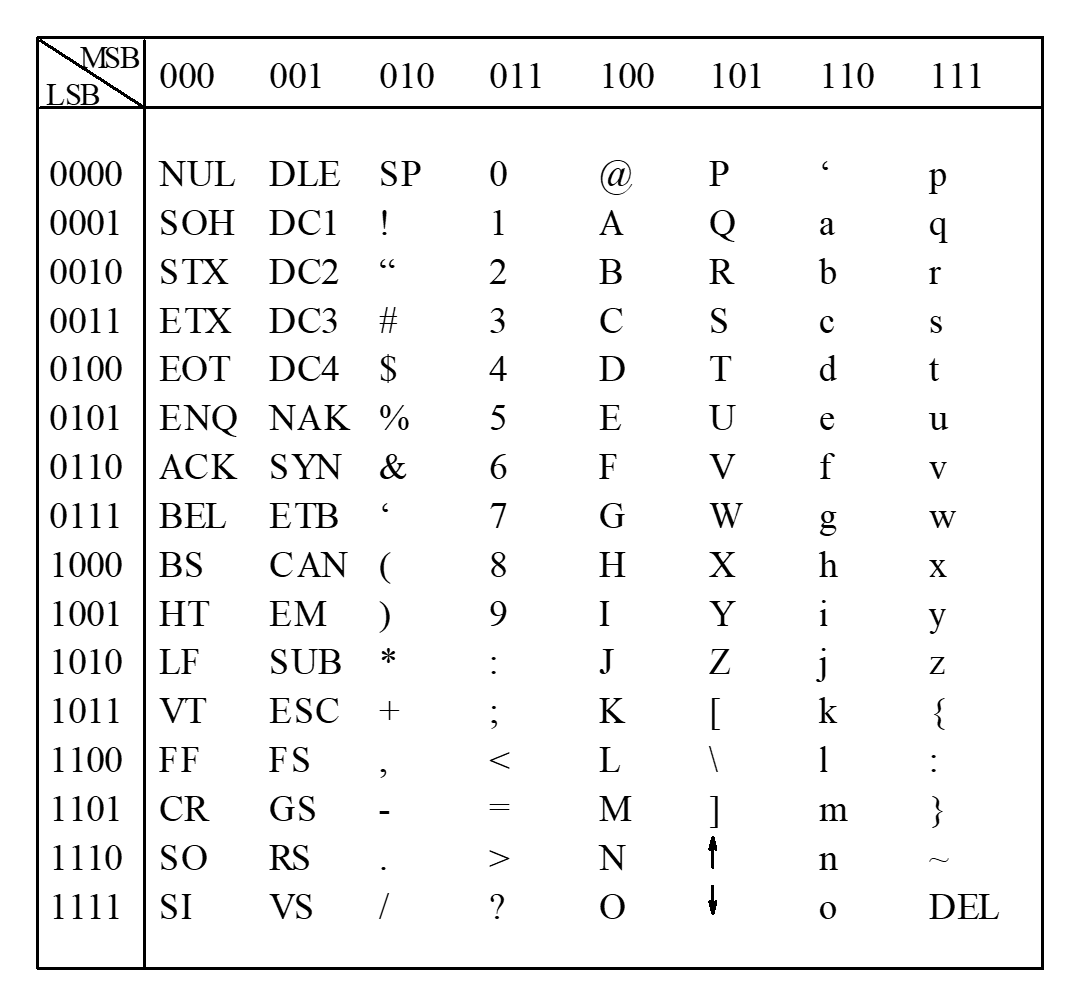
In the ASCII table, the most significant bits (MSBs) are listed across the top and the least significant bits (LSBs) are listed down the side. The seven-bit code for the uppercase letter ‘T’, for example, is 1010100.
If we can store one character per byte, we can form words and sentences by grouping the corresponding bytes together. For example, to transmit the word “This”, we would store the ASCII representations for the characters ‘T’, ‘h’, ‘i’, and ‘s’ in four consecutive bytes of memory, as illustrated in Figure E.2. The eighth bit of each byte is not required for the seven-bit ASCII code and is therefore commonly set to zero (as in this example) or used as a parity bit for error detection (see Chapter 4).
Although ASCII is sufficient for English text, its total of 128 characters is inadequate for many other languages. To address this limitation, the Unicode and ISO 10646 standards were developed—originally as separate initiatives but later unified. Originally defined using 16-bit code units (allowing 65,536 characters), Unicode has since been extended and now supports over one million possible code points through variable-length encodings such as UTF-8 and UTF-16.
Unicode is fully backward-compatible with ASCII—the first 128 character codes are identical—but greatly extends the repertoire to include thousands of additional symbols. These encompass non-Latin alphabets such as Chinese, Japanese, and Korean, as well as Hebrew, Greek, Cyrillic, and Sanskrit. Unicode also provides encodings for punctuation, publishing marks, geometric shapes, mathematical operators, and technical symbols, making it the global standard for multilingual digital communication and data exchange.
Back to reading